Microsegmentation divides your cloud network into small, isolated zones. It stops attackers from moving sideways after a breach. You implement it by defining strict traffic rules between services. This approach reduces risk without requiring expensive hardware appliances.
Why Small Teams Need Network Isolation
Flat networks assume the perimeter is the only line of defence. This assumption fails when credentials leak or endpoints are compromised. Microsegmentation enforces zero-trust principles by verifying every connection request between workloads. It does not rely on network location for security decisions.
Small organisations often believe they are too small to be targeted. Attackers automate scans and exploit misconfigurations regardless of company size. A single compromised server can expose the entire infrastructure if no internal boundaries exist. Microsegmentation creates digital walls between applications, databases, and management interfaces.
The mechanism works by attaching security policies directly to the workload. These policies travel with the service if it moves to another host or availability zone. This dynamic enforcement prevents the drift that occurs when static firewall rules become outdated. You gain granular control without the overhead of managing hundreds of static rules.
The Hidden Cost of Flat Architectures
Flat networks create a hidden risk known as lateral movement. When an attacker gains access to one system, they can pivot to others freely. This expands the blast radius of any incident. Containing a breach in a flat network requires shutting down large sections of the infrastructure, causing significant downtime.
Microsegmentation limits this blast radius to a single segment. If a web server is compromised, the attacker cannot reach the payment processing system. The cost of implementing these controls is often lower than the cost of a single data breach. The investment lies in initial policy definition and ongoing review, not in hardware purchases.
Imagine a scenario where a legacy application has a known vulnerability. In a flat network, patching delays leave the whole system exposed. With microsegmentation, you can isolate the legacy app immediately. It continues to function for its intended users while blocked from accessing sensitive data stores. This buys time for a proper remediation strategy.
Practical Implementation Steps
Start by mapping your critical assets. Identify which systems hold sensitive data and which provide essential services. Group these assets into logical segments based on function and sensitivity. Each segment becomes a zone with strict entry and exit rules.
Define the baseline traffic requirements. Most applications only need to talk to specific services on specific ports. Document these legitimate flows before implementing controls. This documentation serves as the ground truth for your security policies. It prevents accidental blocking of critical business processes during rollout.
Implement policies in monitor mode first. This allows you to observe traffic without blocking it. You can identify unexpected connections and refine your rules. Once the policies accurately reflect legitimate traffic, switch to enforcement mode. This gradual approach minimises operational disruption.
Evaluating IT Provider Capabilities
Your IT provider plays a central role in maintaining these controls. You must ensure they have the tools and expertise to manage dynamic environments. Ask about their approach to policy automation. Manual rule creation does not scale and introduces human error.
The provider should demonstrate visibility into east-west traffic. Standard monitoring often focuses on north-south traffic entering or leaving the cloud. Internal traffic between workloads is where lateral movement occurs. The provider must show you how they detect anomalies within these internal segments.
Request a demonstration of incident response procedures. How quickly can they isolate a compromised workload? Can they restore connectivity without manual intervention? The provider’s ability to act fast determines the duration of your exposure. Slow response times negate the benefits of segmentation.
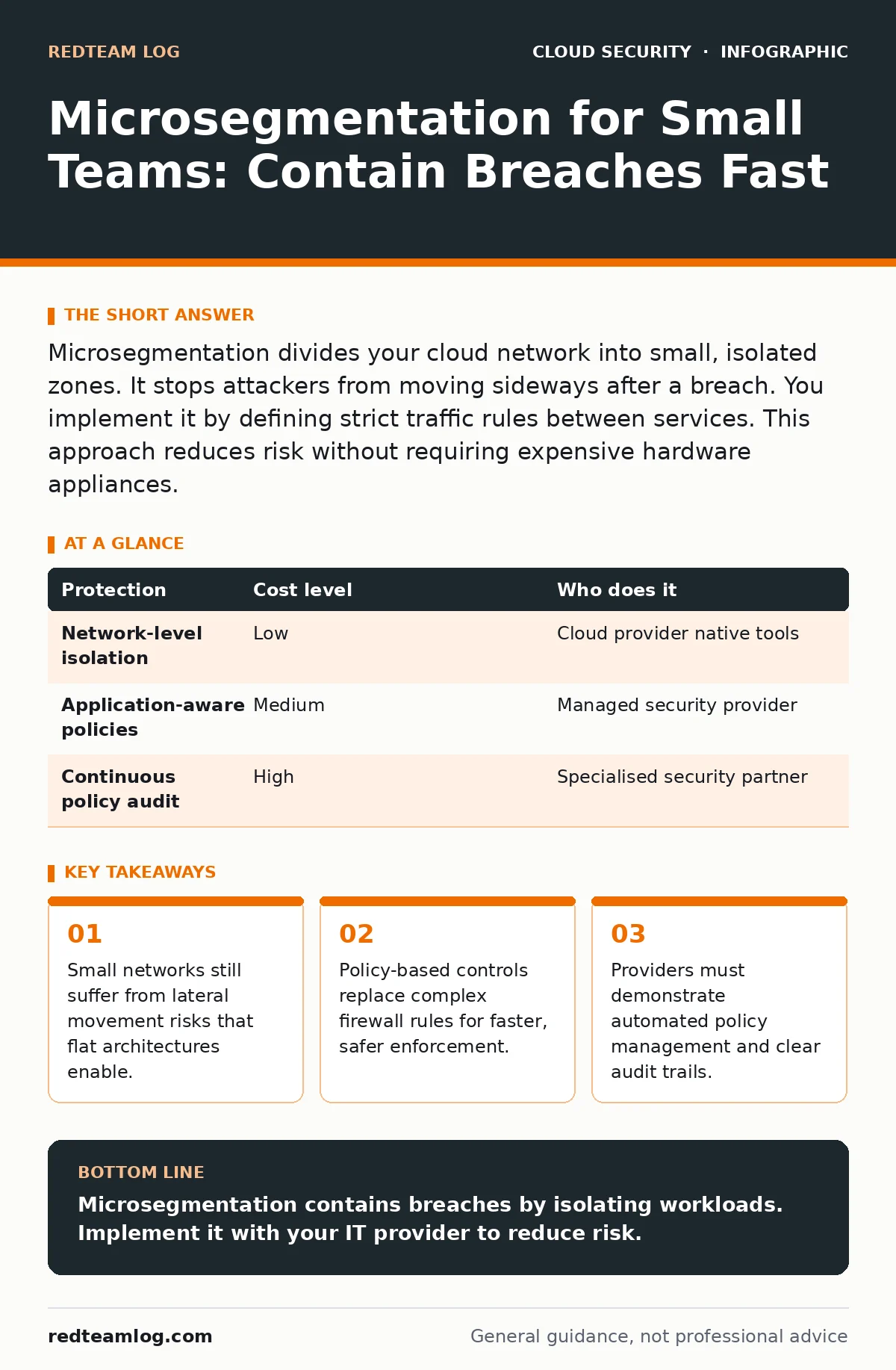
| Protection | Cost level | Who does it |
|---|---|---|
| Network-level isolation | Low | Cloud provider native tools |
| Application-aware policies | Medium | Managed security provider |
| Continuous policy audit | High | Specialised security partner |
Integration With Existing Security Layers
Microsegmentation does not replace other security measures. It works alongside cloud firewalls and identity management systems. Cloud firewalls handle traffic at the edge, while microsegmentation handles traffic inside. Both layers are necessary for defence in depth.
Identity sprawl complicates segmentation efforts. When too many identities have broad access, it becomes harder to enforce strict boundaries. Clean up unused accounts and apply least-privilege principles before implementing segmentation. This reduces the attack surface and simplifies policy creation.
Workload identity ensures that services are authenticated before communication is allowed. Microsegmentation adds a layer of authorisation on top of this authentication. Together, they ensure that only verified and authorised services can exchange data. This combination strengthens the overall security posture.
Consider how bring your own key encryption interacts with network controls. Encryption protects data at rest, while segmentation protects data in transit. Using both ensures that data is secure regardless of where it resides or how it moves. This layered approach addresses different threat vectors.
See also: Data Center Resilience Planning: Keep Services Running During Failures · Difference Between Single Sign On and Federated Identity
Common Pitfalls to Avoid
Overly permissive rules defeat the purpose of segmentation. Avoid using broad allow rules that cover entire subnets. These rules create blind spots and reduce visibility. Define rules at the application or port level whenever possible.
Neglecting to review policies leads to policy drift. Applications change, and new services are added. Old rules may no longer be relevant or secure. Schedule regular reviews to prune unnecessary rules and update existing ones. This maintenance keeps the security posture tight.
Failing to test connectivity after changes causes outages. Always test policy changes in a staging environment first. Validate that legitimate traffic flows correctly before applying changes to production. This prevents accidental blocking of critical business functions.
Key takeaways
- Small networks still suffer from lateral movement risks that flat architectures enable.
- Policy-based controls replace complex firewall rules for faster, safer enforcement.
- Providers must demonstrate automated policy management and clear audit trails.
Microsegmentation contains breaches by isolating workloads. Implement it with your IT provider to reduce risk.
Frequently asked questions
Does microsegmentation slow down network performance?
Modern cloud-native microsegmentation uses software-defined controls that have negligible impact on performance. The overhead is minimal compared to the security benefits gained from restricting lateral movement.
What happens if a policy blocks critical traffic?
Most platforms offer a rollback feature or emergency bypass. You can quickly revert to the previous configuration to restore connectivity while investigating the issue, ensuring business continuity.
How this guide was produced: written by the RedTeam Log editorial team with AI assistance, checked against the public references listed below, and reviewed when the facts change. See our editorial policy or report an error.