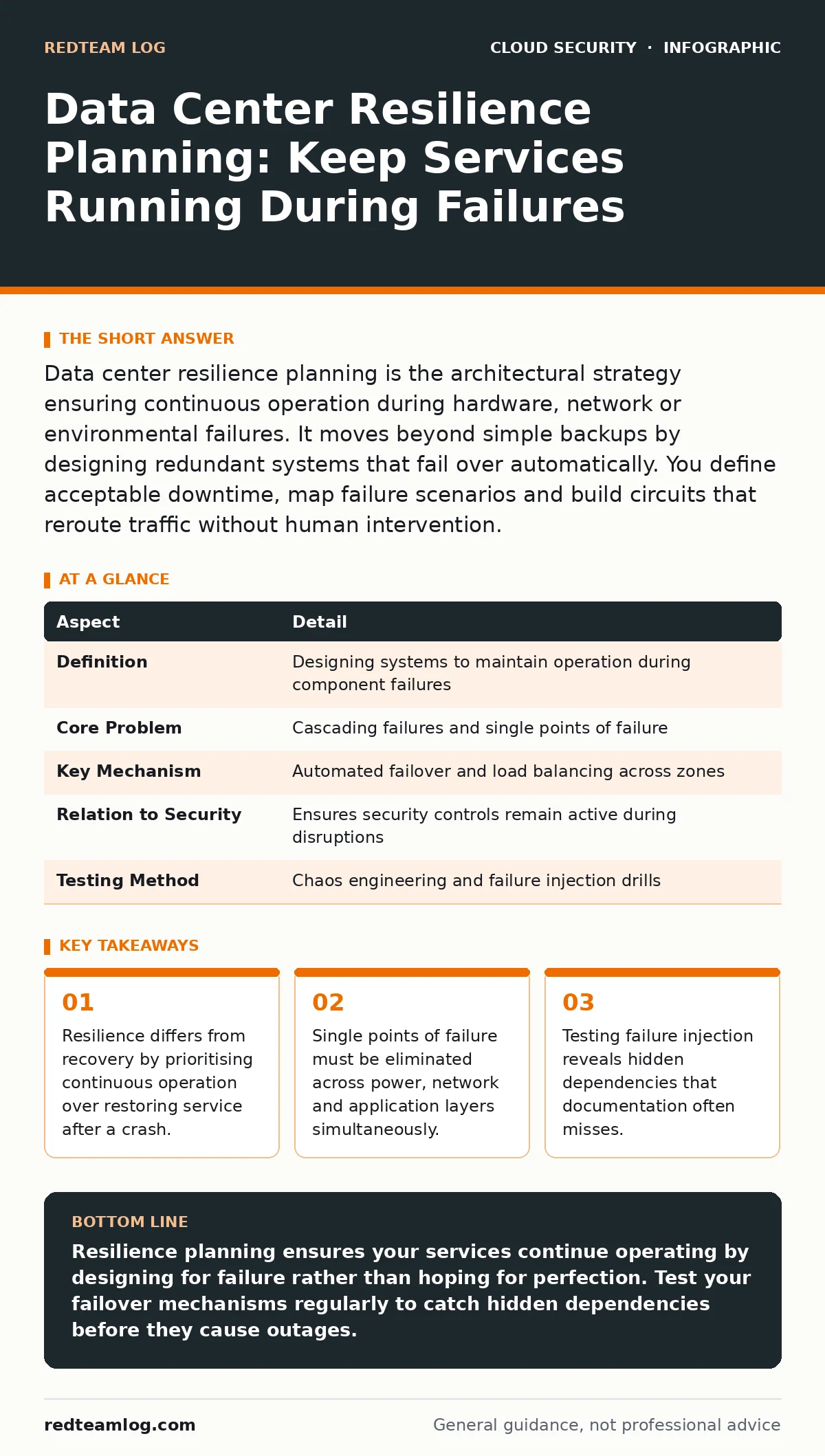
Data center resilience planning is the architectural strategy ensuring continuous operation during hardware, network or environmental failures. It moves beyond simple backups by designing redundant systems that fail over automatically. You define acceptable downtime, map failure scenarios and build circuits that reroute traffic without human intervention.
Resilience As A Utility Analogy
Imagine a city water supply. A single pipe burst does not leave the entire population thirsty if the network contains multiple routes and pressure valves. Data center resilience planning applies this same logic to digital infrastructure. You design systems where the failure of one component triggers an automatic shift to another. The goal is not perfection. The goal is continuity. Users notice a slight delay, not a total blackout.
This approach accepts that hardware degrades, networks drop packets and humans make errors. You build for these inevitabilities. The difference between a resilient system and a fragile one lies in how quickly it absorbs shock. A fragile system stops when one part breaks. A resilient system adapts and keeps serving requests.
What Is Data Center Resilience Planning
Data center resilience planning is the process of designing infrastructure to withstand disruptions while maintaining service levels. It addresses the problem of cascading failures where one minor fault triggers a wider collapse. The main parts include redundant power supplies, diverse network paths and automated failover mechanisms. It fits with other defences by ensuring that security controls like cloud encryption remain available even when primary systems go offline.
You define what "available" means for each service. Not every application requires the same level of uptime. Critical transaction systems need near-instant failover. Internal reporting tools can tolerate longer outages. This planning forces you to prioritise resources based on business impact rather than technical preference.
| Aspect | Detail |
|---|---|
| Definition | Designing systems to maintain operation during component failures |
| Core Problem | Cascading failures and single points of failure |
| Key Mechanism | Automated failover and load balancing across zones |
| Relation to Security | Ensures security controls remain active during disruptions |
| Testing Method | Chaos engineering and failure injection drills |
The Hidden Cost Of Simplicity
Many organisations assume that adding redundancy is simply a matter of buying extra hardware. This view ignores the complexity of state management. When a primary server fails, the secondary server must pick up exactly where the first one left off. If the secondary does not have the latest data state, the failover causes data corruption or loss. This is why cloud backup strategies must integrate tightly with resilience plans.
You must consider how state is synchronised. Database replication introduces latency. Network switches maintain tables that expire. If these states are not managed correctly, the backup system rejects legitimate traffic. The hidden cost is the engineering effort required to keep multiple systems in lockstep. You trade simplicity for complexity. The resilience layer becomes a separate system that also requires maintenance and monitoring.
Power And Network Diversity
Power resilience requires more than just an uninterruptible power supply. You need diversity in the source. If both primary and backup generators draw from the same substation, a grid fault knocks out the entire site. You must connect to independent feeders from different substations. This physical separation ensures that a single electrical fault does not take down the whole facility.
Network resilience follows the same principle. Relying on a single internet provider creates a single point of failure. You should use multiple carriers with separate physical paths. These paths must enter the building through different conduits. If construction work cuts a fibre cable, the secondary carrier remains unaffected. You also need to ensure that your DNS records can redirect traffic between these providers automatically.
This diversity extends to cooling systems. Mechanical failures in cooling can force a shutdown to prevent overheating. Redundant cooling loops and independent chillers ensure that a pump failure does not raise ambient temperatures to critical levels. You monitor temperature sensors as closely as network latency.
Application Layer Failover
Infrastructure resilience is useless if the application cannot handle the switch. Applications must be stateless or have externalised state. If an application stores session data in its own memory, restarting it on a new server loses that data. Users are logged out and transactions fail. You must store session data in a distributed cache that survives server restarts.
Microsegmentation plays a role here by isolating failure domains. If one segment of your network is compromised or fails, the segmentation prevents the issue from spreading to other segments. This isolation limits the blast radius of any incident. You design your applications to expect network partitions. They should queue requests locally and retry when the connection is restored.
You must also consider identity verification during failover. If your primary identity provider goes down, users cannot authenticate. Federated identity setups often rely on multiple providers. You need a fallback mechanism that allows essential staff to access critical systems even if the primary identity service is unavailable. This might involve local credential stores that are updated synchronously.
See also: Confidential Computing: 6 Misconceptions That Compromise Security · Difference Between Single Sign On and Federated Identity
Where Resilience Meets Security
Resilience planning must account for security controls. If a firewall fails, does it fail open or closed? Failing open allows unfiltered traffic. Failing closed blocks all traffic. You need a middle ground. A secondary firewall should take over with the same rules. This requires that configuration changes are replicated in real-time.
Cloud logging and monitoring provide the visibility needed to detect failures before they become outages. You monitor not just uptime but also latency and error rates. A system can be up but performing poorly. Resilience planning includes thresholds for performance degradation. If latency exceeds a certain limit, traffic is redirected to a healthier instance.
Security testing must include resilience scenarios. Cloud penetration testing should verify that attackers cannot exploit the failover process. If the failover mechanism has weaker authentication, attackers might target it specifically. You assume that adversaries know your architecture and will look for the weakest link in your redundant systems.
Common Misconceptions About Resilience
Many teams confuse resilience with disaster recovery. Disaster recovery focuses on restoring service after a catastrophic event. Resilience focuses on preventing the interruption in the first place. You cannot recover from an outage that lasts hours if your business cannot tolerate minutes of downtime. Resilience is proactive. Recovery is reactive.
Another mistake is assuming that multi-region deployment guarantees resilience. If your application has a bug that corrupts data, that bug will run in all regions. You need application-level resilience, not just infrastructure replication. Code must handle inconsistent states and partial failures gracefully.
Testing Your Resilience Plan
Documentation is not proof of resilience. You must test your failover processes regularly. Chaos engineering involves intentionally breaking components in a controlled environment. You shut down servers, cut network links and simulate power failures. This reveals dependencies that were not documented.
You should test during low-traffic periods to minimise impact. However, you must also test under load. Failover behaviour can change when the system is under stress. A secondary system might handle idle traffic well but collapse under peak load. You need to validate that your capacity planning accounts for the temporary increase in load during failover.
Bring your own key encryption adds a layer of complexity to failover. If the keys are not available in the secondary region, you cannot decrypt the data. You must ensure that key management systems are replicated and accessible. The resilience plan must include the cryptographic layer.
Integrating With Broader Defence
Resilience planning does not exist in isolation. It supports identity sprawl management by ensuring that authentication services remain available. It complements cloud encryption by guaranteeing that encrypted data can be accessed during disruptions. You view resilience as a foundation that supports all other security and operational goals.
You update your resilience plan whenever you change your infrastructure. New services introduce new dependencies. New vulnerabilities require new patches that might restart services. Each change is an opportunity to improve resilience or introduce new single points of failure. You treat resilience as a continuous process, not a one-time project.
Key takeaways
- Resilience differs from recovery by prioritising continuous operation over restoring service after a crash.
- Single points of failure must be eliminated across power, network and application layers simultaneously.
- Testing failure injection reveals hidden dependencies that documentation often misses.
Resilience planning ensures your services continue operating by designing for failure rather than hoping for perfection. Test your failover mechanisms regularly to catch hidden dependencies before they cause outages.
Frequently asked questions
How is data center resilience different from disaster recovery?
Resilience focuses on preventing service interruption during component failures through redundancy and automated failover. Disaster recovery focuses on restoring services after a catastrophic event that destroys the primary infrastructure.
Do I need multiple geographic regions for resilience?
Multiple regions provide resilience against site-specific disasters like fires or floods. For most hardware or software failures, redundancy within a single region using different availability zones is sufficient and less complex.
What is the biggest risk in automated failover?
The biggest risk is state inconsistency. If the secondary system does not have the latest data, the failover can cause data loss or corruption. You must ensure real-time replication and validate state before switching traffic.
How often should I test my resilience plan?
You should test critical failover paths at least quarterly. More frequent testing of specific components, such as database replication or load balancer switching, helps catch configuration drift and ensures the team knows how to respond.
How this guide was produced: written by the RedTeam Log editorial team with AI assistance, checked against the public references listed below, and reviewed when the facts change. See our editorial policy or report an error.