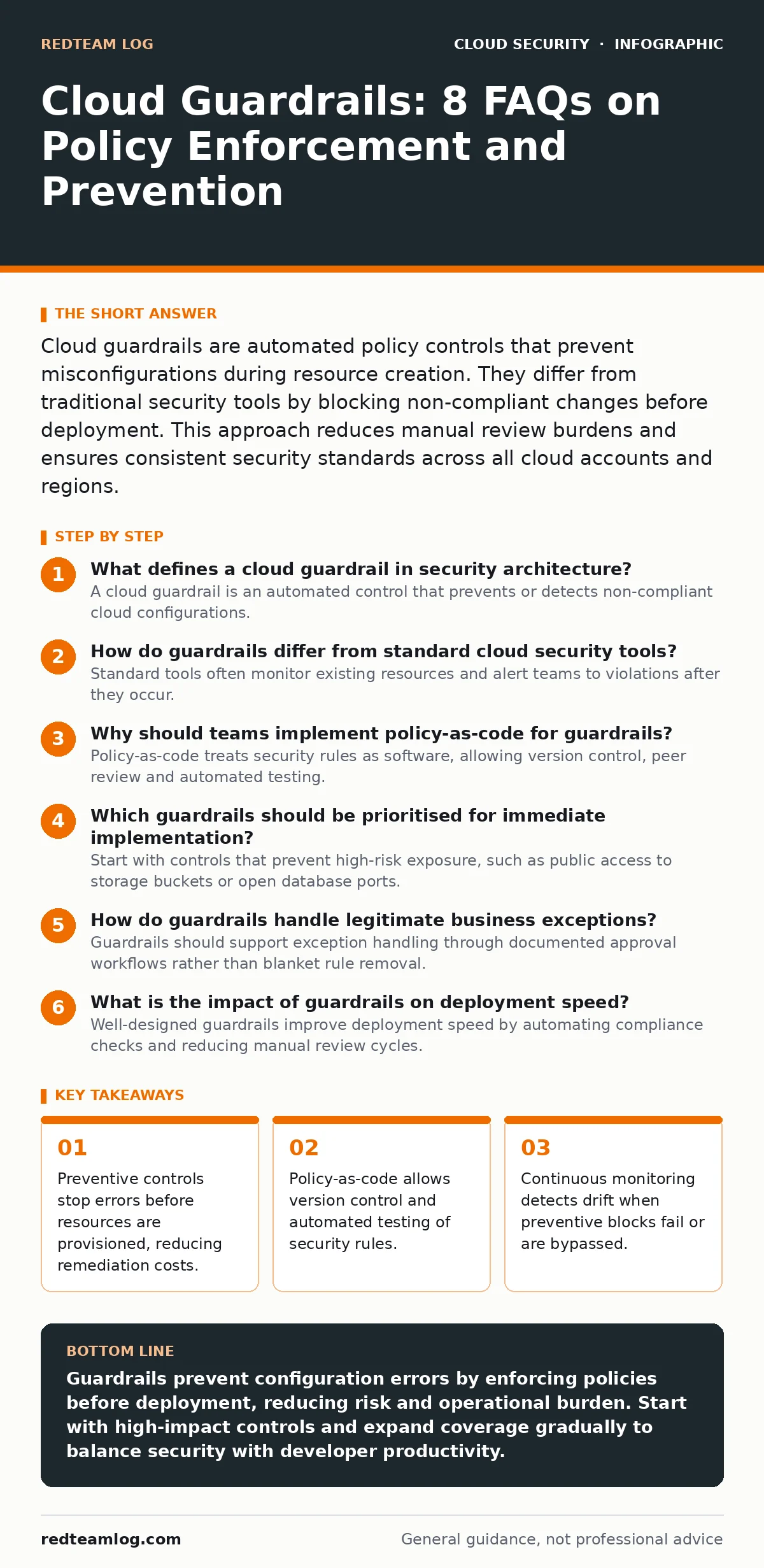
Cloud guardrails are automated policy controls that prevent misconfigurations during resource creation. They differ from traditional security tools by blocking non-compliant changes before deployment. This approach reduces manual review burdens and ensures consistent security standards across all cloud accounts and regions.
What defines a cloud guardrail in security architecture?
A cloud guardrail is an automated control that prevents or detects non-compliant cloud configurations. Unlike traditional security tools that react after an incident, guardrails enforce constraints during the resource creation phase. They ensure that infrastructure adheres to predefined security standards without requiring manual intervention. This mechanism shifts security left in the development lifecycle.
How do guardrails differ from standard cloud security tools?
Standard tools often monitor existing resources and alert teams to violations after they occur. Guardrails focus on prevention by blocking actions that violate policy before resources are created. This distinction reduces the window of exposure and minimises the operational burden of fixing misconfigurations. Prevention is more effective than detection for systemic configuration errors.
Why should teams implement policy-as-code for guardrails?
Policy-as-code treats security rules as software, allowing version control, peer review and automated testing. This approach ensures that policies are consistent, auditable and reproducible across environments. It eliminates manual configuration errors and provides a single source of truth for security requirements. Teams can test policy changes in development before applying them to production.
Which guardrails should be prioritised for immediate implementation?
Start with controls that prevent high-risk exposure, such as public access to storage buckets or open database ports. These configurations are common entry points for attackers and are easy to enforce programmatically. Prioritising these rules provides immediate risk reduction with minimal complexity. Expanding coverage gradually allows teams to build confidence in the enforcement mechanism.
How do guardrails handle legitimate business exceptions?
Guardrails should support exception handling through documented approval workflows rather than blanket rule removal. This ensures that business needs are met without compromising overall security posture. Exceptions must be time-bound and reviewed regularly to prevent policy decay. Automated expiration of exceptions reduces the risk of permanent security gaps.
See also: Data Center Resilience Planning: Keep Services Running During Failures · Difference Between Single Sign On and Federated Identity
What is the impact of guardrails on deployment speed?
Well-designed guardrails improve deployment speed by automating compliance checks and reducing manual review cycles. Developers receive immediate feedback on configuration errors, allowing them to fix issues early. This reduces the time spent waiting for security approvals and minimises rework. The initial learning curve is offset by long-term efficiency gains.
How can teams measure the effectiveness of guardrails?
Measure effectiveness by tracking the number of blocked violations and the time to remediate exceptions. Monitor policy coverage to ensure all critical resources are protected. Review false positive rates to refine rules and reduce developer friction. Regular audits of policy enforcement logs provide visibility into compliance trends and potential gaps.
What are the common pitfalls in guardrail implementation?
Overly restrictive policies can hinder development productivity and encourage workarounds. Lack of stakeholder engagement leads to rules that do not align with business needs. Insufficient testing of policies in development environments causes production disruptions. Teams must balance security requirements with operational flexibility to ensure sustainable adoption.
| Control Type | Timing | Primary Benefit | Common Challenge |
|---|---|---|---|
| Preventive | Before deployment | Stops errors early | Developer friction |
| Detective | After deployment | Identifies drift | Alert fatigue |
| Corrective | Continuous | Auto-remediates issues | False positives |
How do guardrails integrate with existing security frameworks?
Guardrails align with frameworks like CIS Benchmarks and NIST guidelines by automating control implementation. They provide continuous compliance evidence and reduce the effort required for audits. Integration with identity and access management ensures that only authorised users can override policies. This creates a cohesive security posture across the organisation.
Suppose a team deploys a new web application without configuring encryption. A preventive guardrail blocks the deployment until encryption is enabled. This prevents data exposure and ensures compliance with regulatory requirements. The developer receives immediate feedback and corrects the configuration before proceeding.
What role does continuous monitoring play alongside guardrails?
Continuous monitoring detects configuration drift that occurs after initial deployment. It identifies changes made outside of standard deployment pipelines, such as manual console edits. Monitoring complements preventive controls by providing visibility into the entire lifecycle of cloud resources. This ensures that security posture remains consistent over time.
How do guardrails address multi-cloud environments?
Multi-cloud guardrails use standardised policy languages to enforce consistent controls across different providers. This abstraction layer simplifies management and reduces the complexity of maintaining separate rule sets. Teams can apply the same security standards to all cloud accounts and regions. Consistency is critical for maintaining a unified security posture.
Imagine an organisation using multiple cloud providers for redundancy. A unified guardrail framework ensures that data encryption and access controls are consistent across all environments. This prevents accidental exposure due to provider-specific configuration differences. Standardisation reduces the operational burden of managing disparate security tools.
What is the future trend in cloud guardrail technology?
Automation and artificial intelligence are enhancing guardrail capabilities by enabling predictive analysis. These tools can identify potential misconfigurations before they are deployed. Integration with development workflows will become more seamless, reducing friction for developers. The focus is shifting from manual policy management to automated, adaptive security controls.
How do guardrails support incident response?
Guardrails provide detailed logs of blocked actions and policy violations, aiding in incident investigation. These logs help teams understand the root cause of configuration errors and prevent recurrence. Automated remediation can quickly address detected drift, reducing the impact of incidents. Clear audit trails support compliance and regulatory requirements.
Consider a scenario where a storage bucket is accidentally made public. Guardrails block the action and log the attempt. The security team reviews the log to identify the root cause and updates the policy to prevent similar errors. This proactive approach reduces the likelihood of future incidents.
What is the relationship between guardrails and workload identity?
Guardrails enforce policies on workload identity by ensuring that only authorised identities can access resources. This prevents privilege escalation and limits the blast radius of compromised accounts. Integration with identity management systems allows for fine-grained access control. This ensures that workloads operate with the minimum necessary permissions.
How can teams avoid alert fatigue with guardrails?
Filter and prioritise alerts based on risk severity and business impact. Suppress low-risk notifications that do not require immediate action. Integrate guardrail alerts with existing incident management tools to streamline response. Regular review of alert rules ensures that they remain relevant and actionable.
Suppose a team receives hundreds of alerts for minor configuration warnings. By tuning the rules to focus on high-risk violations, they reduce noise and improve response times. This ensures that security teams can focus on critical issues without being overwhelmed by trivial notifications.
Key takeaways
- Preventive controls stop errors before resources are provisioned, reducing remediation costs.
- Policy-as-code allows version control and automated testing of security rules.
- Continuous monitoring detects drift when preventive blocks fail or are bypassed.
Guardrails prevent configuration errors by enforcing policies before deployment, reducing risk and operational burden. Start with high-impact controls and expand coverage gradually to balance security with developer productivity.
Frequently asked questions
Do guardrails replace security teams?
No, guardrails automate routine checks but require human oversight for policy design, exception handling and strategic decisions. They augment security teams by reducing manual workload.
Can guardrails be bypassed by attackers?
Attackers with high-level access may bypass guardrails, so defence-in-depth strategies are necessary. Guardrails are one layer of security, not a complete solution.
How do guardrails handle legacy applications?
Legacy applications may require exceptions or gradual migration to comply with guardrail policies. Teams should assess risk and plan remediation paths for older systems.
Are guardrails effective for serverless architectures?
Yes, guardrails can enforce policies on serverless functions and event-driven workflows. They ensure that serverless resources adhere to security standards during creation.
How this guide was produced: written by the RedTeam Log editorial team with AI assistance, checked against the public references listed below, and reviewed when the facts change. See our editorial policy or report an error.