
Confidential computing protects data while it is being processed in memory, not just when stored or transmitted. It uses hardware-based enclaves to isolate workloads from the host operating system and cloud provider. This prevents privileged insiders and hypervisor-level attacks from accessing plaintext data, but it does not replace network security or identity management protocols.
Misreading: It replaces all other cloud security controls
Correct reading: Confidential computing isolates the processing environment but does not secure the network path or the identity layer. You still need strong authentication and authorisation for users accessing the enclave. Network traffic entering or leaving the enclave is not protected by the hardware isolation itself.
You must combine this technology with existing measures like cloud firewalls to inspect traffic and cloud encryption to protect data at rest. The enclave only secures the memory and CPU state during execution. It does not stop a malicious user from sending a crafted request that causes the application to leak data. You must treat the enclave as one layer in a defence-in-depth strategy, not a silver bullet that removes the need for perimeter security or identity verification.
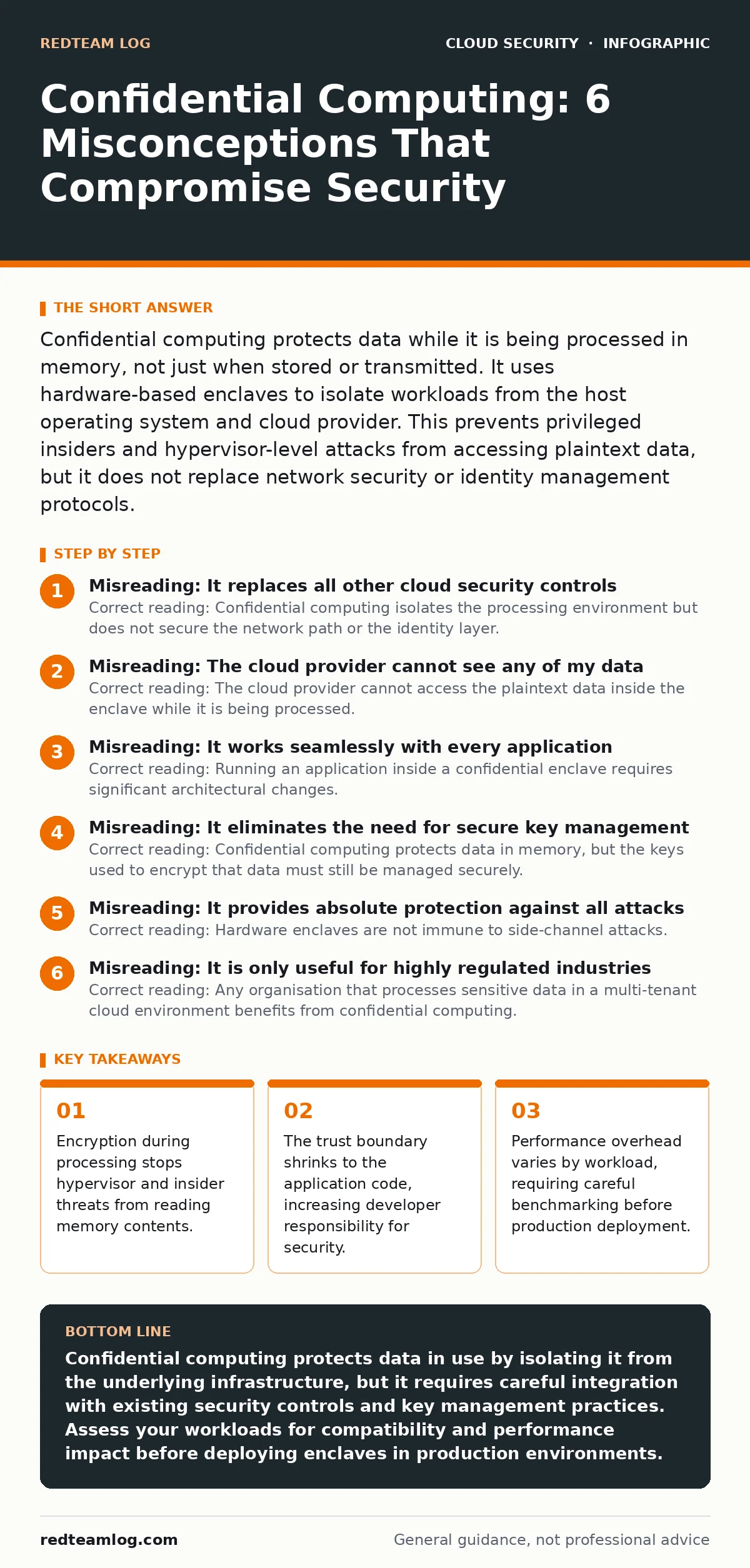
Misreading: The cloud provider cannot see any of my data
Correct reading: The cloud provider cannot access the plaintext data inside the enclave while it is being processed. However, the provider still manages the physical hardware, the hypervisor, and the external storage. They can observe metadata, such as access patterns, volume of data transferred, and timing information. They can also see the encrypted data before it enters the enclave and after it leaves.
If you do not encrypt data at rest using your own keys, the provider can access it when it is stored on disk. Confidential computing only protects the data in use. It does not blind the infrastructure owner to the fact that you are processing data or to the volume of your operations. You must manage your own keys for storage encryption to maintain full confidentiality across the entire data lifecycle.
Misreading: It works seamlessly with every application
Correct reading: Running an application inside a confidential enclave requires significant architectural changes. The application must be designed to handle remote attestation, a process that verifies the integrity of the code before execution. Many legacy applications rely on system calls or libraries that are not compatible with the restricted environment of an enclave. You may need to refactor code to remove dependencies on host-level resources.
The performance overhead of encrypting and decrypting data as it moves in and out of the enclave can also impact latency-sensitive applications. You must test your workloads thoroughly to identify compatibility issues. Not every service benefits from this level of isolation. Simple stateless services may not need the added complexity and cost of enclave execution. Evaluate the security requirements of each workload before attempting migration.
Misreading: It eliminates the need for secure key management
Correct reading: Confidential computing protects data in memory, but the keys used to encrypt that data must still be managed securely. These keys are often stored outside the enclave or in a separate hardware security module. If an attacker compromises the key management system, they can decrypt the data even if the enclave itself is secure. The enclave relies on the assumption that the keys are protected by a different trust boundary.
You must implement strict access controls and rotation policies for these keys. The security of the entire system is only as strong as its weakest link. If you store encryption keys in a standard database or configuration file, the enclave provides no real protection. You must integrate with a dedicated key management service that supports hardware-backed security to maintain the integrity of the encryption chain.
Misreading: It provides absolute protection against all attacks
Correct reading: Hardware enclaves are not immune to side-channel attacks. These attacks exploit physical characteristics of the hardware, such as power consumption, electromagnetic leaks, or timing variations, to infer sensitive information. Researchers have demonstrated methods to extract keys or data from enclaves by monitoring these physical signals. While the threat is difficult to exploit at scale, it remains a theoretical risk.
The hardware manufacturers continuously patch these vulnerabilities, but new attack vectors emerge. You should assume that the enclave is not a perfect black box. Implement additional cryptographic protections within your application code to mitigate side-channel risks. Do not rely solely on the hardware isolation for high-value secrets. Combine enclave execution with cryptographic techniques that are resistant to timing and power analysis attacks to reduce the attack surface.
See also: Data Center Resilience Planning: Keep Services Running During Failures · Difference Between Single Sign On and Federated Identity
Misreading: It is only useful for highly regulated industries
Correct reading: Any organisation that processes sensitive data in a multi-tenant cloud environment benefits from confidential computing. This includes healthcare providers handling patient records, financial institutions processing transactions, and technology companies managing intellectual property. Even if you are not subject to strict regulatory mandates, the risk of insider threats or compromised cloud credentials is universal.
Confidential computing reduces the trust required in the cloud provider. It allows you to share data with third parties for processing without exposing the raw data. This enables new business models based on secure data collaboration. You do not need a compliance audit to justify the adoption of this technology. The value lies in reducing the blast radius of a security incident. Protecting data in use is becoming a standard requirement for modern cloud architectures, regardless of industry sector.
Misreading: It solves the problem of insecure APIs
Correct reading: Confidential computing secures the processing environment but does not fix vulnerabilities in the application code itself. If your application has a logic flaw or an insecure API endpoint, an attacker can still exploit it to manipulate data or trigger unintended actions. The enclave ensures that the code runs as intended and that memory is isolated, but it does not validate the correctness of the business logic.
You must still perform rigorous code reviews and security testing. Practices such as cloud penetration testing help identify logical flaws that hardware isolation cannot prevent. An attacker may not be able to read the memory, but they can still cause the application to make incorrect decisions based on malicious input. Secure coding practices remain the primary defence against application-layer threats. Hardware isolation is a complementary measure, not a substitute for secure development.
Key takeaways
- Encryption during processing stops hypervisor and insider threats from reading memory contents.
- The trust boundary shrinks to the application code, increasing developer responsibility for security.
- Performance overhead varies by workload, requiring careful benchmarking before production deployment.
- Key management remains outside the enclave, meaning root keys still require traditional protection.
Confidential computing protects data in use by isolating it from the underlying infrastructure, but it requires careful integration with existing security controls and key management practices. Assess your workloads for compatibility and performance impact before deploying enclaves in production environments.
Frequently asked questions
Does confidential computing protect against ransomware?
It limits the ability of ransomware to encrypt data in memory, but it does not prevent the malware from running or affecting the host system. You still need endpoint detection and response tools to stop the initial infection.
Can I use confidential computing with serverless functions?
Yes, some cloud providers offer enclave support for serverless workloads. This allows you to benefit from hardware isolation without managing the underlying virtual machines or containers, simplifying the deployment process.
How does remote attestation work in practice?
Remote attestation verifies the integrity of the enclave by comparing a cryptographic hash of the running code against a known good value. This ensures that the application has not been tampered with before it processes sensitive data.
Is confidential computing slower than standard execution?
There is a performance overhead due to the encryption and decryption of data as it moves in and out of the enclave. The impact varies by workload, but most modern hardware minimises this latency to acceptable levels for most applications.
How this guide was produced: written by the RedTeam Log editorial team with AI assistance, checked against the public references listed below, and reviewed when the facts change. See our editorial policy or report an error.