
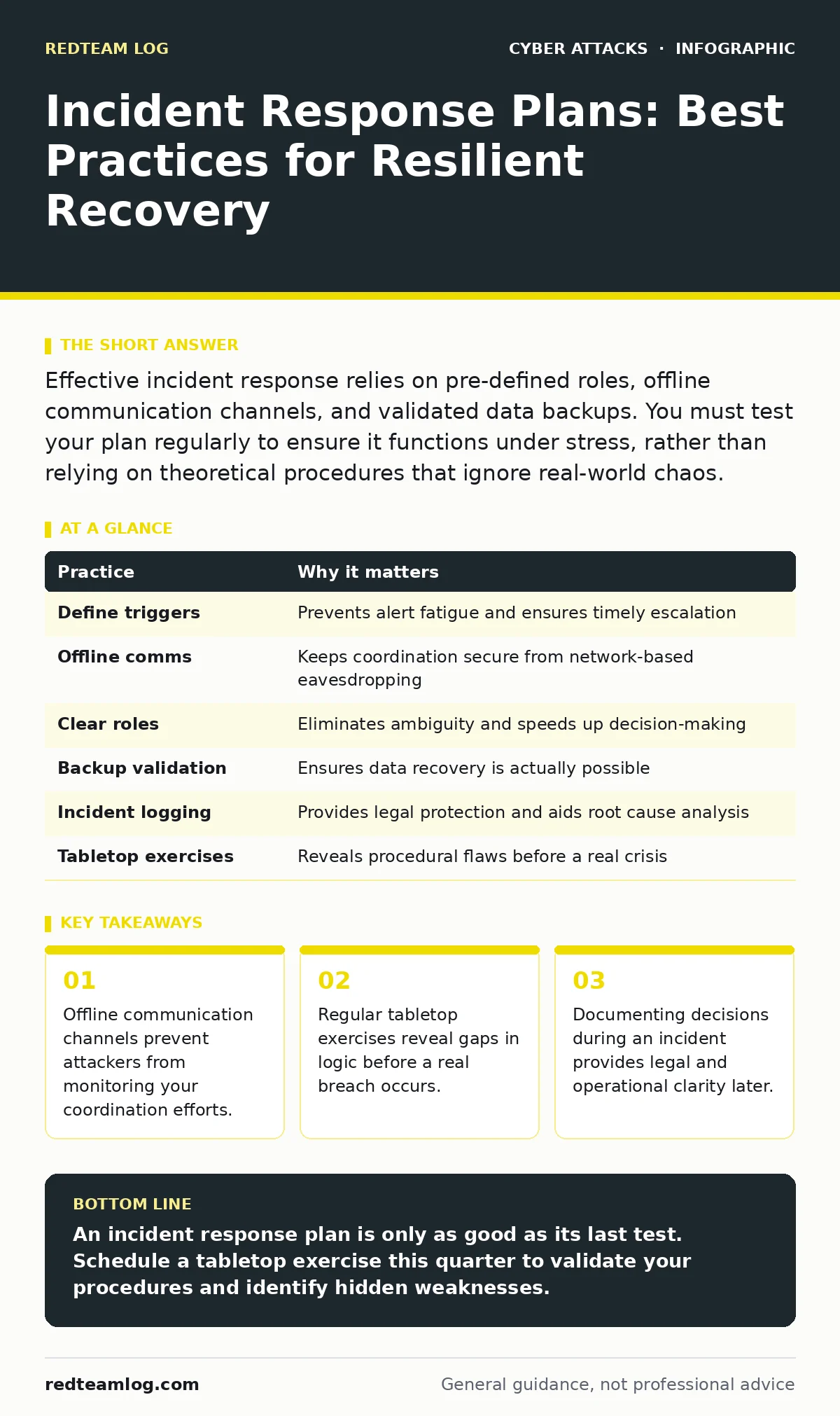
Effective incident response relies on pre-defined roles, offline communication channels, and validated data backups. You must test your plan regularly to ensure it functions under stress, rather than relying on theoretical procedures that ignore real-world chaos.
Defining the Trigger and Scope
You cannot respond effectively if you do not know when to begin. Many organisations suffer from alert fatigue, ignoring genuine threats because they are buried in noise. Your plan must define specific indicators that trigger a formal response, distinct from routine troubleshooting. This boundary prevents small issues from consuming disproportionate resources.
A clear scope also dictates who needs to be involved. Not every security alert requires the full weight of the cyber incident response team. Define the thresholds that escalate an event from a local IT issue to a company-wide emergency. This distinction preserves bandwidth for genuine crises.
Establishing Offline Communication Channels
Attackers often monitor network traffic to understand your reaction. If your team relies solely on email or internal chat platforms, the adversary may see your coordination and adapt their tactics. You must establish communication methods that operate outside the potentially compromised network.
Use encrypted mobile messaging or dedicated phone trees for critical decisions. These channels remain functional even if your primary infrastructure is offline. Ensure every team member has the contact details for these alternatives printed and stored physically. Digital copies may be inaccessible during a ransomware event.
Assigning Clear Roles and Responsibilities
Ambiguity during a crisis leads to duplicated effort or critical tasks being ignored. Your plan must assign specific roles to individuals, not job titles. People change positions, but a named role remains constant within the document. This clarity ensures that decisions are made without hesitation.
Designate a single incident commander who has the authority to make final calls. This person coordinates the technical teams and communicates with leadership. Without a clear chain of command, conflicting instructions can worsen the situation. Ensure this role has a designated deputy to maintain continuity.
Validating Backup Integrity
Restoring data is useless if the backups are corrupted or incomplete. Many plans assume backups work until the moment they are needed. You must regularly test the restoration process to verify that data is recoverable. This testing should include full system restores, not just file-level checks.
Offsite or offline backups provide a safety net against ransomware that targets connected storage. Ensure these backups are immutable, meaning they cannot be altered or deleted by anyone, even administrators. This protection prevents attackers from destroying your recovery options. Regular validation ensures that when you need to rebuild, the foundation is solid.
Documenting the Incident Timeline
Every action you take must be recorded in real time. This log serves as a factual record for post-incident analysis and potential legal requirements. It helps you understand the sequence of events and identify where controls failed. Without a detailed timeline, reconstructing the attack becomes guesswork.
Use a standard template for logging activities. Include timestamps, the person performing the action, and the outcome. This consistency allows different team members to contribute to the record without confusion. The log should be stored securely, separate from the compromised systems, to preserve its integrity.
See also: Should I Invest in SOAR? The Truth About Automation ROI · Emergency Patching: Correcting Five Common Operational Errors
Conducting Regular Tabletop Exercises
A plan that sits in a drawer is a theoretical exercise, not a operational tool. You must simulate incidents to test your procedures under pressure. Tabletop exercises involve walking through hypothetical scenarios with your response team. This reveals gaps in logic, missing contacts, or unclear responsibilities.
Imagine a scenario where your primary email system is compromised and you cannot send messages. How does the team coordinate? Suppose you discover a deepfake scam has led to a significant financial transfer. Does your plan address financial fraud alongside technical containment? These exercises build muscle memory and confidence.
| Practice | Why it matters |
|---|---|
| Define triggers | Prevents alert fatigue and ensures timely escalation |
| Offline comms | Keeps coordination secure from network-based eavesdropping |
| Clear roles | Eliminates ambiguity and speeds up decision-making |
| Backup validation | Ensures data recovery is actually possible |
| Incident logging | Provides legal protection and aids root cause analysis |
| Tabletop exercises | Reveals procedural flaws before a real crisis |
Integrating External Support
You cannot handle every aspect of an incident alone. Your plan should include pre-vetted contacts for external support, such as legal counsel, forensic experts, and communication specialists. These relationships should be established before an incident occurs. Waiting to find help during a crisis wastes valuable time.
Ensure you have clear agreements on who pays for these services and how they are engaged. This administrative clarity prevents delays when every second counts. External experts can provide specialised skills that your internal team may lack, such as advanced forensic analysis or regulatory guidance.
Post-Incident Review and Improvement
The work does not end when the threat is contained. A thorough post-incident review identifies what worked and what failed. This analysis is the primary driver for improving your security posture. Without this step, you are likely to repeat the same mistakes in future incidents.
Update your plan based on the findings from the review. Document new threats, such as baiting attacks that exploit human curiosity, and add specific countermeasures. Share lessons learned with the wider organisation to raise awareness. Continuous improvement turns a single incident into a long-term defence strategy.
Addressing Social Engineering Vectors
Technical controls are only one part of the equation. Attackers increasingly use social engineering to bypass security measures. Your response plan must include procedures for handling incidents involving human manipulation. This includes CEO fraud where attackers impersonate executives to request urgent actions.
Train staff to verify unusual requests through secondary channels. If an email from a senior leader requests a wire transfer, call them on a known number to confirm. This simple step can prevent significant financial loss. Include these verification steps in your incident response protocols to ensure consistency.
Key takeaways
- Offline communication channels prevent attackers from monitoring your coordination efforts.
- Regular tabletop exercises reveal gaps in logic before a real breach occurs.
- Documenting decisions during an incident provides legal and operational clarity later.
An incident response plan is only as good as its last test. Schedule a tabletop exercise this quarter to validate your procedures and identify hidden weaknesses.
Frequently asked questions
How often should I update my incident response plan?
Update your plan at least annually or after any significant change in your infrastructure or team structure. Major incidents should also trigger an immediate review.
What if I do not have a dedicated security team?
Assign clear roles to existing IT staff and identify external partners who can provide specialised support. Clear documentation compensates for limited resources.
Should I notify customers immediately after an incident?
Notify customers as soon as you have confirmed the scope and impact of the breach. Delaying communication can damage trust and may violate regulatory requirements.
How do I handle insider threats during an incident?
Assume insider involvement is possible until proven otherwise. Restrict access to critical systems and monitor unusual activity. Involve legal counsel early to protect employee rights.
How this guide was produced: written by the RedTeam Log editorial team with AI assistance, checked against the public references listed below, and reviewed when the facts change. See our editorial policy or report an error.