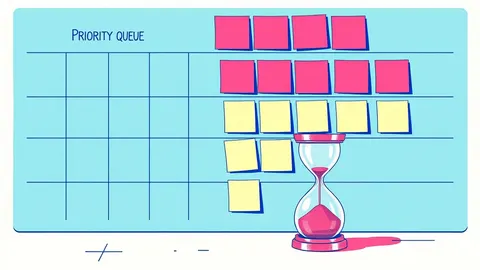
Emergency patching requires a pre-defined fast-track process, not improvised haste. You must validate patches against your specific environment, maintain immediate rollback capability, and communicate changes clearly. Speed without verification increases downtime and introduces new vulnerabilities.
Misreading: Emergency patching means skipping all tests
Correct reading: Emergency patching requires accelerated testing, not omitted testing. The pressure to deploy quickly often leads teams to assume that vendor-supplied code is inherently safe. This assumption ignores the risk of regression bugs or configuration conflicts unique to your infrastructure. You must validate the patch in an isolated environment that mirrors production. This environment should include representative data and network configurations. Testing confirms the fix works without breaking dependent services. Skipping this step turns a security fix into a potential service outage. The goal is verified speed, not blind haste.
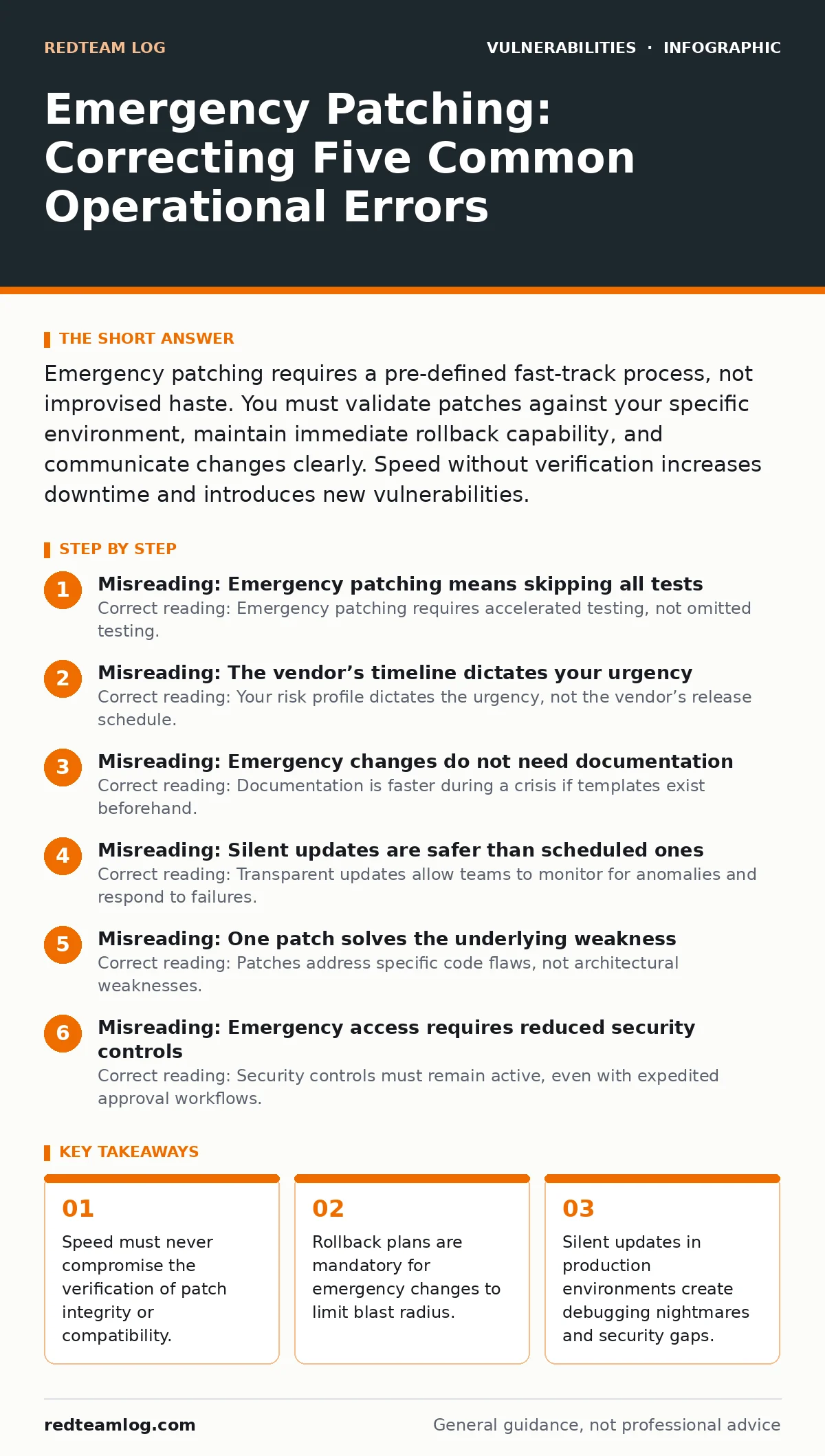
Misreading: The vendor’s timeline dictates your urgency
Correct reading: Your risk profile dictates the urgency, not the vendor’s release schedule. Vendors publish patches based on widespread exploitability and severity scores. Your environment may lack the specific configuration that makes the vulnerability exploitable. Conversely, your system may expose the vulnerability in a way that makes it critical. Assess the exploitability within your network boundaries. Check if the vulnerable component is internet-facing. Determine if authentication is required to trigger the issue. If the component is air-gapped or heavily restricted, the urgency decreases. Align your response with your actual exposure, not external noise.
Misreading: Emergency changes do not need documentation
Correct reading: Documentation is faster during a crisis if templates exist beforehand. The belief that recording changes wastes time during an emergency is dangerous. Without records, you cannot audit the change later or troubleshoot failures. Create standardised change request templates for emergency scenarios. These templates should require fewer fields than normal changes but must capture the patch version, the reason, and the rollback steps. Automated logging tools can capture these details without manual input. This record ensures accountability and aids forensic analysis if the patch causes issues. Silence in the logs is indistinguishable from negligence.
Misreading: Silent updates are safer than scheduled ones
Correct reading: Transparent updates allow teams to monitor for anomalies and respond to failures. Deploying emergency patches without notifying operations teams creates a blind spot. Staff expect stability and may misinterpret patch-induced changes as attacks or failures. When a system behaves differently after a silent update, incident responders waste time investigating false positives. Notify stakeholders of the emergency change window. Explain the expected behaviour changes and potential temporary performance impacts. This awareness reduces alert fatigue and speeds up genuine incident response. Communication is a control mechanism, not just courtesy.
Misreading: One patch solves the underlying weakness
Correct reading: Patches address specific code flaws, not architectural weaknesses. Applying a patch is a reactive measure that closes a known hole. It does not prevent similar vulnerabilities from appearing in future versions or other components. Relying solely on patching ignores the root cause of why the vulnerability existed. Evaluate your software development lifecycle for security gaps. Consider shifting security checks earlier in the development process. Implement stricter input validation and output encoding standards. These measures reduce the likelihood of severe vulnerabilities emerging in the first place. Patching is a stopgap, not a strategy.
See also: Cyber Range Training Myths: What Platforms Actually Do · Router Firmware Vulnerabilities: Response and Recovery Steps
Misreading: Emergency access requires reduced security controls
Correct reading: Security controls must remain active, even with expedited approval workflows. The misconception that speed requires lowering security barriers leads to privilege escalation risks. Emergency patching often involves granting temporary elevated privileges to apply fixes. These privileges must be time-bound and audited. Use just-in-time access models that grant rights only for the duration of the task. Record all actions taken with these privileges. Review the logs immediately after the task completes. Revoke access promptly. Maintaining controls ensures that a rushed process does not introduce insider threats or misconfigurations.
Emergency patching intersects with several other security domains. Understanding how these areas interact helps you build a resilient response. For instance, a patch for file upload vulnerabilities may require changes to server configurations that affect how Content Security Policy headers are enforced.
Similarly, fixing insecure direct object references (IDOR) might involve altering database access patterns that impact NoSQL injection protections. Each change must be validated against your software bill of materials (SBOM) to ensure no conflicting dependencies are introduced. Browser updates also influence how client-side patches are received and applied, affecting the overall security posture.
Misreading: Integer overflow patches are purely mathematical
Correct reading: Integer overflow vulnerabilities often lead to memory corruption, requiring careful system-level validation. Many teams view these as abstract coding errors rather than security risks. An integer overflow occurs when a calculation exceeds the maximum value a variable can hold. This can cause the variable to wrap around to a negative or small positive number.
In security contexts, this can lead to buffer overflows, arbitrary code execution, or privilege escalation. Patches for these issues often involve changing how the system handles memory allocation. These changes can impact performance and stability. Testing must include high-load scenarios to ensure the patch handles edge cases correctly without causing system crashes.
Emergency patching is a high-stakes operation that requires precision and preparation. The following FAQ addresses common queries that arise during and after these events.
Key takeaways
- Speed must never compromise the verification of patch integrity or compatibility.
- Rollback plans are mandatory for emergency changes to limit blast radius.
- Silent updates in production environments create debugging nightmares and security gaps.
- Emergency processes require pre-approval templates to avoid decision paralysis.
Frequently asked questions
How do I determine if a patch is truly emergency?
Assess the exploitability in your specific environment. If the vulnerability is actively exploited and your systems are exposed, it is emergency. If the risk is theoretical or mitigated by other controls, it may not be.
Can I automate emergency patching?
Automation can apply patches quickly, but the decision to apply must be human-led or based on strict, pre-approved criteria. Automated systems should handle the deployment and verification, not the risk assessment.
What if the patch breaks a critical service?
Execute the rollback plan immediately. Do not attempt to fix the broken service while the vulnerability is still open. Restore stability first, then investigate the patch failure in a non-production environment.
How long should emergency access last?
Emergency access should last only as long as the patching task requires. Define a maximum time limit, such as 24 hours, and revoke access automatically if the task is not completed within that window. BOTTOM LINE: Emergency patching is a controlled process, not a reactive scramble. Establish pre-approved templates and test automation to reduce decision time and error rates during crises.
How this guide was produced: written by the RedTeam Log editorial team with AI assistance, checked against the public references listed below, and reviewed when the facts change. See our editorial policy or report an error.