A software bill of materials is a formal record containing the details and supply chain relationships of various components used in building software. It functions like an ingredient list, allowing you to identify known vulnerabilities in dependencies without re-scanning the entire application codebase.
The Ingredient List for Digital Products
Imagine you are buying a complex piece of furniture. The label lists the wood, the screws and the glue. If a recall happens for that specific glue, you know immediately if your item is affected. Software works similarly. An SBOM lists every library, module and third-party component inside an application. It transforms opaque binaries into transparent inventories.
This transparency is not about trust. It is about visibility. You cannot secure what you cannot see. Traditional security tools often look at the surface of an application. They check for open ports or obvious misconfigurations. They rarely inspect the thousands of lines of borrowed code running underneath. An SBOM fills this blind spot. It tells you exactly what is inside, not just how it behaves from the outside.
The Problem of Hidden Dependencies
Modern software is rarely written from scratch. Developers reuse code to save time and reduce errors. This practice creates a deep web of dependencies. A single application might contain hundreds of third-party components. Each of these components has its own dependencies. This creates a complex graph of trust.
When a vulnerability is discovered in a low-level library, the impact ripples outward. Many applications may use that library indirectly. You might not know you are affected until an attacker exploits it. This is the core problem an SBOM solves. It maps the relationship between your software and its parts. It allows you to trace a vulnerability back to the source.
This visibility is critical for managed services. You often support multiple clients with different software stacks. When a major vulnerability emerges, you need to know which clients are at risk. Manual assessment is too slow. An SBOM provides the data needed for rapid triage. It turns a chaotic search into a precise query.
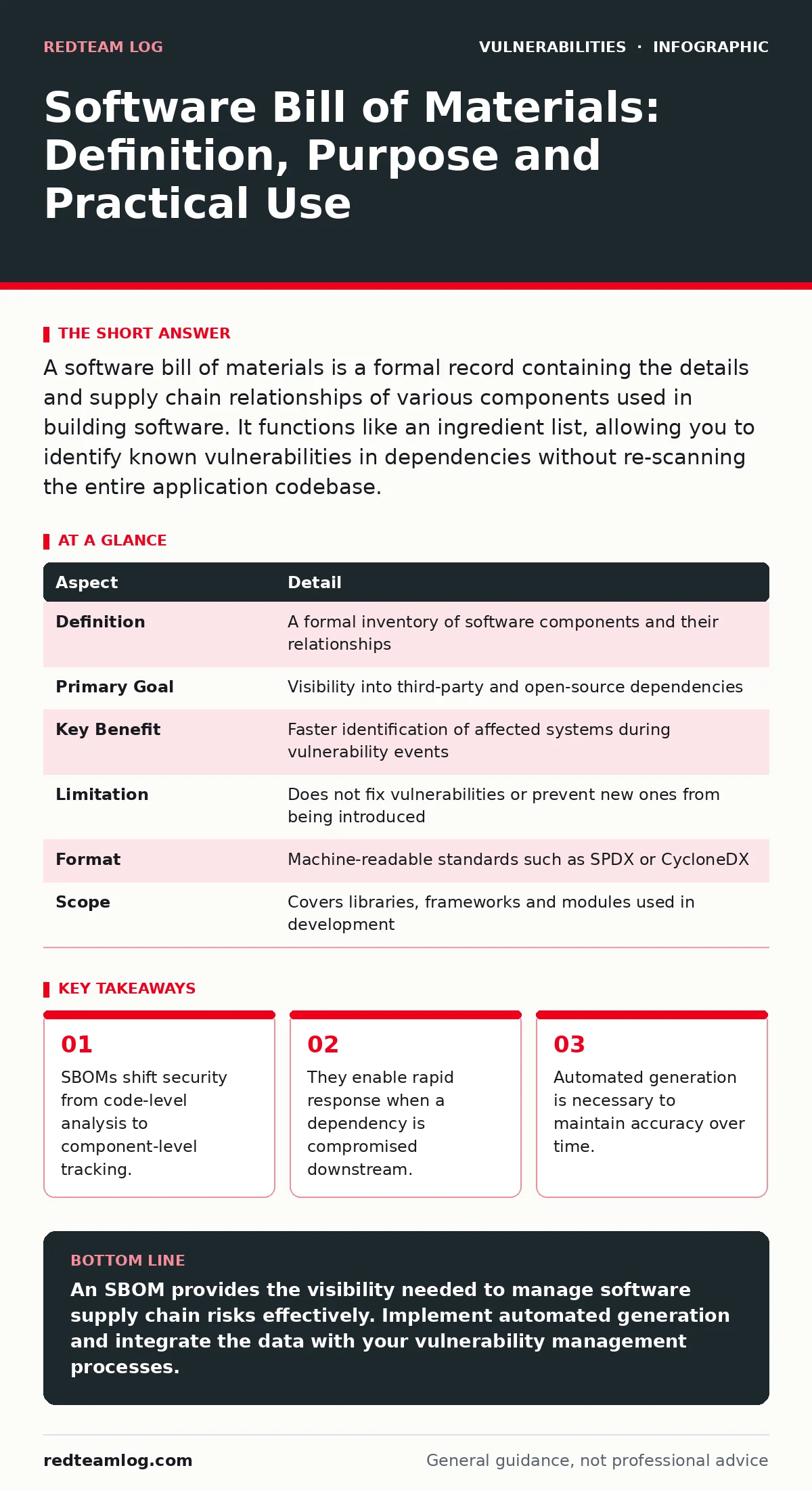
| Aspect | Detail |
|---|---|
| Definition | A formal inventory of software components and their relationships |
| Primary Goal | Visibility into third-party and open-source dependencies |
| Key Benefit | Faster identification of affected systems during vulnerability events |
| Limitation | Does not fix vulnerabilities or prevent new ones from being introduced |
| Format | Machine-readable standards such as SPDX or CycloneDX |
| Scope | Covers libraries, frameworks and modules used in development |
Anatomy of a Standard SBOM
An SBOM is not just a list of names. It contains structured data that machines can process. The format matters because it determines how well different tools can read and share the information. Two common standards are SPDX and CycloneDX. Both are open and widely accepted. They ensure that an SBOM created by one tool can be read by another.
Each entry in an SBOM typically includes several fields. The component name is obvious. The version number is equally important. A vulnerability might affect version 1.0 but not version 2.0. The license information helps with legal compliance. It tells you if a component requires attribution or has restrictions on use.
Relationships are also recorded. An SBOM shows which component depends on which other component. This hierarchy is vital for understanding indirect risks. You might not use a vulnerable library directly. Your main framework might use it. The SBOM reveals this hidden link. Without this depth, you might miss the risk entirely.
Integration with Existing Defences
An SBOM does not replace other security measures. It complements them. It sits alongside vulnerability scanning and secure coding practices. Scanning tools look for known weaknesses in real-time. An SBOM provides the static context for those scans. It tells the scanner what to look for.
Consider the difference between scanning and inventorying. Scanning is active. It probes the system for weaknesses. Inventorying is passive. It records what is present. You need both. Scanning might miss a zero-day vulnerability in a dependency. An SBOM allows you to react quickly when that vulnerability is disclosed. It shortens the time between disclosure and mitigation.
This integration extends to other areas. For instance, vulnerability scanning tools can ingest SBOMs to prioritise findings. Instead of scanning every line of code, they check the components listed in the SBOM. This makes scanning faster and more accurate. It reduces false positives. It focuses effort on known, risky components.
Common Misconceptions and Pitfalls
Many organisations believe an SBOM is a one-time task. They generate it once and file it away. This is a dangerous mistake. Software changes constantly. Dependencies are updated. New components are added. An outdated SBOM is worse than no SBOM. It gives a false sense of security.
Another misconception is that an SBOM solves all supply chain risks. It does not. It only lists what is there. It does not verify that the code is safe. It does not prevent attackers from inserting malicious code into a dependency. You still need to validate sources. You still need to monitor for anomalies.
Some teams also struggle with accuracy. Automated tools can miss manually added components. They might not detect dynamic loading. This leads to gaps in the inventory. You must validate the SBOM against your actual build process. Regular audits are necessary. They ensure the record matches reality.
The Role in Incident Response
When a security incident occurs, speed is critical. Attackers move fast. Defenders must move faster. An SBOM accelerates the response process. It allows you to identify affected systems immediately. You do not need to guess which applications might be vulnerable.
Suppose a critical vulnerability is announced in a popular encryption library. You query your SBOM database. You get a list of all applications using that library. You can then prioritise patching. You focus on the most exposed systems first. This targeted approach saves time and resources.
This capability is particularly valuable for large organisations. They often have hundreds of applications. Manual tracking is impossible. An automated SBOM pipeline ensures that every change is recorded. It provides a single source of truth. This truth is the foundation of effective incident response.
Beyond Compliance: Strategic Value
Regulators and standards bodies are increasingly requiring SBOMs. Compliance is a driver. But the strategic value goes beyond ticking boxes. It improves software quality. It encourages developers to choose well-maintained components. It reduces the use of abandoned or risky libraries.
It also facilitates collaboration. Vendors can share SBOMs with customers. This builds trust. It shows transparency. Customers can verify the security posture of the software they buy. This shifts the market towards higher standards. It rewards good practices.
Next Steps for Implementation
Start by defining your scope. Decide which applications need an SBOM. Prioritise those with external exposure. Choose a standard format early. It simplifies tooling and integration. Select tools that generate SBOMs automatically. Manual creation is error-prone and unsustainable.
Validate your initial SBOMs. Compare them against your known dependencies. Identify gaps. Fix the generation process. Then establish a review process. Regularly update your SBOMs. Integrate them with your vulnerability management tools. This creates a closed loop of visibility and action.
Remember that an SBOM is a tool, not a solution. It provides data. You must act on that data. Combine it with other security measures. Use it to inform decisions. It enhances your overall security posture. It makes your supply chain visible and manageable.
Key takeaways
- SBOMs shift security from code-level analysis to component-level tracking.
- They enable rapid response when a dependency is compromised downstream.
- Automated generation is necessary to maintain accuracy over time.
An SBOM provides the visibility needed to manage software supply chain risks effectively. Implement automated generation and integrate the data with your vulnerability management processes.
Frequently asked questions
How is an SBOM different from a vulnerability scan?
A vulnerability scan actively probes for weaknesses in real-time. An SBOM is a static inventory of components. Scans find current issues; SBOMs provide context for tracking dependencies over time.
Do I need an SBOM for internal tools?
Yes. Internal tools can still be compromised. If they access sensitive data or network resources, they are targets. An SBOM helps track risks in these applications too.
What happens if a component is no longer maintained?
The SBOM will list it. You should flag unmaintained components for review. They pose a higher risk as vulnerabilities may not be patched. Consider replacing them with active alternatives.
Can an SBOM detect malicious code?
No. An SBOM lists components. It does not analyse code content. It relies on external intelligence to flag known malicious or vulnerable components. You still need code analysis and monitoring.
How this guide was produced: written by the RedTeam Log editorial team with AI assistance, checked against the public references listed below, and reviewed when the facts change. See our editorial policy or report an error.