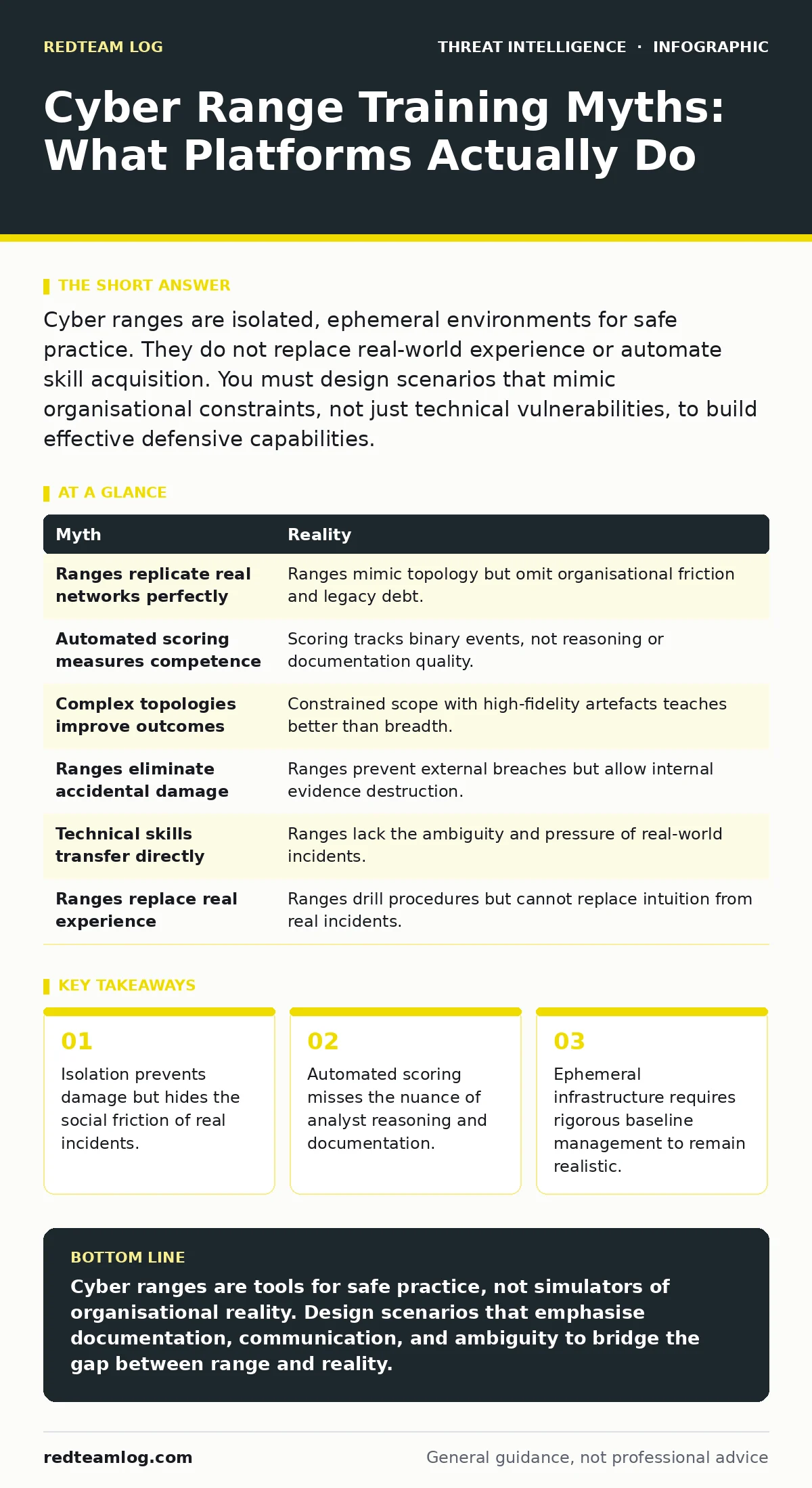
Cyber ranges are isolated, ephemeral environments for safe practice. They do not replace real-world experience or automate skill acquisition. You must design scenarios that mimic organisational constraints, not just technical vulnerabilities, to build effective defensive capabilities.
Myth: Cyber ranges replicate real-world network environments perfectly
Reality: Cyber ranges provide isolated, ephemeral infrastructure that mimics network topology, but they cannot replicate the organisational context of a production environment. Production networks carry legacy debt, undocumented configurations, and political constraints that ranges omit. This gap means technicians learn technical remediation without learning the negotiation required to implement it.
Myth: Automated scoring accurately measures analyst competence
Reality: Automated scoring systems track binary events, such as whether a firewall rule was changed or a specific file was deleted. They do not measure the quality of an analyst’s reasoning, the clarity of their documentation, or their ability to communicate findings to non-technical stakeholders. An analyst might isolate a compromised host correctly but fail to document the scope of lateral movement, leading to incomplete remediation later. Scoring engines cannot penalise poor documentation or vague incident reports, which are critical components of effective incident response runbooks.
Myth: Complex network topologies improve training outcomes
Reality: Adding more virtual machines and subnets increases cognitive load without necessarily improving defensive skills. Novice analysts often struggle with basic triage on a single compromised endpoint; flooding them with a sprawling enterprise network obscures the core learning objective. Effective training requires constrained scope with high-fidelity artefacts, not breadth. A small network with realistic beaconing patterns and subtle remote desktop abuse vectors teaches more than a large, empty network. Complexity should serve the scenario, not the architect’s ego.
Myth: Cyber ranges eliminate the risk of accidental damage
Reality: Cyber ranges isolate traffic from the public internet and your production network, preventing external compromise or data leakage. However, they do not prevent internal mistakes within the range itself. An analyst might accidentally delete a critical log source or misconfigure a virtual firewall, destroying the evidence trail they are meant to analyse. This teaches a valuable lesson about operational hygiene, but it can also frustrate learners if the platform lacks snapshot restoration capabilities. The risk shifts from external breach to internal error.
Myth: Technical skills transfer directly from range to reality
Reality: Technical proficiency in a controlled environment does not guarantee performance under pressure. Real incidents involve ambiguous data, conflicting information from multiple sources, and time pressure from executive leadership. Ranges often provide clean, curated datasets where the compromise is obvious. Real-world detection use cases frequently involve noisy environments where malicious activity blends with legitimate business traffic. Analysts must learn to tolerate ambiguity and make decisions with incomplete information, a skill ranges struggle to simulate without deliberate scenario design.
See also: Emergency Patching: Correcting Five Common Operational Errors · How Log Management Works: The Hidden Friction in Your Pipeline
Myth: Cyber ranges replace the need for real-world experience
Reality: Cyber ranges accelerate skill acquisition by providing safe, repeatable practice environments, but they cannot replace the intuition gained from handling real incidents. Real incidents involve human factors, such as user behaviour and insider threats, that are difficult to model accurately. Ranges are excellent for drilling specific technical procedures, such as memory forensics or packet analysis, but they should complement, not replace, exposure to actual security events. Mentorship and participation in real incident response teams remain irreplaceable for developing holistic security expertise.
| Myth | Reality |
|---|---|
| Ranges replicate real networks perfectly | Ranges mimic topology but omit organisational friction and legacy debt. |
| Automated scoring measures competence | Scoring tracks binary events, not reasoning or documentation quality. |
| Complex topologies improve outcomes | Constrained scope with high-fidelity artefacts teaches better than breadth. |
| Ranges eliminate accidental damage | Ranges prevent external breaches but allow internal evidence destruction. |
| Technical skills transfer directly | Ranges lack the ambiguity and pressure of real-world incidents. |
| Ranges replace real experience | Ranges drill procedures but cannot replace intuition from real incidents. |
Key takeaways
- Isolation prevents damage but hides the social friction of real incidents.
- Automated scoring misses the nuance of analyst reasoning and documentation.
- Ephemeral infrastructure requires rigorous baseline management to remain realistic.
- Range fidelity depends on scenario design, not just network topology complexity.
Cyber ranges are tools for safe practice, not simulators of organisational reality. Design scenarios that emphasise documentation, communication, and ambiguity to bridge the gap between range and reality.
Frequently asked questions
How do I ensure cyber range scenarios remain realistic?
Base scenarios on real-world detection use cases and incorporate organisational constraints, such as change management delays and limited tool access, to mimic production friction.
Can cyber ranges help with threat intelligence integration?
Yes, ranges can simulate the ingestion and analysis of threat feeds, helping analysts understand how to correlate indicators of compromise with internal telemetry.
What is the biggest limitation of cyber range training?
The inability to simulate human factors, such as user error, insider threats, and the political dynamics of incident response, which are critical in real-world scenarios.
How often should cyber range scenarios be updated?
Scenarios should be updated regularly to reflect emerging tactics, techniques, and procedures, ensuring alignment with the latest MITRE ATT&CK framework mappings.
How this guide was produced: written by the RedTeam Log editorial team with AI assistance, checked against the public references listed below, and reviewed when the facts change. See our editorial policy or report an error.