
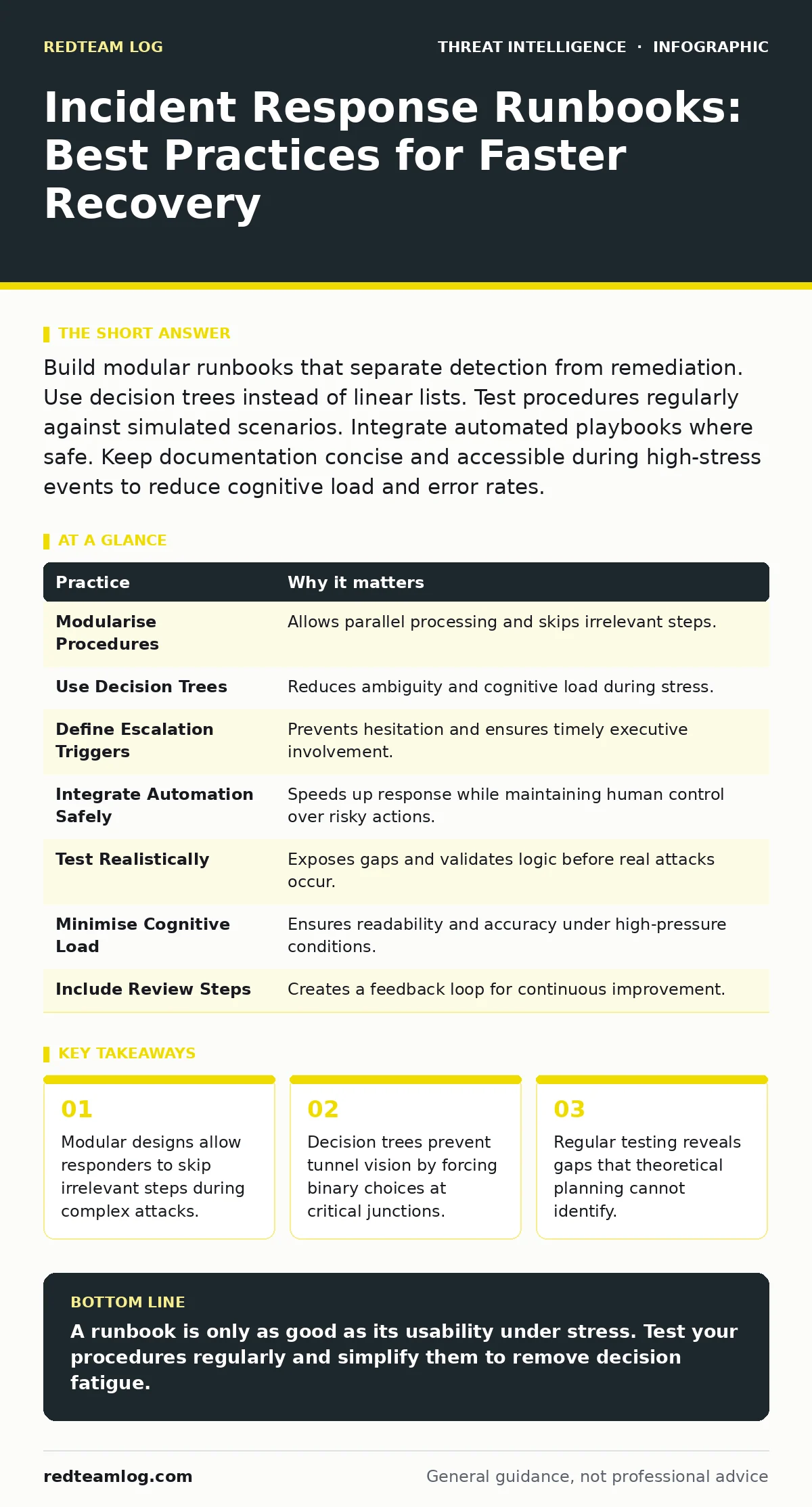
Build modular runbooks that separate detection from remediation. Use decision trees instead of linear lists. Test procedures regularly against simulated scenarios. Integrate automated playbooks where safe. Keep documentation concise and accessible during high-stress events to reduce cognitive load and error rates.
The Architecture of Chaos
Incident response is not a linear process. It is a series of rapid decisions made under pressure with incomplete information. A runbook that reads like a novel will be ignored when the clock is ticking. You need structures that support speed and accuracy simultaneously. The goal is not to document every possible action, but to eliminate decision fatigue during the initial minutes of an attack.
Static documents rot. The environment changes, new vulnerabilities emerge, and attacker tactics evolve. Your runbook must be a living component of your security posture, not a shelf file. This requires a shift from procedural compliance to operational resilience.
1. Modularise Your Procedures
Linear runbooks force responders to follow every step regardless of context. This wastes time and increases the risk of human error. Instead, break your response into independent modules. Each module addresses a specific phase, such as containment, eradication, or recovery.
Imagine a ransomware event where the attacker has already encrypted files. You do not need the module for initial access analysis yet. You jump straight to containment and network isolation. This modularity allows parallel processing by different team members.
Tip: Create standalone cards or short documents for each module. Link them together in a master index. This ensures that a responder can focus on one task without navigating through irrelevant pages.
2. Use Decision Trees, Not Lists
Lists imply a fixed sequence. Reality rarely cooperates. A decision tree presents a question, offers two or three paths, and leads to the next logical step. This structure mirrors how experienced operators think. It reduces the cognitive load by removing ambiguity.
Suppose you detect unusual outbound traffic. A list might say "check firewall logs." A decision tree asks "Is the destination known?" If yes, you check for legitimate business use. If no, you isolate the host. This binary approach forces clarity.
Tip: Draw your runbooks as flowcharts first. Convert them to text only after the logic is sound. Use simple yes/no questions at each branch point.
3. Define Clear Escalation Triggers
Not every alert requires a full-scale response. However, waiting too long to escalate can turn a contained incident into a catastrophe. Your runbook must define specific triggers for escalation. These triggers should be objective and measurable.
For example, if a critical server shows signs of compromise, the trigger might be "immediate executive notification." If a single workstation is infected, the trigger might be "standard containment." Ambiguity here leads to hesitation. Hesitation allows attackers to deepen their foothold.
Tip: List the exact criteria for each escalation level. Include contact details and required information for each tier. Update these contacts regularly to avoid stale information.
4. Integrate Automated Playbooks Safely
Automation speeds up response but introduces new risks. If a script fails, it can cause collateral damage or hide evidence. Your runbook should specify which steps are automated and which require human approval. This hybrid approach balances speed with control.
Consider the use of SIEM tools to trigger automated isolation of infected endpoints. This is generally safe. However, automated deletion of files should always require human confirmation. You must understand the limitations of your automation.
Tip: Document the failure modes of each automated step. Include manual fallback procedures in the runbook. Test these fallbacks regularly to ensure they work when the automation fails.
See also: Should I Invest in SOAR? The Truth About Automation ROI · Emergency Patching: Correcting Five Common Operational Errors
5. Test Against Realistic Scenarios
A runbook that has never been tested is a guess. You must validate your procedures against realistic attack scenarios. This involves simulating attacks and measuring how well the runbook guides the response. It reveals gaps in logic, missing tools, or unclear instructions.
Imagine a scenario involving initial access brokers selling credentials. Your runbook must address credential resets and session invalidation. If it does not, you have a blind spot. Testing exposes these blind spots before a real attack occurs.
Tip: Conduct tabletop exercises quarterly. Rotate participants to ensure knowledge is distributed. Record the time taken for each step and identify bottlenecks.
6. Minimise Cognitive Load During Stress
During an incident, stress impairs decision-making. Complex sentences, jargon, and dense paragraphs increase this impairment. Your runbook must be easy to read under pressure. Use short sentences, active voice, and clear headings.
Avoid technical deep dives in the main procedure. Link to reference materials if further detail is needed. The primary document should guide action, not educate. Clarity saves time. Time saves data.
Tip: Use a consistent format for all steps. Start each step with a strong verb. Keep paragraphs to two or three sentences. Use bold text for critical commands or values.
7. Include Post-Incident Review Steps
The response does not end when the threat is contained. You must document what happened, what worked, and what failed. This feedback loop is vital for improving future responses. Without it, you repeat the same mistakes.
Your runbook should include a template for post-incident reports. This template should capture timeline, actions taken, evidence collected, and lessons learned. This data feeds into your strategic threat intelligence efforts. It helps you anticipate future attacks.
Tip: Schedule a review meeting within 48 hours of incident closure. Assign ownership of each lesson learned. Track implementation of improvements in a separate log.
8. Maintain Contextual Awareness
Runbooks often focus on technical steps but ignore the broader context. Who is affected? What is the business impact? What are the legal implications? Ignoring these factors can lead to poor decisions.
For instance, shutting down a production server might stop an attack but cripple business operations. Your runbook should prompt responders to assess business impact before taking drastic measures. This requires coordination with business units.
Tip: Include a section on stakeholder communication. Define who to notify and what information to share. Keep this section updated with current organisational structures.
| Practice | Why it matters |
|---|---|
| Modularise Procedures | Allows parallel processing and skips irrelevant steps. |
| Use Decision Trees | Reduces ambiguity and cognitive load during stress. |
| Define Escalation Triggers | Prevents hesitation and ensures timely executive involvement. |
| Integrate Automation Safely | Speeds up response while maintaining human control over risky actions. |
| Test Realistically | Exposes gaps and validates logic before real attacks occur. |
| Minimise Cognitive Load | Ensures readability and accuracy under high-pressure conditions. |
| Include Review Steps | Creates a feedback loop for continuous improvement. |
| Maintain Context | Balances technical response with business and legal needs. |
The Hidden Cost of Complexity
Complexity is the enemy of speed. Every extra step, every vague instruction, and every missing detail adds friction. Friction delays containment. Delayed containment increases damage. Your runbook must be a tool that removes friction, not adds it.
Regularly prune your runbooks. Remove steps that are no longer relevant. Simplify language. Update contact lists. Treat your runbook as a product that requires continuous maintenance. This discipline ensures that your team is ready when the next attack arrives.
Key takeaways
- Modular designs allow responders to skip irrelevant steps during complex attacks.
- Decision trees prevent tunnel vision by forcing binary choices at critical junctions.
- Regular testing reveals gaps that theoretical planning cannot identify.
A runbook is only as good as its usability under stress. Test your procedures regularly and simplify them to remove decision fatigue.
Frequently asked questions
How often should I update my incident response runbooks?
Update them after every major incident, significant infrastructure change, or quarterly review. Frequency depends on your environment's volatility.
Can I use the same runbook for all types of attacks?
No. Different attacks require different responses. Use modular components to build specific runbooks for malware, data breaches, and denial-of-service attacks.
How do I handle runbooks for remote workers?
Ensure your runbooks account for limited access to on-premise tools. Include steps for verifying identity and isolating remote devices securely.
What is the role of threat intelligence in runbooks?
Threat intelligence informs the indicators of compromise and tactics used by attackers. It helps tailor your runbooks to current threats, such as **remote desktop abuse** or **DCSync attacks**.
How this guide was produced: written by the RedTeam Log editorial team with AI assistance, checked against the public references listed below, and reviewed when the facts change. See our editorial policy or report an error.