
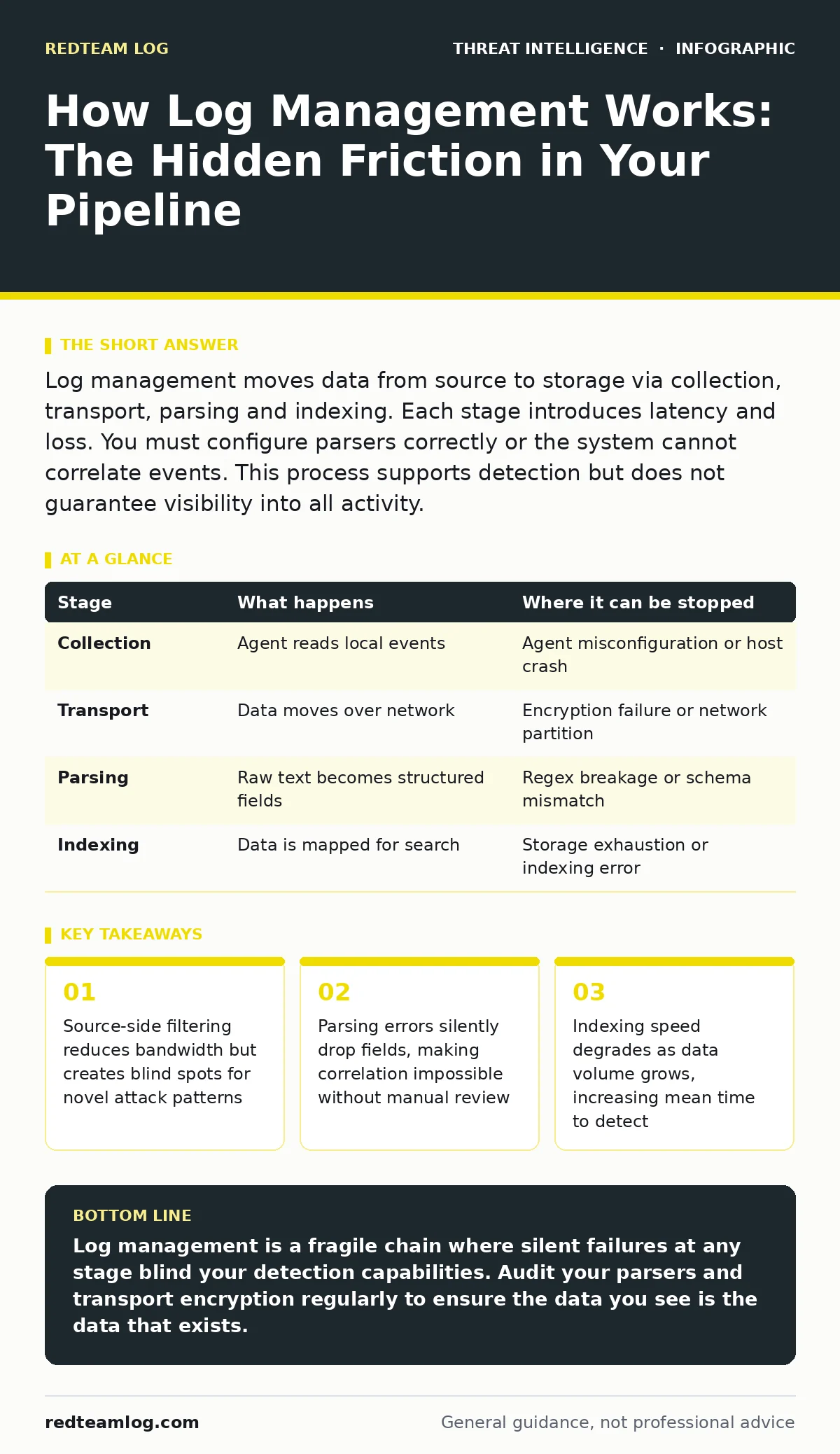
Log management moves data from source to storage via collection, transport, parsing and indexing. Each stage introduces latency and loss. You must configure parsers correctly or the system cannot correlate events. This process supports detection but does not guarantee visibility into all activity.
The Collection Bottleneck
Log management begins at the point of origin. Every server, firewall and endpoint generates raw text or structured data about events. You must decide which events matter before they leave the host. This decision is not merely about storage costs. It determines the baseline of your visibility.
Imagine a web server receiving thousands of requests per second. If you collect every single request, your network capacity saturates within minutes. If you collect only errors, you miss the slow reconnaissance phase of an intrusion. The collection agent, often a lightweight daemon, reads local files or hooks into system APIs. It buffers this data to prevent loss during network spikes.
The mechanism here is simple but fragile. The agent must trust the local clock. If the host time drifts, your timeline becomes useless. You must synchronise time across the entire estate using a reliable protocol. Without this, correlating an authentication failure on a login server with a file access on a database server becomes guesswork.
Transport and Integrity Risks
Once collected, data must move to a central location. This transport phase is where most organisations lose integrity. Sending logs over unencrypted channels exposes them to interception. An attacker who controls the network can alter logs in transit. They can remove evidence of their presence or inject false positives.
You should use encrypted tunnels for all log transport. The encryption must protect the data in motion, not just the connection. Many default configurations rely on weak ciphers or expired certificates. This creates a false sense of security. The transport mechanism also needs resilience. If the central server is down, the local agent must store logs securely until connectivity returns.
A hidden cost in this stage is latency. Encryption and decryption consume CPU cycles on the source host. On high-volume systems, this can degrade performance. You must balance security with operational stability. If the logging agent causes the server to crash, you have lost both the service and the logs.
Parsing and Normalisation Challenges
Raw logs are rarely useful in their native format. Different vendors use different timestamps, field names and structures. Parsing converts this chaos into a standard schema. This step is critical for correlation. You cannot compare events if one system calls the user ID "uid" and another calls it "username".
The parser applies rules to extract fields. Regular expressions are common but brittle. A slight change in the vendor software version can break the parser. When this happens, the log is often discarded or stored as raw text. It becomes invisible to automated detection rules. This is a silent failure. No alert triggers, but the data is not analysed.
You must validate your parsers regularly. Test them against sample logs from different versions of your software. A broken parser is worse than no logs. It gives you confidence in a system that is actually blind to key fields. This is where many detection use cases fail in practice. The rule is correct, but the data it relies on was never extracted.
Indexing and Search Performance
Parsed logs are indexed for fast retrieval. Indexing creates a map of the data. It allows you to search for specific terms across millions of entries in seconds. Without indexing, you would have to read every log file sequentially. This is impractical for large environments.
The indexing mechanism trades storage space for speed. It creates additional metadata for each log entry. This increases the total data volume significantly. You must plan your storage capacity accordingly. As data grows, search times increase. You may need to archive old logs to a cheaper, slower storage tier.
A non-obvious consequence of indexing is the loss of unstructured data. Some parsers strip out comments or debug information to save space. If an attacker uses a technique that relies on these ignored fields, your index will not see it. You must decide what is noise and what is signal. This decision shapes your defensive posture.
| Stage | What happens | Where it can be stopped |
|---|---|---|
| Collection | Agent reads local events | Agent misconfiguration or host crash |
| Transport | Data moves over network | Encryption failure or network partition |
| Parsing | Raw text becomes structured fields | Regex breakage or schema mismatch |
| Indexing | Data is mapped for search | Storage exhaustion or indexing error |
Correlation and Context Building
Indexing alone does not provide insight. You need to connect related events. Correlation engines look for patterns across multiple sources. For example, a failed login followed by a successful one from a different IP address. This pattern suggests credential theft.
The mechanism relies on time windows and entity matching. The system groups events by user, host or network address. It applies rules to identify anomalies. These rules are often based on threat actor profiling data. Knowing how an adversary typically moves helps you tune the correlation logic.
However, correlation generates noise. False positives occur when legitimate user behaviour matches attack patterns. You must tune these rules to reduce alert fatigue. If analysts see too many false alarms, they will ignore real threats. This is a psychological limit of the system. The technology works, but the human response degrades.
See also: Remediation Tracking: Build a Closed-Loop System That Prevents Repeat Vulnerabilities · Detection Use Cases: 6 Common Misreadings and the Correct View
Retention and Legal Constraints
Logs must be kept for a certain period. This is driven by legal and compliance requirements. You must balance these needs with storage costs. Keeping logs forever is expensive and often unnecessary. Most incidents are detected within days or weeks.
The retention mechanism involves tiered storage. Recent logs stay on fast storage for immediate analysis. Older logs move to cold storage. Accessing cold storage is slow. This limits your ability to investigate historical events quickly. You must define your retention policy clearly.
A hidden risk is data privacy. Logs may contain personal information. You must anonymise or redact sensitive data before storage. Failure to do so can lead to legal liability. This adds complexity to the parsing stage. You must identify and mask fields automatically. This is not just a technical task. It is a legal one.
The Limits of Visibility
Log management does not give you complete visibility. It only shows what is logged. Many attacks occur in memory or use fileless techniques. These leave no traditional logs. You must complement logging with other detection methods.
The system also cannot interpret intent. It shows actions, not motives. You must combine log data with strategic threat intelligence to understand the bigger picture. Without this context, you are reacting to symptoms, not causes. This limits your ability to predict future attacks.
Imagine an attacker who uses legitimate administrative tools. The logs will show valid commands. The system cannot distinguish between a administrator and an attacker using stolen credentials. This is the fundamental limit of log-based detection. You must rely on behaviour analysis and anomaly detection to bridge this gap.
Operational Reality Check
Implementing log management is not a one-time task. It requires continuous maintenance. Parsers break, schemas change and new sources appear. You must have a process for updating your configuration. This is often overlooked in favour of new features.
The biggest challenge is scale. As your environment grows, so does the log volume. Your infrastructure must scale accordingly. This means more storage, more processing power and more network bandwidth. Budget for this growth from the start.
You must also train your team. They need to understand the pipeline. When an alert fires, they must know where to look. If they do not understand how the data was collected and parsed, they cannot trust it. This undermines the entire security programme.
Key takeaways
- Source-side filtering reduces bandwidth but creates blind spots for novel attack patterns
- Parsing errors silently drop fields, making correlation impossible without manual review
- Indexing speed degrades as data volume grows, increasing mean time to detect
Log management is a fragile chain where silent failures at any stage blind your detection capabilities. Audit your parsers and transport encryption regularly to ensure the data you see is the data that exists.
Frequently asked questions
How long should I keep my logs?
Keep recent logs for immediate analysis and archive older logs for compliance. Balance legal requirements with storage costs and access speed.
What happens if a parser breaks?
Logs may be stored as raw text or discarded. This creates blind spots where automated detection rules cannot find the data they need.
Can I trust the timestamps in my logs?
Only if all systems are synchronised to a single time source. Drift between clocks makes correlation impossible and investigations unreliable.
Does log management prevent attacks?
No. It only records events. It supports detection and response but does not block malicious activity. You need other controls for prevention.
How this guide was produced: written by the RedTeam Log editorial team with AI assistance, checked against the public references listed below, and reviewed when the facts change. See our editorial policy or report an error.