
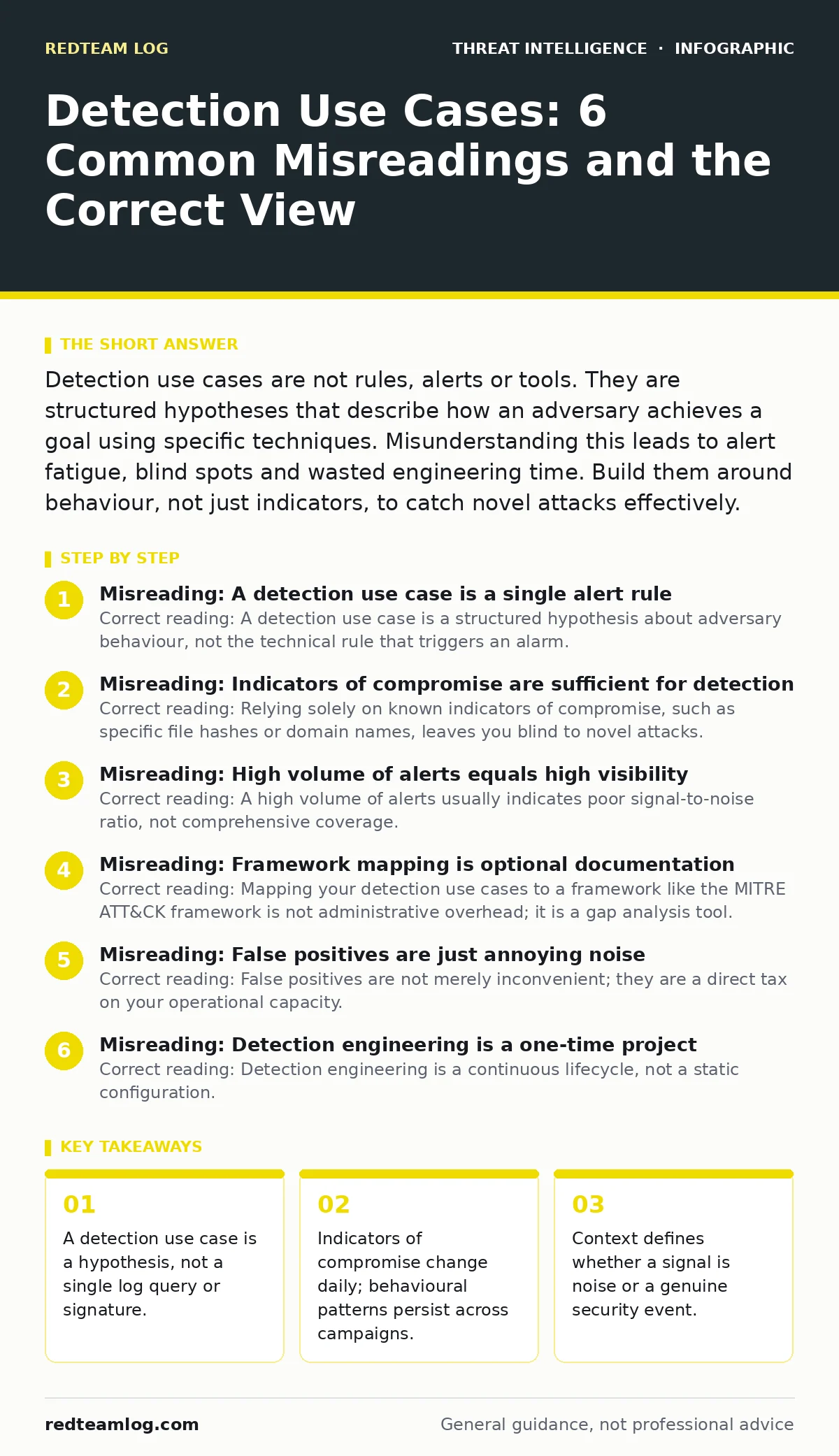
Detection use cases are not rules, alerts or tools. They are structured hypotheses that describe how an adversary achieves a goal using specific techniques. Misunderstanding this leads to alert fatigue, blind spots and wasted engineering time. Build them around behaviour, not just indicators, to catch novel attacks effectively.
Misreading: A detection use case is a single alert rule
Correct reading: A detection use case is a structured hypothesis about adversary behaviour, not the technical rule that triggers an alarm. You might write a query to find failed logins, but the use case is the concept that brute-force authentication is a precursor to credential theft. The rule is merely the implementation. Treating the rule as the use case causes you to miss variations. An attacker might use a different protocol or a legitimate service to achieve the same goal.
Your hypothesis remains valid even if the technical implementation changes. Focus on the intent and the outcome. Define the adversary action first. Then determine which data sources can prove that action occurred. This separation allows you to update rules without rebuilding your strategic understanding of the threat. It also helps when you switch vendors or platforms. The behaviour you seek remains constant.
Misreading: Indicators of compromise are sufficient for detection
Correct reading: Relying solely on known indicators of compromise, such as specific file hashes or domain names, leaves you blind to novel attacks. These indicators have a short lifespan. Attackers modify them quickly to evade signature-based detection. You need to detect the behaviour that produces the indicator. For example, instead of looking for a specific malicious IP address, look for unusual outbound connections from a workstation.
This approach catches new threats that do not yet have known signatures. It also reduces the maintenance burden. You do not need to update your rules every time a new variant appears. You only need to ensure your behavioural logic remains sound. This shift from static indicators to dynamic behaviour is fundamental to modern defence. It requires richer data and more complex analysis, but it provides lasting protection.
Misreading: High volume of alerts equals high visibility
Correct reading: A high volume of alerts usually indicates poor signal-to-noise ratio, not comprehensive coverage. When every minor anomaly triggers an alarm, analysts suffer from alert fatigue. They begin to ignore warnings, assuming they are false positives. This desensitization is dangerous. It allows genuine breaches to slip through unnoticed. Quality matters more than quantity. A single, well-contextualised alert is far more valuable than hundreds of generic warnings.
You must tune your detections to suppress expected activity. Define what normal looks like for your environment. Then flag only significant deviations from that baseline. This requires careful initial configuration and ongoing refinement. It also means accepting that some noise is inevitable. The goal is to reduce noise to a manageable level, not to eliminate it entirely. Precision builds trust in your detection capabilities.
Misreading: Framework mapping is optional documentation
Correct reading: Mapping your detection use cases to a framework like the MITRE ATT&CK framework is not administrative overhead; it is a gap analysis tool. Without this mapping, you cannot see what you are missing. You might have excellent coverage for network intrusion but zero detection for privilege escalation. The framework provides a common language to discuss these gaps. It allows you to prioritise development based on risk.
It also facilitates sharing with industry groups. When you describe your coverage in standard terms, you can compare notes with peers. This helps you understand where the industry is focusing and where you might be lagging. It turns detection engineering from a reactive task into a strategic discipline. You build coverage intentionally, not accidentally. This structure is vital for long-term resilience.
Misreading: False positives are just annoying noise
Correct reading: False positives are not merely inconvenient; they are a direct tax on your operational capacity. Each false alert consumes analyst time. It distracts from genuine investigations. Over time, this erodes confidence in the detection system. Analysts may start to bypass or disable rules, creating blind spots. You must treat false positive reduction as a core engineering task. This involves refining logic, adding contextual filters and excluding known benign activity.
It also requires feedback loops. Analysts must report false alerts easily. Engineers must act on that feedback promptly. This cycle improves detection accuracy over time. It also helps you understand your environment better. You learn which activities are normal and which are truly suspicious. This knowledge is invaluable for future detection development. Ignoring false positives is a recipe for detection failure.
See also: Fixing MITRE ATT&CK Misreadings for Better Security Posture · How to Build Threat Actor Profiles for Accurate Detection
Misreading: Detection engineering is a one-time project
Correct reading: Detection engineering is a continuous lifecycle, not a static configuration. Adversaries change their tactics. Your environment evolves. New software is deployed. New data sources become available. Your detections must adapt to these changes. Regular review and tuning are mandatory. You must test your rules against simulated attacks to ensure they still work. You must update them when false positive rates rise.
You must retire rules that no longer provide value. This requires dedicated resources and processes. It is not a task for occasional attention. It is a core function of your security operations. Treat detection engineering like software development. Use version control, peer review and automated testing. This discipline ensures your detections remain effective and relevant. It also helps you scale your programme efficiently. Consistency is key to long-term success.
Misreading: All data sources are equally valuable
Correct reading: Not all data sources provide equal value for every detection use case. Some logs are noisy and low fidelity. Others are rich and precise. You must evaluate data sources based on their ability to support your hypotheses. Endpoint logs might be ideal for file creation events. Network logs might be better for lateral movement. Identity logs are critical for privilege abuse. You need a mix of sources to get a complete picture.
Relying on a single source creates blind spots. An attacker who evades endpoint detection might still leave traces in network traffic. You must correlate data across sources. This requires robust log management and normalisation. It also means investing in data quality. Poor quality data leads to poor detections. Ensure your data is complete, accurate and timely. This foundation is essential for effective detection engineering.
Misreading: Detection is solely a technical problem
Correct reading: Detection is a socio-technical challenge. It requires collaboration between engineers, analysts and management. Engineers build the rules. Analysts interpret the alerts. Management provides resources and context. If these groups do not communicate, the detection programme fails. Engineers might build rules that are too complex for analysts to investigate.
Analysts might not provide feedback to improve rules. Management might not understand the need for tuning time. You must break down these silos. Create channels for feedback and collaboration. Share knowledge about adversary behaviour. Align goals and metrics. This cultural aspect is often overlooked but is critical for success. Technical tools alone cannot solve the detection problem. You need a team that works together effectively.
Key takeaways
- A detection use case is a hypothesis, not a single log query or signature.
- Indicators of compromise change daily; behavioural patterns persist across campaigns.
- Context defines whether a signal is noise or a genuine security event.
- Mapping to frameworks prevents gaps in your overall detection coverage.
Frequently asked questions
How do I start building detection use cases?
Begin by identifying high-risk assets and the most likely attack paths against them. Map these to known techniques using a framework like MITRE ATT&CK. Then determine which data sources can evidence those techniques. Start with simple, high-value detections and iterate from there.
What is the difference between a detection rule and a use case?
A detection rule is a specific query or signature that triggers an alert. A detection use case is the broader hypothesis about adversary behaviour that the rule supports. The use case defines the goal and context; the rule is the implementation.
How often should I tune my detections?
Tune your detections continuously. Review false positives and negatives regularly. Adjust rules based on analyst feedback and changes in your environment. Aim for a weekly or monthly cadence depending on your volume and resources.
Can I automate detection tuning?
Automation can help with initial filtering and standardisation. However, human judgement is required for complex tuning and hypothesis validation. Use automation to handle routine tasks, but keep humans in the loop for strategic decisions.
How this guide was produced: written by the RedTeam Log editorial team with AI assistance, checked against the public references listed below, and reviewed when the facts change. See our editorial policy or report an error.