
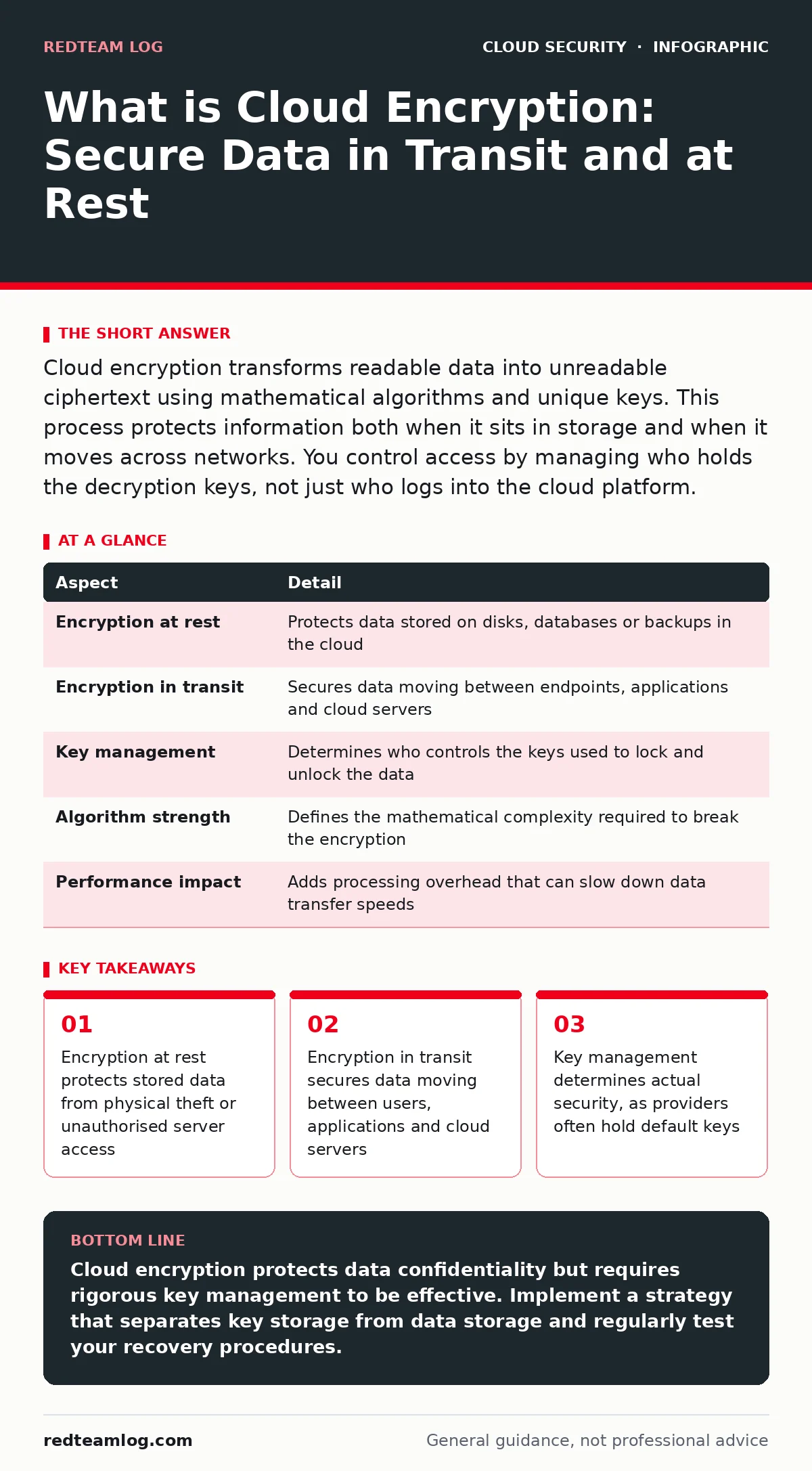
Cloud encryption transforms readable data into unreadable ciphertext using mathematical algorithms and unique keys. This process protects information both when it sits in storage and when it moves across networks. You control access by managing who holds the decryption keys, not just who logs into the cloud platform.
Everyday analogy for cloud data protection
Imagine sending a sealed letter through a public post office. The letter itself contains your secret message, but the envelope is locked with a complex padlock. The postal workers handle the envelope, sort it, and deliver it, but none of them possess the key. Without that specific key, the contents remain invisible to everyone except the intended recipient. Cloud encryption functions as that digital padlock. It ensures that even if someone intercepts your data or steals the physical storage drive, they cannot read the information without the matching cryptographic key. This separation of data from access rights is the foundation of modern cloud security.
What is cloud encryption
What is cloud encryption? It is the process of converting plaintext data into ciphertext using encryption algorithms and unique keys. Plaintext is readable information, while ciphertext is scrambled code that appears random. The encryption algorithm applies a mathematical transformation to the data. The key is a unique string of characters that dictates how the transformation occurs. To read the data, the recipient must use the corresponding decryption key to reverse the process. This mechanism ensures confidentiality. It does not verify identity or prevent data deletion. It only ensures that unauthorised parties cannot interpret the content.
| Aspect | Detail |
|---|---|
| Encryption at rest | Protects data stored on disks, databases or backups in the cloud |
| Encryption in transit | Secures data moving between endpoints, applications and cloud servers |
| Key management | Determines who controls the keys used to lock and unlock the data |
| Algorithm strength | Defines the mathematical complexity required to break the encryption |
| Performance impact | Adds processing overhead that can slow down data transfer speeds |
How encryption mechanisms operate
Encryption relies on two primary methods: symmetric and asymmetric cryptography. Symmetric encryption uses the same key for both locking and unlocking data. This method is fast and efficient for large volumes of stored information. Asymmetric encryption uses a pair of keys: one public key for locking and one private key for unlocking.
This method is slower but ideal for secure key exchange. Cloud platforms often combine both methods. They use asymmetric encryption to securely transmit a symmetric key, then use the symmetric key to encrypt the actual data. This hybrid approach balances security and performance. Understanding this distinction helps you evaluate the overhead of encryption in your architecture.
Who controls the data access
The entity holding the decryption key holds the true power. Most cloud providers offer managed encryption by default. They generate and store the keys for you. This simplifies setup but means the provider can technically access your data if compelled or if their systems are compromised. You retain administrative access, but the provider retains cryptographic access.
For higher security, you can implement bring your own key encryption. This approach allows you to generate and manage keys outside the cloud provider's environment. The provider still handles the encryption process, but they cannot decrypt the data without your active permission. This separation adds a layer of defence against insider threats or provider-side breaches.
Common misconceptions about protection
Many organisations assume that enabling encryption solves all security problems. This belief is dangerous. Encryption protects confidentiality, not integrity or availability. If an attacker deletes your encrypted data, encryption cannot restore it. If an attacker modifies the ciphertext, you may detect the tampering, but the data is still lost. Furthermore, poor key management can render encryption useless.
If you lose the key, the data becomes permanently inaccessible. If you share the key insecurely, the encryption provides no protection. Encryption is a single layer of defence. It must be combined with access controls, logging and backup strategies. See our guide on cloud logging and monitoring for details on tracking key usage and access patterns.
See also: Data Masking Misconceptions That Leave Sensitive Records Exposed · Microsegmentation for Small Teams: Contain Breaches Fast
Implementation strategies for security
Implementing encryption requires a structured approach. Start by identifying sensitive data. Not all data requires the same level of protection. Public marketing materials need less security than customer records. Apply encryption at rest for all persistent storage. Enable encryption in transit for all data movement. Use transport layer security protocols to secure network connections.
Review your key management strategy. Decide whether to use provider-managed keys or manage your own. Regularly rotate keys to limit the damage of a potential leak. Test your recovery procedures. Ensure you can decrypt data in an emergency. Check for orphaned cloud resources that may hold unencrypted data. These unused assets often bypass security policies and create hidden vulnerabilities.
Advanced considerations and trade-offs
Encryption introduces performance overhead. Every byte of data must be processed by the encryption algorithm. This processing consumes CPU cycles and increases latency. For high-throughput applications, this can impact user experience. You must balance security requirements with performance needs. Hardware acceleration can mitigate some of this overhead. Cloud providers often offer specialised instances with encryption capabilities built into the hardware.
Additionally, consider the impact on data recovery. Encrypted backups require the same keys as the live data. If your key management system fails, your backups are useless. Ensure your disaster recovery plan includes key recovery procedures. Review your virtual private clouds configurations to ensure encrypted traffic stays within secure boundaries. Misconfigured network rules can expose encrypted data to unintended recipients.
Conclusion on data security posture
Cloud encryption is a fundamental requirement for modern data protection. It ensures that your data remains confidential even if physical or network boundaries are breached. However, it is not a silver bullet. Effective security requires a combination of encryption, strict access controls, continuous monitoring and robust key management.
By understanding the mechanisms and trade-offs, you can implement a strategy that meets your security needs without compromising performance. Regularly review your encryption policies. Update them as your data landscape evolves. Stay informed about new threats and vulnerabilities. See our guide on cloud penetration testing to identify weaknesses in your encryption implementation.
Key takeaways
- Encryption at rest protects stored data from physical theft or unauthorised server access
- Encryption in transit secures data moving between users, applications and cloud servers
- Key management determines actual security, as providers often hold default keys
- Separating key storage from data storage prevents provider-side breaches from exposing content
Cloud encryption protects data confidentiality but requires rigorous key management to be effective. Implement a strategy that separates key storage from data storage and regularly test your recovery procedures.
Frequently asked questions
Does cloud encryption protect against ransomware?
Encryption protects data confidentiality, but it does not prevent ransomware from encrypting your backups or deleting your files. You still need immutable backups and strict access controls to defend against ransomware attacks.
Is encryption in transit necessary for internal cloud traffic?
Yes, internal traffic can be intercepted within the cloud provider's network. Encrypting data in transit ensures that even if network boundaries are breached, the data remains unreadable to unauthorised parties.
How often should encryption keys be rotated?
Key rotation frequency depends on your security policy and regulatory requirements. Regular rotation limits the impact of a compromised key. Automate this process to ensure consistency and reduce administrative overhead.
Can I use the same key for all my cloud data?
Using a single key for all data creates a single point of failure. If that key is compromised, all your data is exposed. Use unique keys for different data sets or applications to limit the blast radius of a breach.
How this guide was produced: written by the RedTeam Log editorial team with AI assistance, checked against the public references listed below, and reviewed when the facts change. See our editorial policy or report an error.