
Data masking is not encryption and does not protect data at rest. It obscures sensitive information in non-production environments to prevent exposure during development or testing. Misunderstanding its limits leads to false security assumptions and regulatory gaps.
Misreading: Masking Is a Substitute for Encryption
Correct reading: Data masking and data encryption serve entirely different purposes and operate at different layers of the technology stack. Encryption scrambles data using mathematical algorithms and keys, protecting it while it sits on a disk or travels across a network. Masking alters the visible representation of data, usually by replacing characters with symbols or random values, to hide it from human eyes in non-production environments.
You cannot unmask data without a reference table or algorithm, but you also cannot use masked data for its original business purpose. Encryption protects confidentiality during storage and transit. Masking protects privacy during development, testing, and analytics. Using masking where encryption is required leaves data exposed to any process that can read the underlying storage medium. Refer to your guide on data encryption for strategies that secure data at rest.
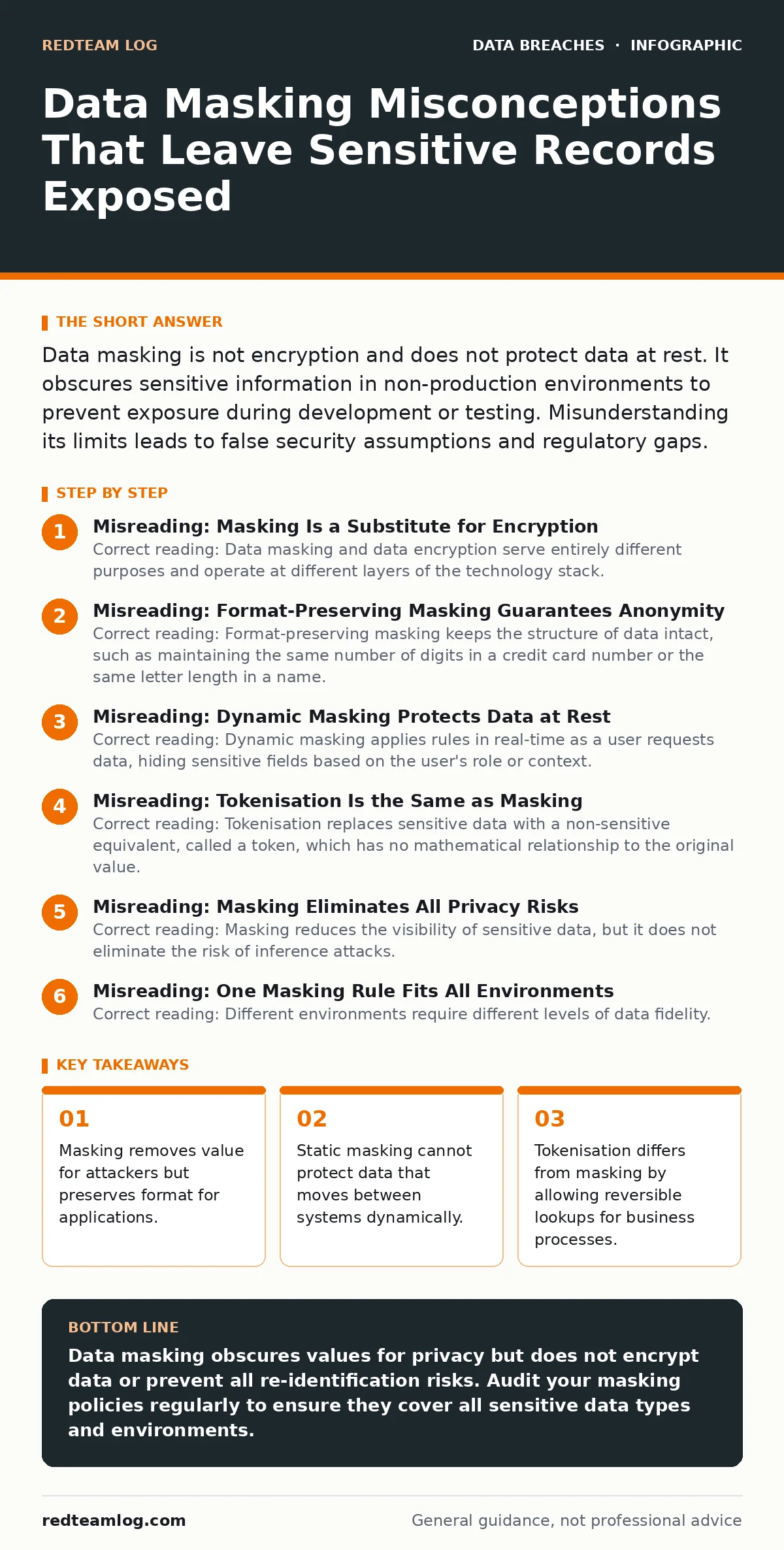
Misreading: Format-Preserving Masking Guarantees Anonymity
Correct reading: Format-preserving masking keeps the structure of data intact, such as maintaining the same number of digits in a credit card number or the same letter length in a name. This allows legacy applications to function without code changes. However, preserving format often preserves patterns. If you mask a list of names but keep the length and initial letters identical, an analyst can correlate the masked data with public records to re-identify individuals.
This is known as the residual risk of quasi-identifiers. True anonymity requires breaking these patterns, often by generalising data or adding noise. Format preservation is a convenience for software compatibility, not a privacy guarantee. It fails when the masked dataset is combined with other sources that share those same structural patterns.
Misreading: Dynamic Masking Protects Data at Rest
Correct reading: Dynamic masking applies rules in real-time as a user requests data, hiding sensitive fields based on the user's role or context. It does not change the actual data stored in the database. The original, clear-text value remains on the disk. If an attacker gains direct access to the storage layer, bypassing the application layer where the masking rules live, they see the raw data.
Dynamic masking is a presentation layer control, not a storage layer control. It prevents casual viewing by authorised users who do not need specific details, such as a customer service agent seeing only the last four digits of an account number. It does not protect against insider threats who have administrative access to the database engine itself. For storage protection, you must implement database security measures that encrypt the data before it hits the disk.
Misreading: Tokenisation Is the Same as Masking
Correct reading: Tokenisation replaces sensitive data with a non-sensitive equivalent, called a token, which has no mathematical relationship to the original value. The original data is stored in a secure vault, and the token can be used in non-production systems for testing. Masking alters the data directly, often irreversibly. Tokenisation is reversible if you have access to the vault, whereas masking is usually a one-way transformation.
This distinction matters for compliance and recovery. If you need to restore the original data for a legal hold or business process, tokenisation allows it. Masking destroys the original value in the target environment. Confusing the two leads to architecture failures where you attempt to reverse a masked value that can never be recovered. Understand the difference to choose the right method for your data lifecycle.
Misreading: Masking Eliminates All Privacy Risks
Correct reading: Masking reduces the visibility of sensitive data, but it does not eliminate the risk of inference attacks. Attackers can use statistical techniques to guess the original values based on the distribution of the masked data. Masking also fails if metadata is not handled correctly.
Column names, data types, and relationships between tables can reveal sensitive information even if the cell values are obscured. You must also consider data subject rights, as masked data may still be considered personal data under certain regulations if it can be linked back to an individual. Masking is a control, not a cure. It must be part of a broader strategy that includes access controls and monitoring.
See also: Warning Signs of Lost and Stolen Devices: Early Detection Strategies · User Account Provisioning: Stop Access Drift Before It Costs You
Misreading: One Masking Rule Fits All Environments
Correct reading: Different environments require different levels of data fidelity. A development team testing a payment module needs data that looks realistic to trigger error handling logic, such as valid card formats that fail validation checks. A marketing team analysing trends needs data that preserves statistical distributions but removes individual identifiers. Applying a single, aggressive masking rule across all environments breaks application functionality or renders analytics useless.
You must define data classification policies that dictate how much detail each environment requires. This often involves multiple masking strategies, such as shuffling values within a column to preserve distribution while breaking row-level links. Ignoring these nuances leads to failed tests and inaccurate business intelligence. Refer to your guide on principle of least privilege to ensure users only see the data fidelity they need.
Misreading: Masking Solves Insider Threats Completely
Correct reading: Masking prevents users from seeing specific values, but it does not stop them from seeing that sensitive data exists. An insider threat actor can still infer the presence of high-value targets by observing which fields are masked. They can also export large volumes of masked data and attempt to de-anonymise it using external datasets. Masking does not audit access. It does not log who viewed what, or when.
You need robust logging and monitoring to detect unusual access patterns, such as a user exporting thousands of records just before a holiday. Masking is a deterrent, not a detection mechanism. It slows down an attacker but does not stop a determined insider who has other avenues of access. Combine masking with strict access reviews and anomaly detection to mitigate these risks. Read about unauthorized access controls to understand how to layer these defences.
Misreading: Masking Is a Set-and-Forget Control
Correct reading: Data masking policies degrade over time as applications evolve and new data fields are added. New sensitive columns may appear in databases without corresponding masking rules, leaving them exposed in non-production environments. Automated discovery tools can help identify sensitive data, but they require regular re-scanning. You must treat masking configuration as part of your change management process.
Any new database schema change should trigger a review of masking rules. Failure to update these rules creates blind spots where sensitive data is visible to developers and testers. This drift is a common cause of data leaks in mature organisations. Regular audits are necessary to verify that all sensitive fields are consistently obscured across all environments. Check your incident communication plans to ensure you can respond if a masking failure leads to exposure.
Misreading: Masking Protects Against Data Breaches in Production
Correct reading: Data masking is primarily designed for non-production environments, such as development, testing, and analytics. It is rarely used in production systems where real-time, accurate data is required for business operations. Using masking in production can disrupt services and confuse users. Production systems rely on encryption, access controls, and network segmentation to protect data. Masking in production is often a misunderstanding of the technology's purpose.
It adds latency and complexity without providing the security benefits of encryption. If you are masking data in production, you are likely misusing the tool. Focus on securing the production environment with appropriate controls and reserve masking for downstream environments where data fidelity can be sacrificed for privacy. Refer to your guide on data leaks to understand how production exposures differ from non-production risks.
Misreading: Masking Is Only for Personal Identifiable Information
Correct reading: While personal identifiable information is the most common target, other types of sensitive data also require masking. This includes intellectual property, financial records, health information, and business secrets. Masking these values prevents competitors or malicious insiders from accessing strategic information during testing or analysis. Ignoring non-personal sensitive data creates gaps in your security posture.
For instance, a competitor could gain insight into your pricing strategies if unmasked financial data is used in a test environment. Define a comprehensive data classification scheme that identifies all sensitive data types, not just those regulated by privacy laws. Apply masking rules consistently across all classified data to ensure complete protection. This holistic approach reduces the risk of accidental exposure of any sensitive information.
Misreading: Masking Rules Are Easy to Maintain
Correct reading: Maintaining masking rules across multiple environments and databases is complex. Different systems may have different data formats, constraints, and relationships. A rule that works in one database may fail in another due to subtle differences in schema or data types. Manual management of these rules is error-prone and unsustainable. You need a centralised policy management system that can deploy and update rules across all environments consistently.
This system should also handle exceptions and overrides carefully. Without centralisation, teams may create ad-hoc masking scripts that are undocumented and untested, leading to inconsistent protection. Invest in tools that simplify rule management and provide visibility into the state of masking across your organisation. This reduces the operational burden and ensures consistent security.
Misreading: Masking Provides Audit Trail Capabilities
Correct reading: Masking itself does not provide an audit trail. It only changes how data is presented. To know who accessed what data, when, and why, you need separate logging and monitoring solutions. These solutions must be integrated with your masking engine to capture the context of each access request. Without this integration, you cannot prove compliance or investigate incidents.
You must ensure that your logging system captures the original request and the masked response, along with the user identity and timestamp. This data is critical for forensic analysis and regulatory reporting. Relying on masking alone for accountability is a significant oversight. Implement comprehensive logging that complements your masking strategy to create a complete picture of data access and usage.
Key takeaways
- Masking removes value for attackers but preserves format for applications.
- Static masking cannot protect data that moves between systems dynamically.
- Tokenisation differs from masking by allowing reversible lookups for business processes.
Data masking obscures values for privacy but does not encrypt data or prevent all re-identification risks. Audit your masking policies regularly to ensure they cover all sensitive data types and environments.
Frequently asked questions
Does data masking comply with GDPR requirements?
Masking can support compliance by reducing the visibility of personal data, but it is not a standalone solution. You must ensure that masked data cannot be easily re-identified and that you have other controls in place to meet regulatory obligations.
Can I use masking for real-time production applications?
Dynamic masking can be used in production for specific user roles, but it adds latency and complexity. It is generally better suited for non-production environments. For production, encryption and access controls are more appropriate.
How do I choose between tokenisation and masking?
Use tokenisation if you need to reverse the process for business operations or legal holds. Use masking if you only need to hide the data for testing or analytics and do not require the original values.
What happens if my masking rules are misconfigured?
Misconfigured rules can expose sensitive data or break application functionality. Regular testing and automated discovery are essential to detect and correct errors before they lead to data breaches or service disruptions.
How this guide was produced: written by the RedTeam Log editorial team with AI assistance, checked against the public references listed below, and reviewed when the facts change. See our editorial policy or report an error.