
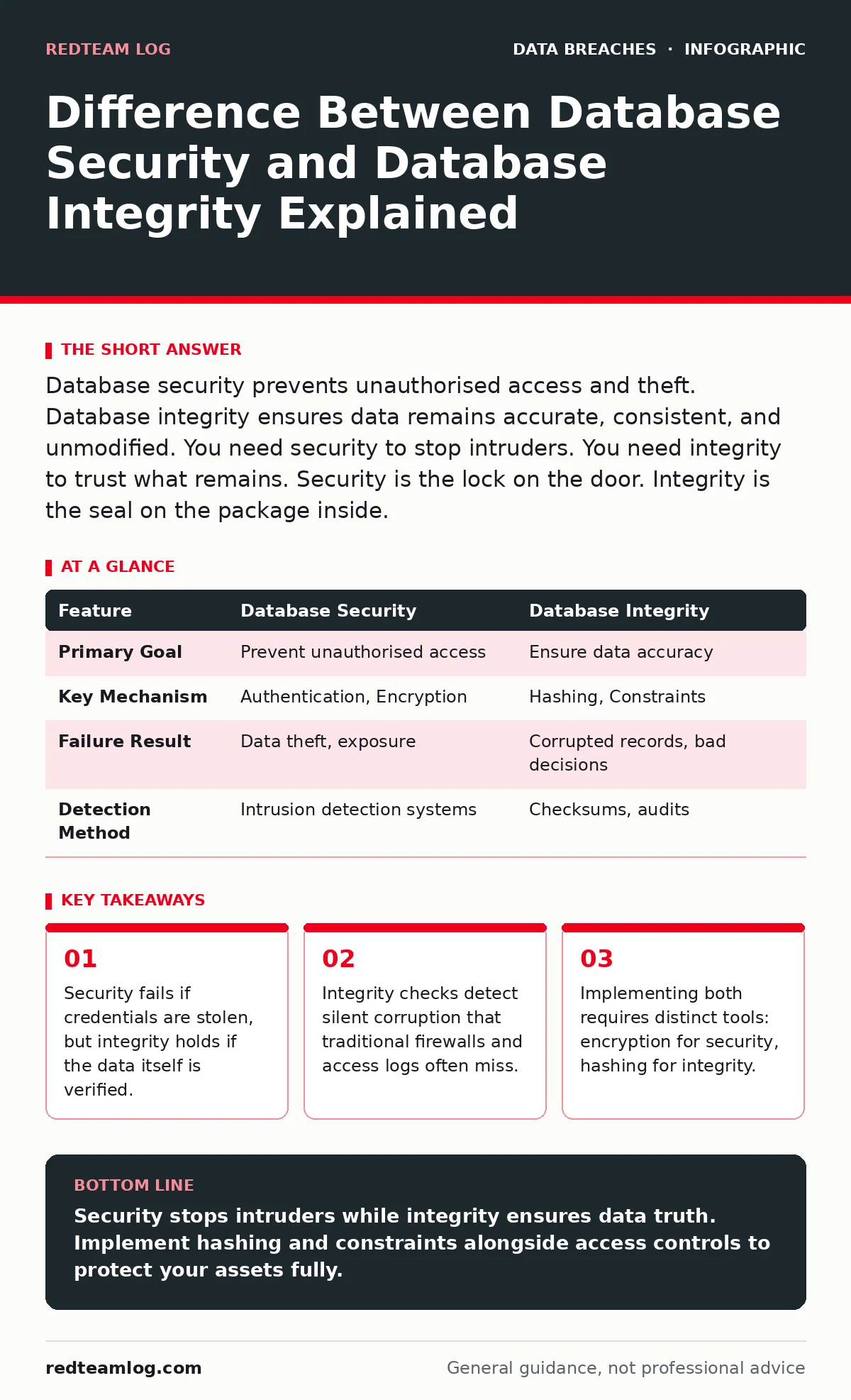
Database security prevents unauthorised access and theft. Database integrity ensures data remains accurate, consistent, and unmodified. You need security to stop intruders. You need integrity to trust what remains. Security is the lock on the door. Integrity is the seal on the package inside.
What is the difference between database security and database integrity?
Database security controls who can access the system and what they can do. Database integrity verifies that the data remains accurate, consistent, and unmodified from the moment it is written. Security is about permission. Integrity is about truth. A system can be secure from external hackers but still suffer from internal data corruption due to hardware failure or application bugs. You must address both to maintain trust.
Why does security not guarantee data accuracy?
Access controls stop unauthorised users from reading or writing records. They do not check if the data being written is valid or if existing data has been silently altered. Suppose a privileged administrator accidentally runs a command that zeroes out a column. Security logs show an authorised action. Integrity constraints would flag the invalid state. Security prevents entry. Integrity validates content.
How do integrity constraints prevent silent corruption?
Integrity constraints are rules defined at the schema level. They enforce logical consistency. Primary keys ensure each record is unique. Foreign keys maintain relationships between tables. Check constraints validate that data fits expected formats. If a transaction violates these rules, the database rejects it. This prevents partial updates that leave the system in an inconsistent state. It catches errors before they propagate.
| Feature | Database Security | Database Integrity |
|---|---|---|
| Primary Goal | Prevent unauthorised access | Ensure data accuracy |
| Key Mechanism | Authentication, Encryption | Hashing, Constraints |
| Failure Result | Data theft, exposure | Corrupted records, bad decisions |
| Detection Method | Intrusion detection systems | Checksums, audits |
What happens when integrity fails despite strong security?
Imagine a scenario where encryption protects data at rest. A power surge corrupts the storage medium. The encrypted blocks become unreadable. Security held firm. No one stole the data. But the data is lost. Integrity mechanisms like regular backups and checksums would have detected the corruption. Without them, you lose the asset entirely. Security protects the container. Integrity protects the contents.
How do you detect unauthorised changes to records?
You need change detection mechanisms separate from access controls. Hashing creates a unique fingerprint for data sets. When data changes, the hash changes. Comparing current hashes against known good values reveals tampering. This works even if the attacker had valid credentials. It exposes modifications that security logs might miss because the access was technically authorised. It adds a layer of truth verification.
See also: Warning Signs of Lost and Stolen Devices: Early Detection Strategies
Why is encryption not enough for integrity?
Encryption scrambles data to hide it from prying eyes. It does not prove the data has not been altered. An attacker with access might modify encrypted blocks. The decryption process might succeed, but the output is garbage or malicious. You need additional integrity checks, such as authenticated encryption or separate hash verification. Encryption hides the data. Integrity confirms its validity.
How does the principle of least privilege support integrity?
Limiting user permissions reduces the surface area for accidental or malicious changes. If a user can only read data, they cannot corrupt it. If a developer can only test in a sandbox, production data remains safe. This reduces the risk of integrity violations. It does not eliminate them, but it makes them harder to execute. Combine this with regular audits to catch any breaches of this principle.
What role do backups play in maintaining integrity?
Backups provide a recovery point if integrity is compromised. If data is corrupted, you restore from a known good state. Regular testing of backups ensures they are usable. Without tested backups, integrity failures lead to permanent data loss. Backups are the last line of defence. They do not prevent corruption, but they mitigate the impact. Treat backup integrity as seriously as primary data integrity.
How do you handle data subject rights without breaking integrity?
Users may request deletion or correction of their records. Deleting data must not break referential integrity. If you remove a user, linked transaction records might become orphaned. You must design your schema to handle these deletions gracefully. Use soft deletes or archive tables. This maintains historical accuracy while respecting rights. It ensures that removing one piece of data does not invalidate the whole dataset.
What are the hidden costs of ignoring integrity?
Ignoring integrity leads to bad decisions based on bad data. Financial reports might show incorrect balances. Customer records might have wrong contact details. Trust erodes when users notice inconsistencies. Fixing integrity issues later is far more expensive than preventing them. It requires forensic analysis to find the source of corruption. It damages reputation. Security breaches make headlines. Integrity failures kill business slowly.
How do you audit for both security and integrity?
Audits must check access logs for security violations. They must also verify data states for integrity. Look for gaps in logs. Check for unexpected hash mismatches. Review constraint violations. Ensure that monitoring covers both dimensions. A comprehensive audit reveals if security controls are being bypassed or if data is being corrupted silently. It provides a complete picture of system health.
Key takeaways
- Security fails if credentials are stolen, but integrity holds if the data itself is verified.
- Integrity checks detect silent corruption that traditional firewalls and access logs often miss.
- Implementing both requires distinct tools: encryption for security, hashing for integrity.
Security stops intruders while integrity ensures data truth. Implement hashing and constraints alongside access controls to protect your assets fully.
Frequently asked questions
Can a database be secure but have poor integrity?
Yes. Strong encryption and access controls can exist alongside corrupted data caused by hardware failures or application bugs.
Does encryption provide data integrity?
Standard encryption hides data but does not verify its accuracy. You need additional mechanisms like hashing to ensure integrity.
How often should I check data integrity?
Check integrity continuously where possible. Perform full verification regularly, especially after major updates or suspected incidents.
What is the first step to improve database integrity?
Enable built-in integrity constraints. Define primary keys, foreign keys, and check rules to enforce data consistency at the source.
How this guide was produced: written by the RedTeam Log editorial team with AI assistance, checked against the public references listed below, and reviewed when the facts change. See our editorial policy or report an error.