
Data subject rights are not optional courtesies. They are statutory obligations that require technical automation, not manual processes. Misinterpreting these rights leads to incomplete data deletion, unnecessary credential exposure, and failed audit trails. You must map your data flows to respond accurately within statutory timeframes.
Misreading: Rights Only Apply to Directly Identifiable Data
Correct reading: The scope extends to pseudonymised data, where identifiers have been replaced with artificial keys but re-identification remains possible with additional information. Many organisations believe that hashing an email address or replacing a name with a user ID removes the data from the scope of data subject rights. This is incorrect.
If you hold the key to reverse the pseudonymisation, or if the data can be linked back to an individual through other datasets you control, it remains personal data. You must treat pseudonymised records with the same rigour as directly identifiable records when processing requests. Failing to do so leaves a significant blind spot in your data mapping, increasing the risk of non-compliance during an audit or investigation.
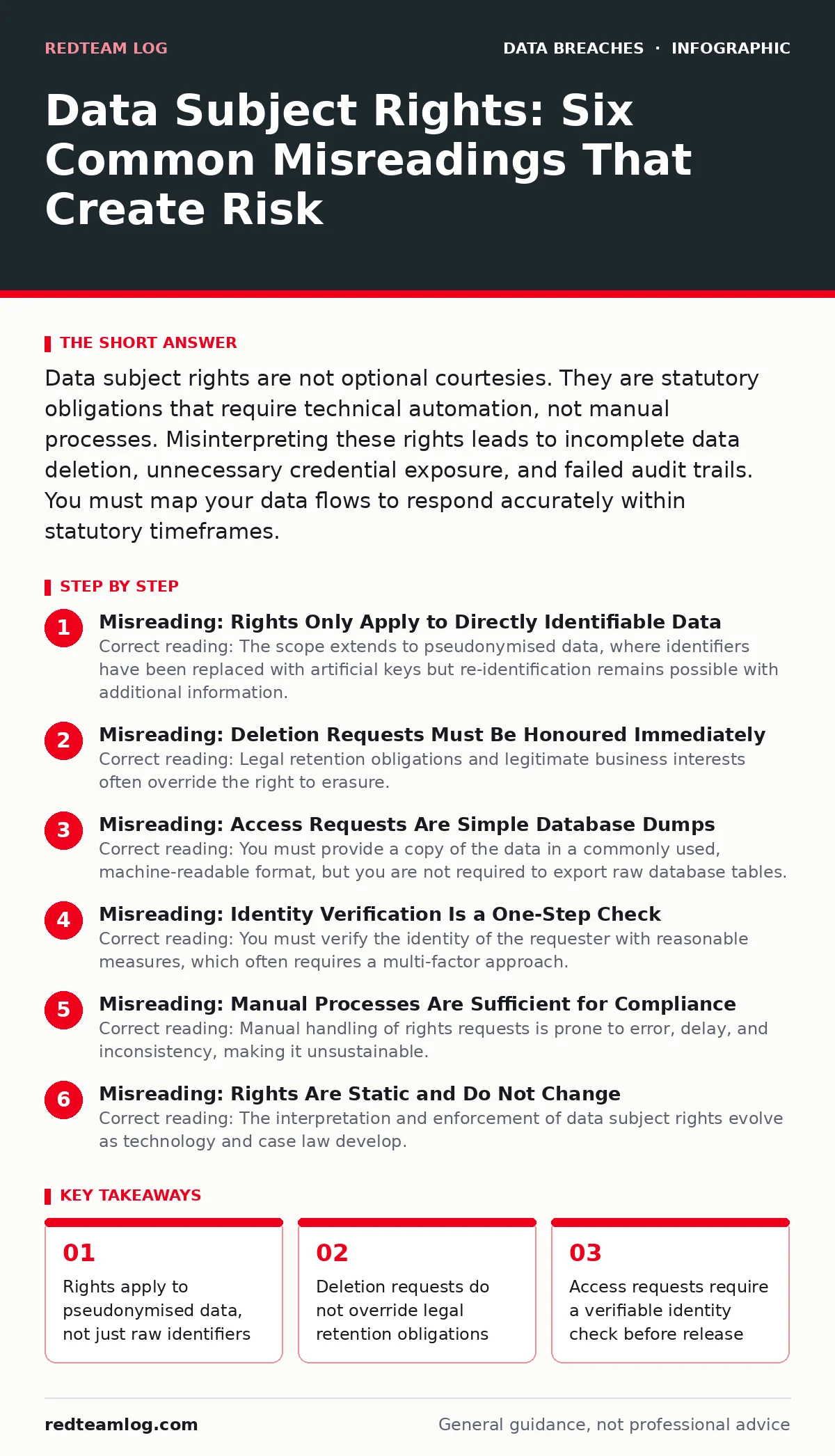
Misreading: Deletion Requests Must Be Honoured Immediately
Correct reading: Legal retention obligations and legitimate business interests often override the right to erasure. When a data subject asks for their data to be deleted, you are not required to wipe every byte immediately if you have a legal basis to keep it. For example, tax regulations may require you to retain financial records for several years. Contractual disputes may require you to keep communication logs.
In these cases, you must inform the data subject of the retention obligation and restrict the processing of their data instead of deleting it. This restriction means the data is stored separately and not used for any other purpose. Understanding this distinction prevents you from accidentally destroying evidence or violating financial regulations while still respecting the individual’s privacy concerns.
Misreading: Access Requests Are Simple Database Dumps
Correct reading: You must provide a copy of the data in a commonly used, machine-readable format, but you are not required to export raw database tables. A data subject has the right to access their personal data, but this does not mean you should send them a SQL dump or a log file containing internal system metadata.
You must filter out data that belongs to other individuals, such as comments on a forum post or emails where the subject is mentioned but is not the primary sender. You also need to ensure the format is usable. If the data is held in a proprietary system, you may need to transform it into a standard format like CSV or JSON. This transformation requires careful data mapping to ensure you do not inadvertently expose system architecture details or other users’ information during the process.
Misreading: Identity Verification Is a One-Step Check
Correct reading: You must verify the identity of the requester with reasonable measures, which often requires a multi-factor approach. Simply asking for a password or a date of birth is insufficient and insecure. If you grant access based on weak verification, you risk handing over personal data to an attacker who has stolen credentials.
This aligns with the principle of least privilege, where you only grant access to those who have proven their identity beyond doubt. You should use methods that are difficult to forge, such as a signed letter from a solicitor or a verified government ID cross-referenced with your records. The verification process itself must be secure, ensuring that the proof of identity is not stored long-term or exposed in your systems.
Misreading: Manual Processes Are Sufficient for Compliance
Correct reading: Manual handling of rights requests is prone to error, delay, and inconsistency, making it unsustainable. If you rely on staff to search through emails, tickets, and databases manually, you will likely miss data instances. This creates a high risk of non-compliance and increases the operational burden on your team. Automation is necessary to discover, classify, and act on data across your environment.
You need tools that can tag data at rest and in transit, allowing you to respond to requests within the statutory timeframe. Without automation, you cannot guarantee that every instance of an individual’s data is accounted for, leaving you vulnerable to complaints and fines. This also applies to managing personally identifiable information across different departments and systems.
See also: Difference Between Database Security and Database Integrity Explained · Warning Signs of Lost and Stolen Devices: Early Detection Strategies
Misreading: Rights Are Static and Do Not Change
Correct reading: The interpretation and enforcement of data subject rights evolve as technology and case law develop. What was considered acceptable five years ago may not be today. For instance, the rise of artificial intelligence and automated decision-making has introduced new rights regarding transparency and the right to contest automated decisions.
You must regularly review your processes to ensure they align with current expectations. This includes updating your incident communication plans to reflect how you handle rights requests during a crisis. Ignoring these changes can lead to outdated practices that fail to protect individuals or meet regulatory standards. Staying informed about these shifts is part of maintaining a secure and compliant data environment.
Key takeaways
- Rights apply to pseudonymised data, not just raw identifiers
- Deletion requests do not override legal retention obligations
- Access requests require a verifiable identity check before release
- Automation is required for timely and accurate response
Frequently asked questions
Can I charge a fee for handling data subject rights requests?
Generally, you must handle these requests free of charge. You can only charge a reasonable fee if the request is manifestly unfounded or excessive, such as repeated identical requests. You must inform the data subject if you intend to charge a fee and justify the cost.
What happens if I miss the deadline to respond to a request?
Failing to respond within the statutory timeframe is a compliance breach. Regulators can issue warnings, fines, or orders to rectify the situation. It also damages trust with your users. You should acknowledge receipt promptly and inform the requester if you need more time, providing a clear reason for the extension.
Do I need to delete data from backups when a deletion request is made?
You are not required to delete data from backups immediately if it is technically disproportionate or impossible. However, you must ensure that the backup data is not restored or used. Once the backup is overwritten in the normal course of operations, the data is effectively deleted. Document this process to demonstrate compliance.
How do I handle requests for data that involves third parties?
You can only disclose data that you hold. If the data involves third parties, you must redact their information before providing a copy. You do not need to contact the third parties for permission unless the request is specifically about them. Focus on your own data holdings and ensure you do not inadvertently expose others’ personal data. BOTTOM LINE: Data subject rights are legal obligations that require technical precision, not just goodwill. Map your data flows and automate your response pro
How this guide was produced: written by the RedTeam Log editorial team with AI assistance, checked against the public references listed below, and reviewed when the facts change. See our editorial policy or report an error.