
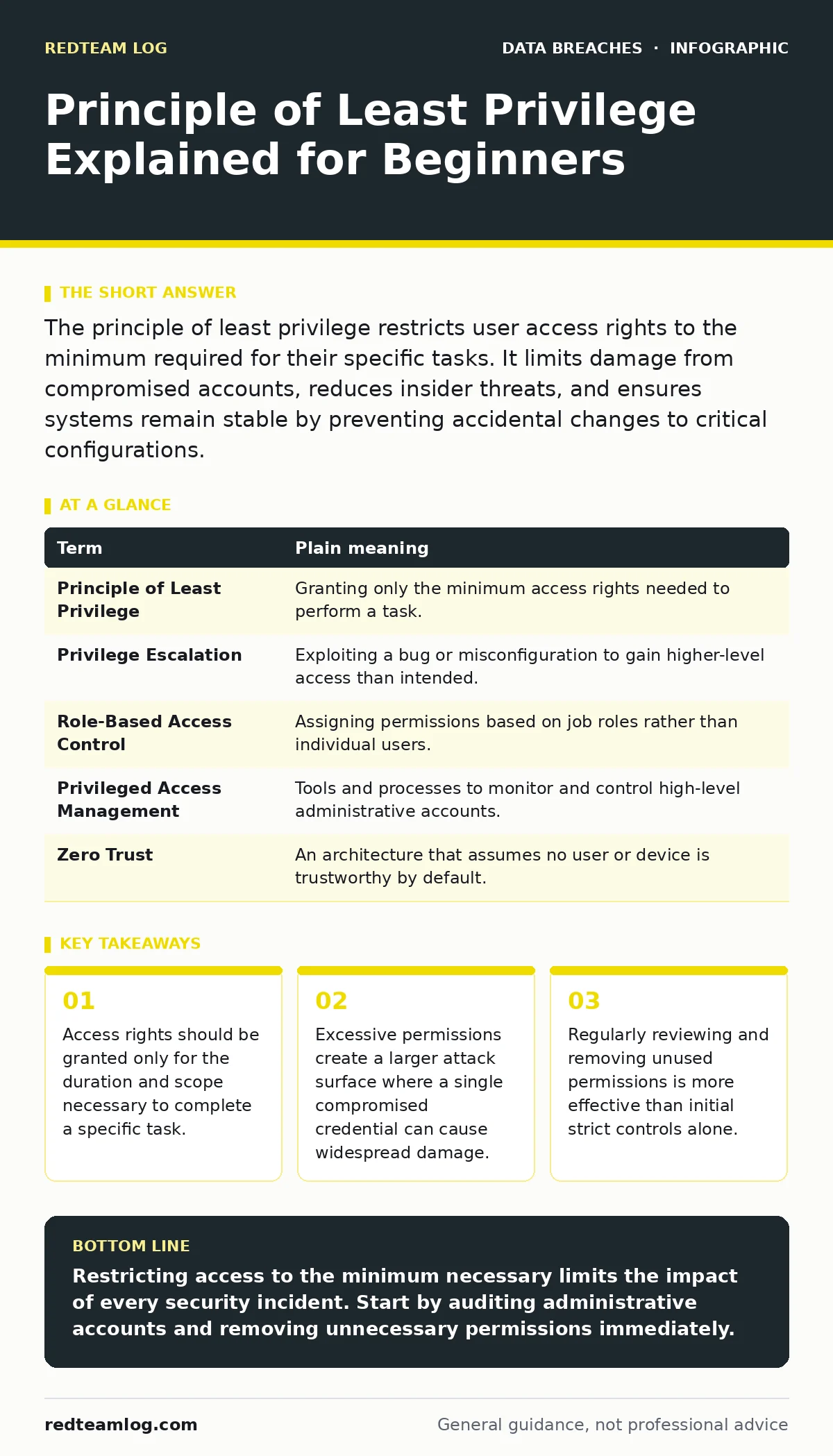
The principle of least privilege restricts user access rights to the minimum required for their specific tasks. It limits damage from compromised accounts, reduces insider threats, and ensures systems remain stable by preventing accidental changes to critical configurations.
The Library Card Analogy
Imagine a large public library. You hold a library card that allows you to borrow books and use the public computers. You do not have a key to the server room where the catalog database lives. You cannot re-shelve books in the restricted archives, nor can you delete records from the circulation system. This is the principle of least privilege in action. You have access only to what you need to function as a patron.
If you were given a master key to every door in the building, the risk changes dramatically. If someone steals your key, they can enter the server room and destroy the catalog. If you accidentally bump into a shelf in the archives, you might knock over rare manuscripts. Restricting your access protects the library from both malicious actors and your own mistakes.
Defining the Core Mechanism
In cybersecurity, this principle means granting users and systems only the permissions they strictly need to perform their job functions. Nothing more, nothing less. If a user needs to read a file, they should not have write access. If a service account needs to run a script, it should not have administrative rights over the entire server.
This is distinct from general security hygiene. It is a structural constraint on how identity and access management works. It forces a design choice where trust is never implicit. Every permission must be justified by a specific operational requirement.
| Term | Plain meaning |
|---|---|
| Principle of Least Privilege | Granting only the minimum access rights needed to perform a task. |
| Privilege Escalation | Exploiting a bug or misconfiguration to gain higher-level access than intended. |
| Role-Based Access Control | Assigning permissions based on job roles rather than individual users. |
| Privileged Access Management | Tools and processes to monitor and control high-level administrative accounts. |
| Zero Trust | An architecture that assumes no user or device is trustworthy by default. |
The Hidden Cost of Convenience
Many organisations struggle with this principle because it feels inefficient. It is easier to grant a user full administrative rights so they do not have to request access every time they need to install software. This convenience creates a hidden cost: increased complexity during an incident.
When every user has high-level access, investigating a breach becomes difficult. You cannot easily tell who did what because everyone has the same power. Imagine a scenario where a credential exposure occurs. If the stolen account had limited rights, the attacker is contained to a small area. If the account had full admin rights, the attacker can move laterally across the entire network.
Common Points of Confusion
A frequent misunderstanding is that least privilege means making work difficult for employees. In reality, it means making work safer. It does not mean denying access; it means granting the right access. Another confusion is the belief that internal threats are the primary concern. While insider risk is real, the biggest threat is often external attackers who steal credentials.
Suppose an attacker compromises a standard user account via phishing. If that account has least privilege, the attacker cannot install malware that affects other users. They cannot change security settings. They are stuck in a small room. If that account has excessive rights, the attacker can escalate their privileges and take control of the environment.
The Problem with Permanent Access
Permissions are often granted once and never revoked. Employees change roles, projects end, and contractors leave. If access rights remain static, they become stale. This is known as privilege creep. Over time, a user accumulates permissions from previous roles that they no longer need.
This accumulation increases the risk surface. A user who once needed database access for a project that ended six months ago still holds that key. If their account is compromised, the attacker gains access to the database even though the user’s current job does not require it. Regular review processes are necessary to prune these unused rights.
See also: OAuth Misconfigurations: Definition, Risks and Practical Fixes
Try This Now
- Audit one critical system to identify all users with administrative or write access. Compare this list against current job roles to find mismatches.
- Implement a process where new hires receive only the minimum permissions required for their first week, with additional access granted on a need-to-know basis.
- Review service accounts and application permissions to ensure they do not run with elevated privileges unless absolutely necessary for their function.
Integrating with Broader Security
Least privilege works best when combined with other controls. For example, data encryption protects information at rest, but least privilege ensures that only authorised users can decrypt it. Without least privilege, encryption keys might be accessible to too many people, rendering the encryption useless.
Similarly, understanding personally identifiable information helps you determine which data requires the strictest access controls. Not all data is equal. Access to customer names should be more restricted than access to public marketing materials. This tiered approach allows you to apply least privilege where it matters most.
The Path Forward
Adopting this principle is a continuous process, not a one-time fix. It requires cultural change and technical discipline. Start by identifying your most critical assets and ensuring that access to them is tightly controlled. Then expand this practice to other systems.
Consider how incident communication plans benefit from this approach. When a breach occurs, knowing exactly who had access to what allows for faster containment and clearer communication. It reduces the uncertainty that fuels panic. By limiting privileges, you limit the potential damage, making recovery faster and less costly.
Key takeaways
- Access rights should be granted only for the duration and scope necessary to complete a specific task.
- Excessive permissions create a larger attack surface where a single compromised credential can cause widespread damage.
- Regularly reviewing and removing unused permissions is more effective than initial strict controls alone.
Restricting access to the minimum necessary limits the impact of every security incident. Start by auditing administrative accounts and removing unnecessary permissions immediately.
Frequently asked questions
Does least privilege slow down employee productivity?
It may cause minor friction initially, but it prevents major disruptions caused by security incidents and accidental system changes.
How do I handle users who need temporary high-level access?
Use time-bound access grants that automatically expire after the task is completed, rather than permanent elevation.
Is least privilege enough to prevent all breaches?
No, it reduces the impact of breaches but must be combined with other controls like monitoring and encryption for full protection.
How often should I review user permissions?
Reviews should occur at least quarterly, or immediately when an employee changes roles or leaves the organisation.
How this guide was produced: written by the RedTeam Log editorial team with AI assistance, checked against the public references listed below, and reviewed when the facts change. See our editorial policy or report an error.