
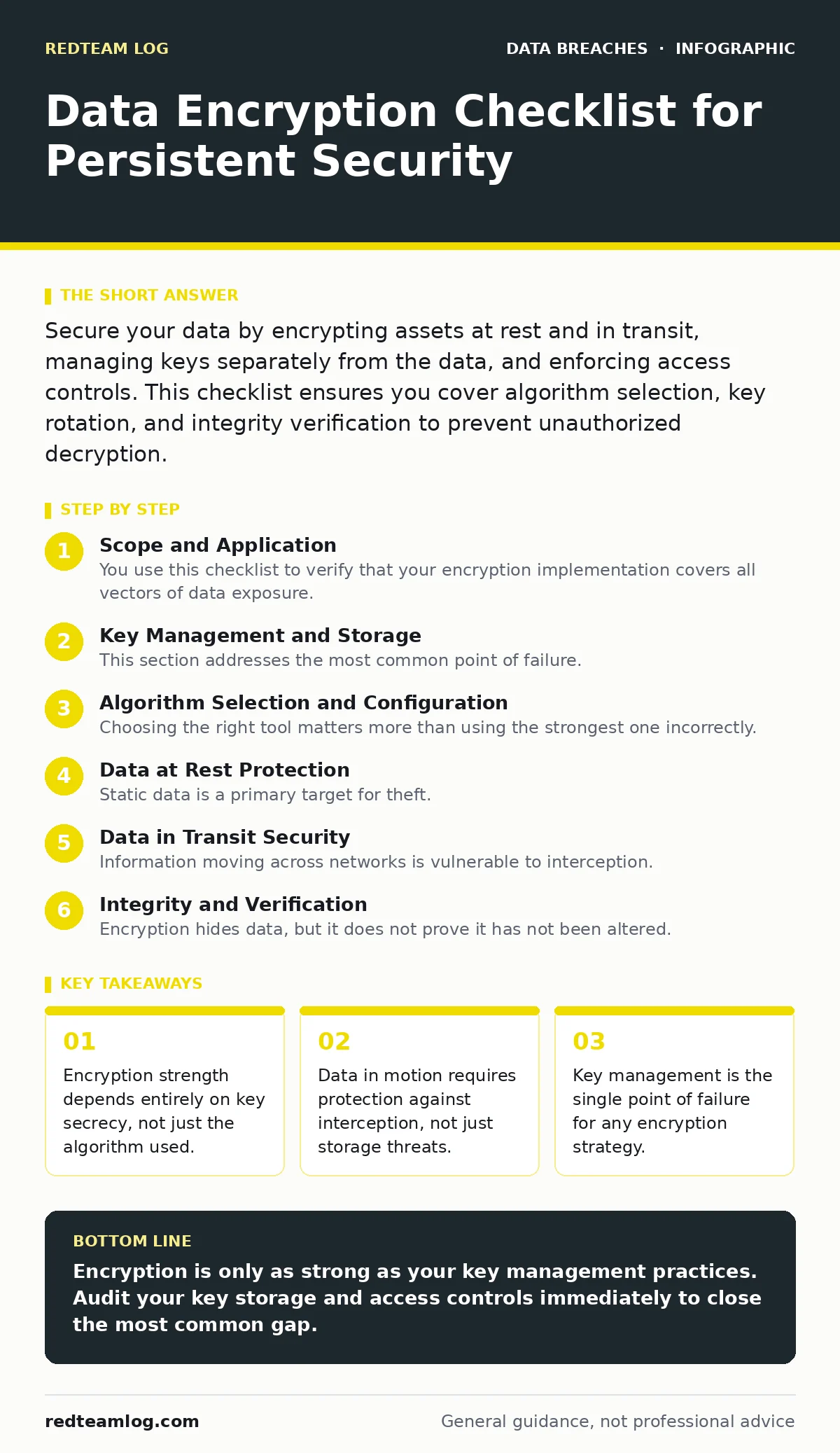
Secure your data by encrypting assets at rest and in transit, managing keys separately from the data, and enforcing access controls. This checklist ensures you cover algorithm selection, key rotation, and integrity verification to prevent unauthorized decryption.
Scope and Application
You use this checklist to verify that your encryption implementation covers all vectors of data exposure. It applies to any environment where sensitive information is stored, processed or transmitted. You should run through these items before deploying new systems or during annual security reviews.
Key Management and Storage
This section addresses the most common point of failure. If an attacker obtains the key, the encryption provides no security. You must separate the key from the data it protects.
- Store keys in a dedicated hardware security module: Physical isolation prevents remote extraction of cryptographic material.
- Implement a key hierarchy with root keys: Compromise of a working key does not expose the master secret.
- Automate key rotation schedules: Regular changes limit the window of exposure if a key is leaked.
- Secure key backups in a separate location: You retain recovery options without exposing keys to the primary storage environment.
Algorithm Selection and Configuration
Choosing the right tool matters more than using the strongest one incorrectly. Weak implementations of strong algorithms fail under scrutiny. You must verify that your settings match current standards.
- Use authenticated encryption modes like GCM: This prevents tampering with ciphertext without detection.
- Disable legacy protocols such as TLS 1.0: Older versions contain known vulnerabilities that allow decryption.
- Ensure sufficient key length for symmetric ciphers: Short keys are vulnerable to brute-force attacks over time.
- Verify random number generator quality: Predictable seeds allow attackers to reconstruct session keys.
Data at Rest Protection
Static data is a primary target for theft. Encryption here ensures that stolen drives or backups remain unreadable. You must encrypt both the file system and individual sensitive fields.
- Encrypt full disks on endpoint devices: Protection persists even if the device is lost or stolen.
- Encrypt database columns containing personally identifiable information: Field-level encryption limits exposure during bulk database theft.
- Verify encryption is enabled on cloud storage buckets: Default settings often leave data unencrypted by mistake.
- Use transparent encryption for application data: Developers do not need to manage keys manually, reducing error risk.
Data in Transit Security
Information moving across networks is vulnerable to interception. You must ensure that every connection is secured from end to end. Trust boundaries define where encryption starts and ends.
- Enforce HTTPS for all web traffic: This prevents eavesdropping on credentials and session tokens.
- Use mutual TLS for service-to-service communication: Both parties verify identity, preventing man-in-the-middle attacks.
- Encrypt internal network traffic between segments: Insider threats can monitor traffic if it remains in plaintext.
- Validate certificates at the client side: Prevents attackers from using spoofed certificates to intercept data.
See also: Data Masking Misconceptions That Leave Sensitive Records Exposed · Warning Signs of Lost and Stolen Devices: Early Detection Strategies
Integrity and Verification
Encryption hides data, but it does not prove it has not been altered. You need mechanisms to detect any changes to the ciphertext. Without integrity checks, you cannot trust the data you decrypt.
- Use message authentication codes for small payloads: This verifies both origin and integrity without full encryption overhead.
- Implement digital signatures for critical logs: Ensures that audit trails have not been modified by attackers.
- Test decryption failure handling: Systems must not leak information through error messages when keys fail.
- Monitor for downgrade attacks: Alerts trigger if a client attempts to use a weaker protocol version.
Operational Hygiene and Access
The human element often undermines technical controls. You must ensure that only authorised processes can access the keys. Overly broad permissions negate the value of encryption.
- Apply the principle of least privilege to key access: Only services that need to decrypt data receive the key.
- Audit key usage logs regularly: Unusual access patterns may indicate credential exposure or insider threat.
- Define clear key destruction procedures: Deleted data must have its keys wiped to prevent recovery.
- Train staff on phishing risks related to keys: Social engineering often targets the people who manage cryptographic material.
Incident Response Integration
When a breach occurs, your ability to respond depends on how well you understand your encryption state. You must know what is encrypted and where the keys are stored. This knowledge speeds up containment efforts.
- Maintain an inventory of encrypted assets: Quick identification of affected systems limits the blast radius.
- Pre-define key revocation procedures: Immediate invalidation of compromised keys stops further decryption.
- Align encryption status with incident communication plans: Accurate reporting requires knowing what data was actually at risk.
- Test decryption recovery from backups: Ensures business continuity even if primary keys are lost or corrupted.
Key takeaways
- Encryption strength depends entirely on key secrecy, not just the algorithm used.
- Data in motion requires protection against interception, not just storage threats.
- Key management is the single point of failure for any encryption strategy.
Encryption is only as strong as your key management practices. Audit your key storage and access controls immediately to close the most common gap.
Frequently asked questions
Does encryption protect against ransomware?
No, encryption does not prevent ransomware from encrypting your data again. It only ensures that if files are exfiltrated, the attacker cannot read them without the original keys.
How often should I rotate encryption keys?
Rotate keys based on sensitivity and risk. High-value data requires more frequent rotation, while low-risk data can follow annual cycles.
Is cloud storage encryption sufficient?
Cloud providers often encrypt data by default, but they manage the keys. For maximum control, bring your own keys to ensure the provider cannot access your data.
What is the difference between symmetric and asymmetric encryption?
Symmetric encryption uses one key for both locking and unlocking, making it fast. Asymmetric uses a pair of keys, one public and one private, which is slower but better for secure key exchange.
How this guide was produced: written by the RedTeam Log editorial team with AI assistance, checked against the public references listed below, and reviewed when the facts change. See our editorial policy or report an error.