
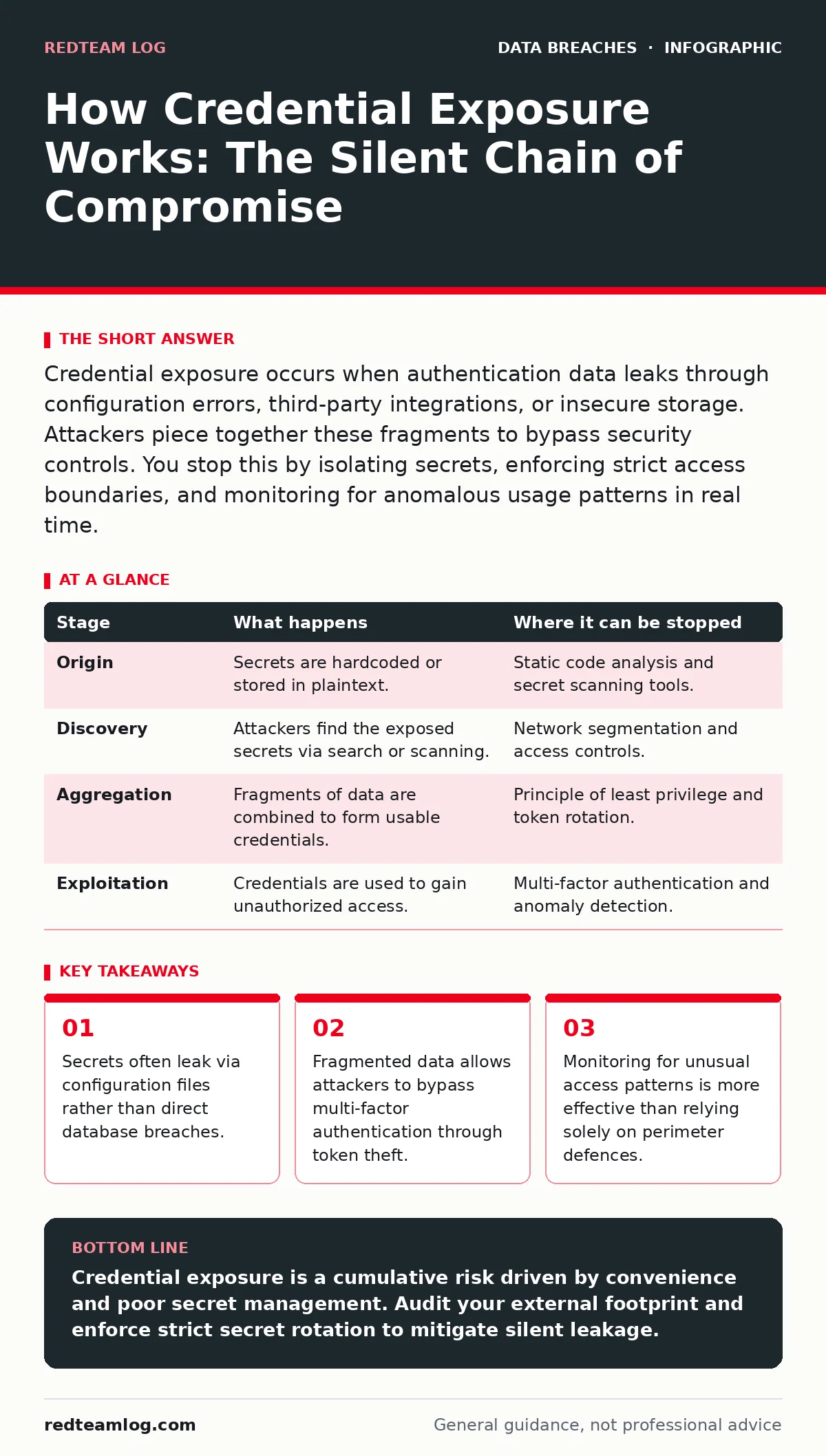
Credential exposure occurs when authentication data leaks through configuration errors, third-party integrations, or insecure storage. Attackers piece together these fragments to bypass security controls. You stop this by isolating secrets, enforcing strict access boundaries, and monitoring for anomalous usage patterns in real time.
The Anatomy of Silent Leakage
Credential exposure is not always a dramatic break-in. More often, it is a slow bleed of information from systems that were never designed to hold secrets securely. You might assume your passwords are safe behind a firewall, but the reality is far more distributed. Secrets reside in application configurations, environment variables, and third-party integrations. When these components are misconfigured or poorly monitored, they become open doors for attackers.
The danger lies in the assumption that centralised identity management solves the problem. It does not. Even with robust identity governance, individual services often cache credentials or store them in plaintext for convenience. This creates a vast attack surface where a single misconfigured service can expose the keys to the kingdom.
Stage 1: The Origin of Exposure
The first stage involves the initial placement of sensitive data in an insecure location. Developers frequently hardcode API keys or database passwords directly into source code. These keys are then committed to version control systems, where they remain visible to anyone with repository access. Even if the repository is private, contractors, former employees, or compromised accounts can access it.
Another common origin is the use of insecure storage mechanisms. Applications may write temporary credentials to local disk files without proper encryption. These files are often accessible to the operating system user, which may have broader privileges than necessary. This stage is critical because it establishes the foothold. Once the data is in the wrong place, it is only a matter of time before it is discovered.
| Stage | What happens | Where it can be stopped |
|---|---|---|
| Origin | Secrets are hardcoded or stored in plaintext. | Static code analysis and secret scanning tools. |
| Discovery | Attackers find the exposed secrets via search or scanning. | Network segmentation and access controls. |
| Aggregation | Fragments of data are combined to form usable credentials. | Principle of least privilege and token rotation. |
| Exploitation | Credentials are used to gain unauthorized access. | Multi-factor authentication and anomaly detection. |
Stage 2: Discovery and Reconnaissance
Attackers do not typically brute-force their way in. Instead, they look for what you have left behind. They use automated tools to scan public code repositories, cloud storage buckets, and configuration files for known patterns of secrets. These patterns include base64-encoded strings, specific prefixes for API keys, and common database connection strings.
This stage relies on the attacker’s ability to find needles in haystacks. They exploit the fact that many organisations fail to audit their external digital footprint. A single forgotten development environment or a misconfigured cloud bucket can reveal thousands of credentials. The attacker does not need to break into your network; they simply need to find what you have accidentally published.
Stage 3: Aggregation and Context
Finding a single password is rarely enough. Modern security architectures use multiple layers of defence. An attacker must often combine several pieces of information to gain meaningful access. They might find a database password in one place and the corresponding server IP address in another. By aggregating these fragments, they construct a complete set of credentials.
This aggregation process is where the principle of least privilege often fails. If a compromised account has broad access, the attacker can move laterally to gather more data. They might access internal documentation, chat logs, or ticketing systems to find additional context. This contextual information helps them understand the structure of your environment and identify high-value targets.
Stage 4: Exploitation and Persistence
With usable credentials in hand, the attacker begins exploitation. They log into systems, often using stolen session tokens rather than raw passwords. This allows them to bypass multi-factor authentication, as the token represents an already-authenticated session. Once inside, they establish persistence by creating new accounts or installing backdoors.
The goal is not just immediate access but long-term control. They move slowly to avoid detection, accessing small amounts of data at a time. This behaviour can mimic legitimate user activity, making it difficult for standard monitoring tools to flag. The attacker may also escalate privileges, using the initial access to gain higher-level permissions within the system.
See also: User Account Provisioning: Stop Access Drift Before It Costs You · Data Sovereignty Explained: Where Your Data Legally Lives
Reading the Signals
Detecting credential exposure requires looking beyond traditional intrusion detection. You must monitor for anomalous access patterns. This includes logins from unusual locations, access during off-hours, or requests for sensitive data that do not match the user’s role. These signals often indicate that an attacker is testing the waters.
You should also audit your external digital footprint regularly. Check for leaked credentials on paste sites, code repositories, and dark web forums. This proactive approach helps you identify exposure before it is exploited. Remember, the absence of alerts does not mean the absence of risk. Silent leakage is the norm, not the exception.
Applying Defences in Depth
Defending against credential exposure requires a multi-layered approach. Start by eliminating hardcoded secrets. Use dedicated secret management solutions that encrypt and rotate credentials automatically. This reduces the risk of static secrets being exposed in source code or configuration files.
Next, enforce strict access controls. Limit who can view and use secrets, and ensure that access is logged and monitored. Regularly review these logs for anomalies. Additionally, implement short-lived credentials where possible. This limits the window of opportunity for an attacker who manages to steal a credential.
The Hidden Cost of Convenience
The biggest driver of credential exposure is convenience. Developers and administrators often choose insecure methods because they are faster and easier. Hardcoding a password takes seconds; setting up a secret manager takes minutes. Over time, these small decisions accumulate into significant risk.
You must address this cultural issue. Security cannot be an afterthought. It must be integrated into the development lifecycle from the start. Train your teams to recognise the risks of insecure secret handling. Provide them with the tools and processes to manage secrets securely without sacrificing productivity.
Beyond Technical Fixes
Technical controls are necessary but not sufficient. You need a holistic approach that includes people and processes. Regularly update your incident communication plans to include scenarios involving credential exposure. Ensure that your team knows how to respond quickly and effectively when a leak is discovered.
Furthermore, consider the implications for personally identifiable information. If credentials are exposed, there is a risk that associated personal data could be accessed. Understand your obligations regarding data subject rights and be prepared to notify affected individuals if necessary. This is not just a technical issue; it is a legal and reputational one.
Key takeaways
- Secrets often leak via configuration files rather than direct database breaches.
- Fragmented data allows attackers to bypass multi-factor authentication through token theft.
- Monitoring for unusual access patterns is more effective than relying solely on perimeter defences.
Credential exposure is a cumulative risk driven by convenience and poor secret management. Audit your external footprint and enforce strict secret rotation to mitigate silent leakage.
Frequently asked questions
How do I know if my credentials have been exposed?
Monitor dark web forums, paste sites, and code repositories for leaks. Use automated scanning tools to detect exposed secrets in your digital footprint.
Can multi-factor authentication prevent credential exposure?
MFA protects against password guessing but does not prevent exposure. If a session token or API key is leaked, MFA may be bypassed entirely.
What is the difference between credential stuffing and exposure?
Stuffing uses leaked credentials from other breaches to attack your systems. Exposure involves your own credentials leaking from your infrastructure.
How often should I rotate secrets?
Rotate secrets regularly, ideally automatically. Short-lived credentials reduce the impact of any single exposure event.
How this guide was produced: written by the RedTeam Log editorial team with AI assistance, checked against the public references listed below, and reviewed when the facts change. See our editorial policy or report an error.