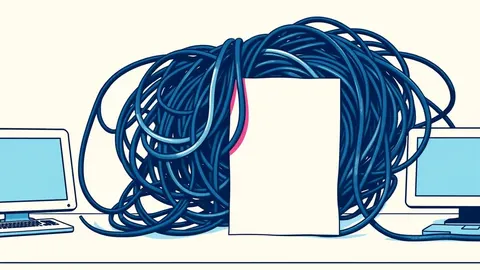
Personally identifiable information is any data that can identify a specific individual. This includes obvious items like names and addresses, but also subtle fragments like IP addresses or device IDs. Protecting this data requires treating every piece as potentially sensitive, not just the obvious identifiers.
The Library Analogy
Imagine a public library. A single book on a shelf is just an object. It has a title, a barcode, and a location. If you find one book on the street, you know nothing about the person who last checked it out. It is anonymous. However, if you collect ten books from that street, all with the same library card number stamped inside, you can identify the owner. You can see their interests, their location, and their habits.
In cybersecurity, personally identifiable information works the same way. A single data point, like a zip code, is often considered anonymous. But when you combine that zip code with a birth date and a gender, you have identified a significant portion of the population. Add a partial credit card number, and you have identified a single individual. The danger lies in the combination, not necessarily in the individual piece of data.
Defining the Scope
Most people think of personally identifiable information as just a name and an address. This is a narrow view that leaves systems vulnerable. The term covers any information that can be used to distinguish or trace an individual's identity. This includes direct identifiers, such as full names and social security numbers. It also includes indirect identifiers, such as employment history, educational background, or even browsing patterns.
The classification depends on the context. In a healthcare setting, a patient's room number is personally identifiable information because it links to a specific person. In a retail setting, a transaction ID might seem anonymous, but if it links to a loyalty card, it becomes personally identifiable. You must evaluate data based on how it can be used, not just what it looks like.
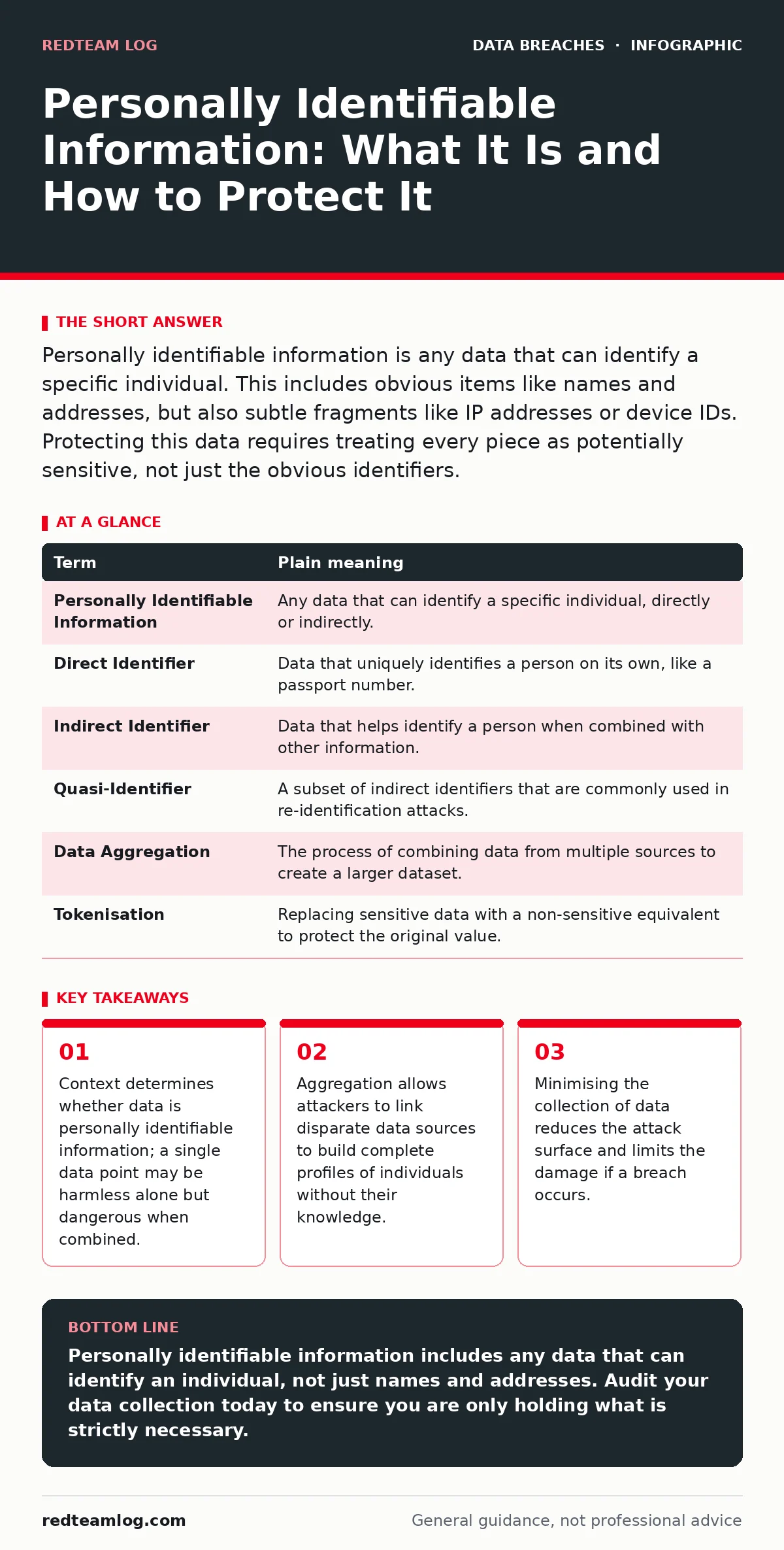
| Term | Plain meaning |
|---|---|
| Personally Identifiable Information | Any data that can identify a specific individual, directly or indirectly. |
| Direct Identifier | Data that uniquely identifies a person on its own, like a passport number. |
| Indirect Identifier | Data that helps identify a person when combined with other information. |
| Quasi-Identifier | A subset of indirect identifiers that are commonly used in re-identification attacks. |
| Data Aggregation | The process of combining data from multiple sources to create a larger dataset. |
| Tokenisation | Replacing sensitive data with a non-sensitive equivalent to protect the original value. |
The Hidden Cost of Anonymity
A common mistake is assuming that removing names makes data safe. This is false. Attackers use data aggregation to re-identify individuals. They take a dataset that has had names removed and cross-reference it with public records, social media profiles, or leaked databases. If the remaining data points are unique enough, they can match the anonymous record back to a real person.
This is why data encryption is a fundamental control. It ensures that even if data is stolen, it cannot be read without the key. However, encryption alone is not enough. You must also limit the amount of data you collect. If you do not collect a birth date, an attacker cannot use it to re-identify a user. This principle, known as data minimisation, reduces the risk of credential exposure by removing the fuel for identity theft.
Points of Confusion
One major point of confusion is the difference between personally identifiable information and sensitive personal data. All sensitive personal data is personally identifiable, but not all personally identifiable information is sensitive. A name is personally identifiable, but it is not inherently sensitive. Health records or political opinions are both personally identifiable and sensitive, requiring stricter protection.
Another confusion arises with device identifiers. An IP address is often considered anonymous in casual conversation. In reality, it can be traced to a specific internet service provider account, and often to a specific household. When combined with timestamps and browsing history, it becomes a powerful tracking tool. Understanding this helps you see why unauthorized access to network logs is a serious breach of privacy, not just a technical glitch.
Practical Steps for Protection
You can start protecting personally identifiable information immediately by changing how you view data. Do not treat it as a resource to hoard. Treat it as a liability. Every piece of data you store is a potential entry point for an attacker. The more you have, the more you have to lose.
- Audit your data collection. List every piece of information you gather from users or employees. Ask yourself if you truly need it. If the answer is no, delete it. This reduces the impact of any future data leaks.
- Implement strict access controls. Only allow staff to access the personally identifiable information they need to do their jobs. This limits the damage if an account is compromised during an employee data breaches scenario.
- Encrypt data at rest and in transit. This ensures that even if data is stolen, it remains unreadable. This is a critical layer of defence against incident communication plans failures, as it buys you time to respond.
See also: Principle of Least Privilege Explained for Beginners · Warning Signs of Lost and Stolen Devices: Early Detection Strategies
The Role of User Rights
Individuals have the right to know what data you hold about them. This is not just a legal requirement; it is a trust builder. When users can easily request access to their data, or request that it be deleted, they feel more in control. This transparency can reduce the severity of data subject rights disputes.
Ignoring these requests creates legal and reputational risk. It also signals to attackers that your security posture is weak. If you cannot manage your own data efficiently, you cannot protect it from external threats. Building systems that respect user rights from the start, known as privacy by design, makes security easier to implement later.
Looking Ahead
Protecting personally identifiable information is an ongoing process. Threats evolve, and so do the methods attackers use to re-identify individuals. You must stay informed about new techniques and adjust your defences accordingly. Frameworks like SOC 2 provide a structure for evaluating your security controls, but they are not a substitute for good judgment.
The goal is not to eliminate risk, but to manage it. By understanding the true scope of personally identifiable information, you can build better defences. You can protect your users and your organisation from the hidden dangers of data aggregation.
Key takeaways
- Context determines whether data is personally identifiable information; a single data point may be harmless alone but dangerous when combined.
- Aggregation allows attackers to link disparate data sources to build complete profiles of individuals without their knowledge.
- Minimising the collection of data reduces the attack surface and limits the damage if a breach occurs.
Personally identifiable information includes any data that can identify an individual, not just names and addresses. Audit your data collection today to ensure you are only holding what is strictly necessary.
Frequently asked questions
Is an email address considered personally identifiable information?
Yes, an email address is a direct identifier. It is unique to an individual and can be used to contact or identify them.
How can I tell if my data is anonymous?
You cannot be certain. Anonymity is difficult to prove. If there is any chance the data can be linked back to an individual, treat it as personally identifiable.
What is the difference between encryption and tokenisation?
Encryption scrambles data using a mathematical key. Tokenisation replaces data with a random value that has no mathematical relationship to the original.
Does deleting data make it safe?
Only if it is securely deleted. Simple deletion often leaves data recoverable. Use secure erasure methods that overwrite the data multiple times.
How this guide was produced: written by the RedTeam Log editorial team with AI assistance, checked against the public references listed below, and reviewed when the facts change. See our editorial policy or report an error.