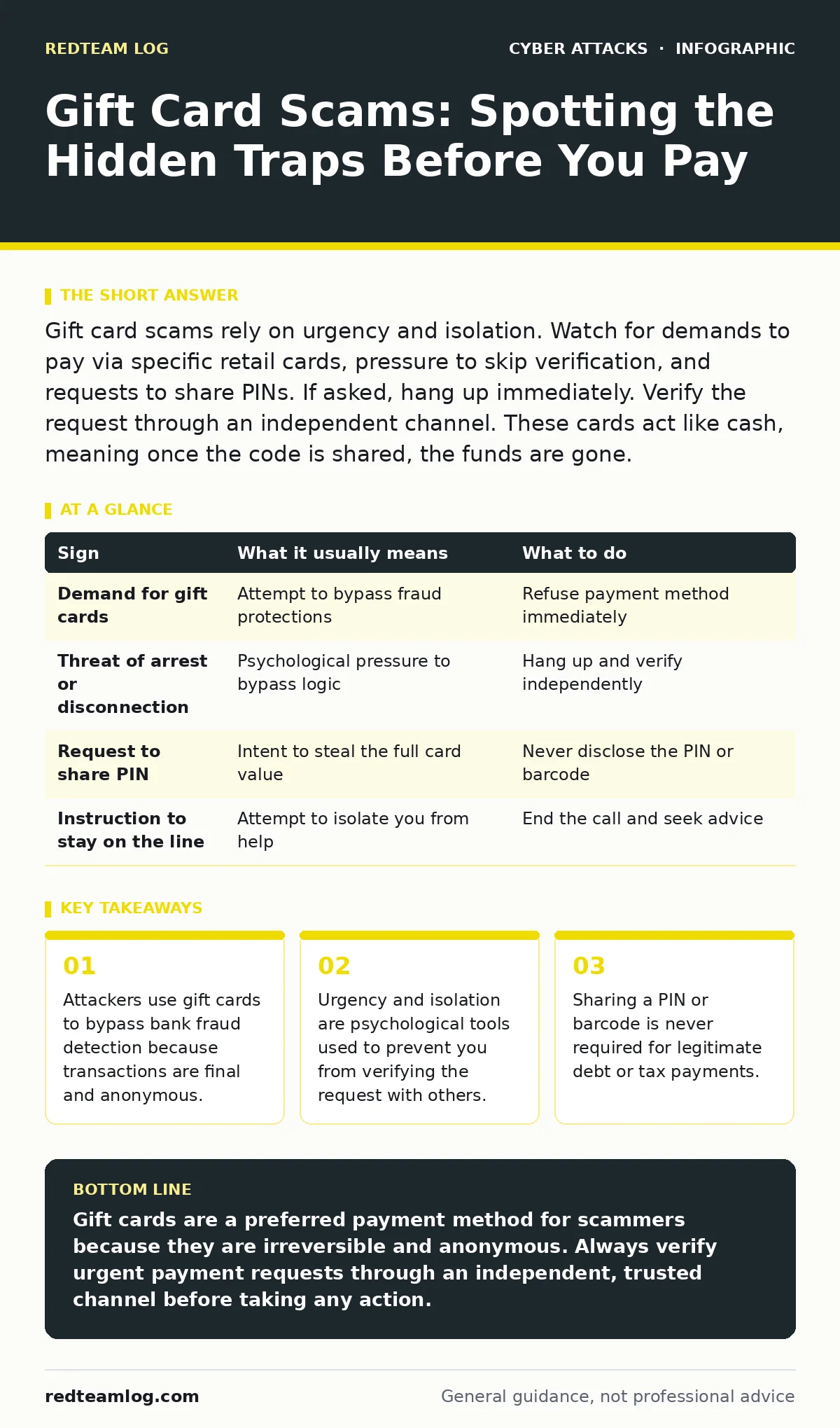
Gift card scams rely on urgency and isolation. Watch for demands to pay via specific retail cards, pressure to skip verification, and requests to share PINs. If asked, hang up immediately. Verify the request through an independent channel. These cards act like cash, meaning once the code is shared, the funds are gone.
The Psychology of Immediate Payment
Gift card scams succeed because they bypass the friction of traditional banking. When you pay with a credit card or bank transfer, there are checks, balances, and often a window to dispute a charge. Prepaid gift cards function differently. They are designed to be spent quickly and anonymously. Once the value is loaded or the code is revealed, the transaction is effectively final. There is no "undo" button.
Attackers understand this mechanism. They do not want a payment method that allows for reversals. They want a digital equivalent of unmarked cash. This is why they insist on specific types of cards, often from major retailers or tech stores. The brand recognition provides a veneer of legitimacy, while the underlying technology ensures the money disappears instantly.
The First Red Flags: Urgency and Isolation
The most common signs are loud and aggressive. You receive a call or message claiming you owe money to a government agency, a utility provider, or a family member in distress. The caller will demand immediate payment to avoid arrest, service disconnection, or a worsening emergency. This pressure is deliberate. It is designed to trigger a stress response that shuts down critical thinking.
You will be told not to hang up. You will be instructed not to tell anyone else. This isolation is a key tactic. If you speak to a colleague, a family member, or a bank representative, they might point out the absurdity of the request. By keeping you alone, the attacker removes your safety net. If anyone asks you to pay immediately via gift card and tells you to keep it secret, it is a scam.
The Silent Indicators: Technical and Linguistic Clues
Some signs are subtler and require a closer look at the communication itself. The caller may claim to be from a specific department, such as IT support or tax enforcement, but their knowledge of your account will be vague. They may ask for basic information that they should already have, such as your account number or date of birth. Legitimate organisations do not ask for sensitive data over an unsolicited call.
Another hidden sign is the specific type of card requested. Attackers often ask for cards that are easy to resell or convert into cryptocurrency. They may also ask you to read the balance multiple times to ensure the card is fully loaded. If the caller asks you to wait on the line while they "verify" the card code, they are likely listening for the PIN or the magnetic stripe data. This data can be used to clone the card or spend the balance remotely before you even leave the store.
Action Plan: What to Do When Suspicion Arises
When you encounter these signs, your response must be immediate and decisive. Do not engage in debate with the caller. Do not try to outsmart them by providing fake codes. This wastes time and may escalate their tactics. Instead, end the conversation politely but firmly. Say you will handle it later and hang up.
Once the call is ended, verify the claim through an independent channel. If the caller claimed to be from your bank, call the number on the back of your card. If they claimed to be from a tax agency, visit the official website directly. Do not use any links or numbers provided in the suspicious message. This verification step is critical. It confirms whether the debt or emergency is real.
| Sign | What it usually means | What to do |
|---|---|---|
| Demand for gift cards | Attempt to bypass fraud protections | Refuse payment method immediately |
| Threat of arrest or disconnection | Psychological pressure to bypass logic | Hang up and verify independently |
| Request to share PIN | Intent to steal the full card value | Never disclose the PIN or barcode |
| Instruction to stay on the line | Attempt to isolate you from help | End the call and seek advice |
The Hidden Cost of Verification
Verifying a scam attempt has a hidden cost: time and emotional energy. You may feel foolish for considering the request. You may worry that you have already compromised your security. This anxiety is a secondary attack vector. Attackers count on your fear of having done something wrong to keep you compliant.
Remember that legitimate organisations will never threaten you with immediate legal action over the phone. They will send written notices. They will give you time to respond. If you are unsure, consult your incident response plans. Even if you are not a large enterprise, having a personal protocol for suspicious contacts reduces the cognitive load during an attack.
See also: Social Engineering Red Flags: Spotting Manipulation Before Data Loss · Phishing vs Spam: How to Tell the Difference and Stop Threats
Protecting Your Digital Perimeter
Gift card scams often overlap with other attack vectors. For instance, an attacker might use a phishing email to gain access to your email account, then send gift card requests to your contacts. This is why email security is vital. Consider how your web filtering rules might block malicious links that lead to social engineering pages.
Similarly, be aware of CEO fraud, where attackers impersonate senior staff to request urgent payments. The mechanics are similar: urgency, authority, and a demand for an unusual payment method. By recognising the pattern, you can defend against both gift card scams and executive impersonation.
Long-Term Resilience
Building resilience against these scams requires a shift in mindset. You must accept that you will be targeted. The goal is not to avoid contact, but to recognise the pattern and disengage. Educate yourself on the basics of cyber incident response team procedures, even if you do not have a formal team. Knowing who to contact and what steps to take reduces panic.
Stay informed about emerging trends, such as deepfake scams, which use AI to mimic voices and faces. While gift card scams are low-tech, the psychological principles are the same. By understanding the mechanism, you can protect yourself and others. Regularly review your security habits and update your knowledge base.
Key takeaways
- Attackers use gift cards to bypass bank fraud detection because transactions are final and anonymous.
- Urgency and isolation are psychological tools used to prevent you from verifying the request with others.
- Sharing a PIN or barcode is never required for legitimate debt or tax payments.
Gift cards are a preferred payment method for scammers because they are irreversible and anonymous. Always verify urgent payment requests through an independent, trusted channel before taking any action.
Frequently asked questions
Can I track a gift card once the code is shared?
Generally, no. Once the code is revealed and the value is transferred, it is nearly impossible to trace or recover the funds.
Why do attackers prefer gift cards over bank transfers?
Bank transfers can be flagged by fraud detection systems and reversed by the bank. Gift cards are treated as cash, with no reversal mechanism.
What if the caller knows my personal details?
Attackers often obtain personal data from data breaches or social media. Knowing your details does not make the caller legitimate.
Should I report a gift card scam attempt?
Yes. Reporting helps authorities track trends and warn others. Contact your local fraud reporting centre or financial institution.
How this guide was produced: written by the RedTeam Log editorial team with AI assistance, checked against the public references listed below, and reviewed when the facts change. See our editorial policy or report an error.