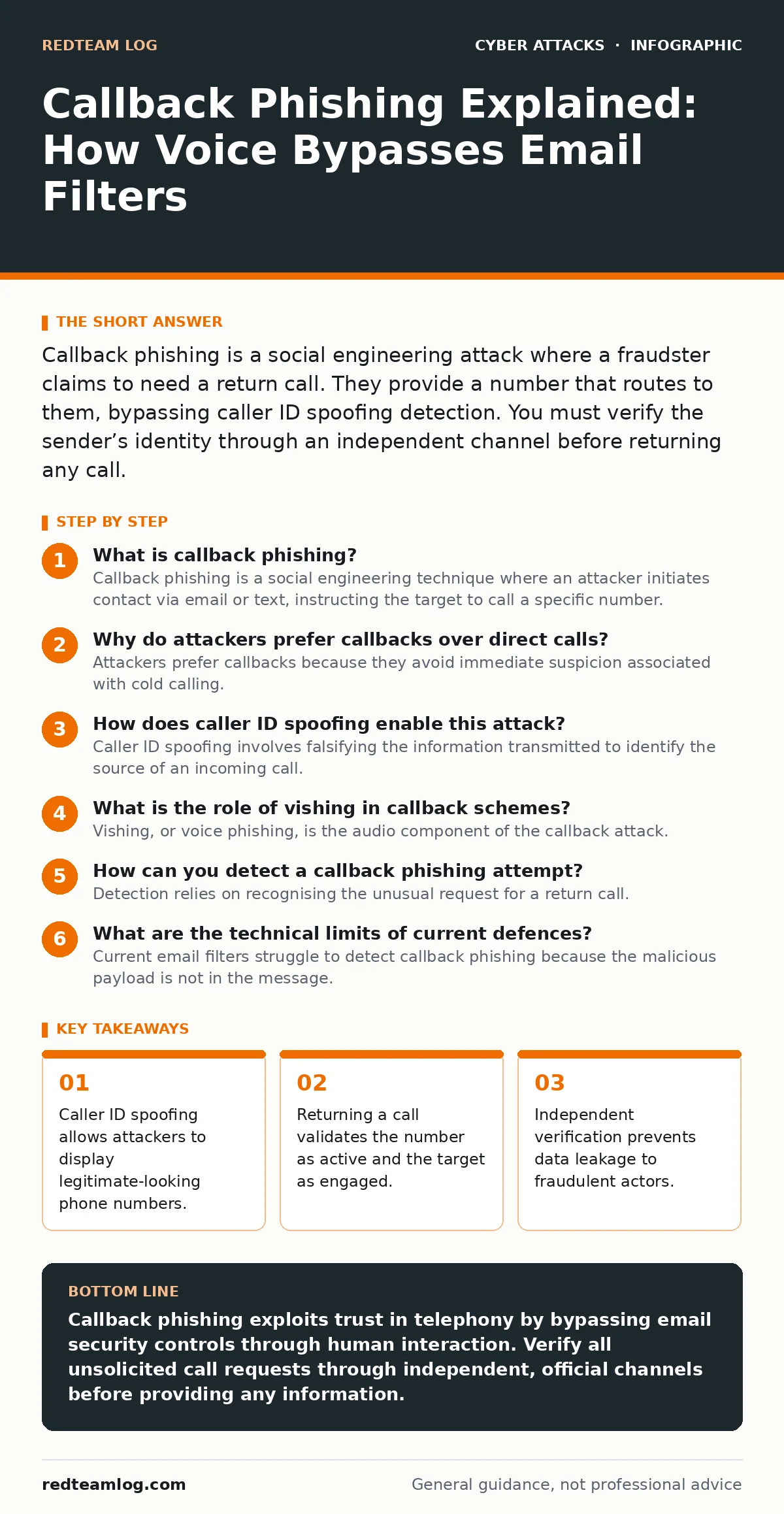
Callback phishing is a social engineering attack where a fraudster claims to need a return call. They provide a number that routes to them, bypassing caller ID spoofing detection. You must verify the sender’s identity through an independent channel before returning any call.
What is callback phishing?
Callback phishing is a social engineering technique where an attacker initiates contact via email or text, instructing the target to call a specific number. The attacker usually claims to be from a trusted organisation, such as a bank or IT support team. They request the callback to discuss urgent matters or verify account details. The goal is to move the conversation from a filtered email channel to a direct voice line.
The attacker often spoofs the caller ID to match the organisation’s official number. This makes the incoming call appear legitimate to the recipient. By forcing the victim to initiate the call, the attacker bypasses many automated security checks. These checks often flag outgoing calls from unknown origins but trust inbound traffic from known numbers.
Why do attackers prefer callbacks over direct calls?
Attackers prefer callbacks because they avoid immediate suspicion associated with cold calling. Direct unsolicited calls trigger high alert levels in security-conscious organisations. A callback request appears as if the victim initiated the contact, reducing psychological resistance. It also allows the attacker to control the timing and context of the interaction.
Furthermore, callbacks help attackers filter for engaged targets. Only individuals who comply with the instruction to call back are likely to be susceptible to further manipulation. This saves the attacker time and resources by focusing efforts on compliant victims. It also reduces the likelihood of being blocked by automated call screening systems.
How does caller ID spoofing enable this attack?
Caller ID spoofing involves falsifying the information transmitted to identify the source of an incoming call. Attackers use this technique to display a number that matches the organisation they are impersonating. This deception relies on the lack of end-to-end encryption in traditional telephony signalling. The network trusts the displayed number without verifying the actual origin.
Imagine receiving a call from your bank’s official support line. The number matches the one on your debit card. However, the call actually originates from an unregistered VoIP provider overseas. This discrepancy allows the attacker to establish trust instantly. The victim assumes the call is legitimate because the identifier matches their expectations.
What is the role of vishing in callback schemes?
Vishing, or voice phishing, is the audio component of the callback attack. Once the victim calls back, the attacker uses pre-recorded messages or live scripts to extract sensitive information. They may ask for passwords, PIN codes, or confirmation of recent transactions. The human voice adds a layer of empathy and urgency that text-based attacks lack.
The attacker often creates a sense of emergency to bypass rational thought. They claim there is suspicious activity on the account that requires immediate attention. This pressure prevents the victim from pausing to verify the caller’s identity. The combination of a trusted number and an urgent narrative increases the success rate significantly.
How can you detect a callback phishing attempt?
Detection relies on recognising the unusual request for a return call. Legitimate organisations rarely ask customers to call back a specific number provided in an unsolicited message. They usually provide a standard support line or direct you to their website. Look for inconsistencies in the sender’s email address or the urgency of the message.
Check the context of the request. If you did not initiate contact with the organisation, a callback request is a red flag. Verify the phone number against official sources. Do not trust the number in the email or SMS. Cross-reference it with the contact details on your bill or the organisation’s official domain.
See also: Phishing vs Spam: How to Tell the Difference and Stop Threats · Deepfake Scams: Spotting the Hidden Signs Before It Is Too Late
What are the technical limits of current defences?
Current email filters struggle to detect callback phishing because the malicious payload is not in the message. The email itself may contain no malware or malicious links. It simply instructs the user to take action outside the digital environment. This makes traditional signature-based detection ineffective against this vector.
Security operations centers often monitor for inbound threats but may miss outbound social engineering. The attack bypasses perimeter defences by leveraging human behaviour. Even with advanced DNS filtering, the initial contact method remains unblocked. The defence gap lies in the disconnect between email security and telephony security.
How does this relate to deepfake technology?
Deepfake scams are evolving to include audio synthesis. Attackers can clone voices from public recordings to mimic executives or IT staff. When combined with callback phishing, the attacker can impersonate a specific individual during the return call. This adds a layer of personalised trust that is difficult to challenge.
Imagine receiving an email from your CEO asking for a callback regarding a time-sensitive merger. The voice on the other end sounds exactly like your boss. This convergence of social engineering and AI makes verification even more critical. You cannot rely on voice recognition alone to confirm identity.
| Attack Vector | Primary Goal | Detection Difficulty | Mitigation Strategy |
|---|---|---|---|
| Email Phishing | Credential Theft | Low | SPF and DMARC records |
| Callback Phishing | Information Extraction | High | Independent verification |
| Vishing | Trust Building | Medium | Call authentication protocols |
| Deepfake Audio | Impersonation | Very High | Out-of-band verification |
What is the impact on incident response plans?
Callback phishing complicates incident response plans by introducing a non-digital attack vector. Traditional plans focus on malware removal and network containment. They often lack procedures for verifying human interactions. This gap allows attackers to gain initial access through trusted channels.
A cyber incident response team must include protocols for verifying phone-based requests. This includes mandatory steps for confirming the identity of callers. Training staff to recognise callback requests as potential threats is necessary. Without these steps, the human element remains the weakest link in the security chain.
How do you verify the caller’s identity independently?
Independent verification requires using a separate communication channel. Do not use the number provided in the suspicious message. Instead, find the official contact number from a trusted source, such as a previous statement or the organisation’s website. Call this number to confirm whether the original request was legitimate.
This process breaks the attacker’s control over the narrative. It forces the attacker to either admit the fraud or lose the victim’s trust. It also provides a record of the verification attempt. Documenting these steps helps in reporting the incident and improving future defences.
What is the long-term risk of compliance?
Compliance with callback requests establishes a pattern of engagement. Attackers may record the interaction to refine future scripts. They may also harvest personal data for identity theft or further social engineering. The immediate loss might be minor, but the long-term risk is significant.
The attacker now knows you are responsive to authority and urgency. This profile makes you a target for more sophisticated attacks. Building a reputation for compliance can lead to targeted campaigns against you and your organisation. Consistent verification protects not just your data, but your operational security posture.
Key takeaways
- Caller ID spoofing allows attackers to display legitimate-looking phone numbers.
- Returning a call validates the number as active and the target as engaged.
- Independent verification prevents data leakage to fraudulent actors.
Callback phishing exploits trust in telephony by bypassing email security controls through human interaction. Verify all unsolicited call requests through independent, official channels before providing any information.
Frequently asked questions
Can email filters stop callback phishing?
No, because the attack relies on human action outside the email system. The message itself contains no malicious code or links that filters can detect.
Is spoofing a caller ID illegal?
Yes, in many jurisdictions, spoofing caller ID with intent to defraud is illegal. However, enforcement is difficult due to the global nature of internet telephony.
How does SPF help with this attack?
SPF verifies the sender’s email domain, preventing email spoofing. While it stops the initial email from appearing fake, it does not prevent the recipient from calling the number in the message.
Should I block unknown numbers?
Blocking unknown numbers can reduce nuisance calls but does not stop determined attackers. They will simply use a different number or rely on the callback mechanism to bypass blocks.
How this guide was produced: written by the RedTeam Log editorial team with AI assistance, checked against the public references listed below, and reviewed when the facts change. See our editorial policy or report an error.