Attackers hijack or mimic executive accounts to demand urgent financial transfers. They rely on authority bias and time pressure to bypass standard verification. You can interrupt the process by enforcing out-of-band confirmation for any payment request that deviates from normal workflow.
The Psychology of Authority and Urgency
Executive impersonation relies on a specific intersection of social engineering and organisational hierarchy. The attacker does not need to break complex encryption or exploit software vulnerabilities. Instead, they exploit the natural human tendency to defer to authority figures. When a message appears to come from the Chief Executive Officer, recipients often suspend their usual caution.
This deference is amplified by the introduction of urgency. A request that demands immediate action creates a cognitive load that overrides analytical thinking. The victim feels pressured to comply to avoid professional embarrassment or appearing unhelpful. This psychological state is the primary entry point for the fraud. It allows the attacker to bypass procedural safeguards that would normally catch irregularities.
Reconnaissance and Identity Selection
The process begins with careful observation. Attackers study public information to identify key decision-makers and their reporting structures. They look for executives who are frequently in the news, have active social media profiles, or travel often. This public footprint provides the raw material for the impersonation.
The attacker selects a target based on perceived vulnerability. A newly appointed executive is a prime candidate because staff are still learning their communication style. Alternatively, an executive who is currently on leave or traveling is ideal. Their absence creates a gap in direct verification. The attacker maps the organisational chart to identify who handles finances or procurement. This mapping ensures the request goes to someone with the authority to move money.
Account Compromise or Spoofing
There are two primary methods for establishing the fake identity. The first is account takeover. The attacker gains access to the executive’s actual email or messaging account. This can happen through weak credentials, a lack of multi-factor authentication, or a previous breach. When the email comes from the real account, all technical filters pass it through as legitimate.
The second method is domain spoofing. The attacker registers a domain name that looks nearly identical to the company’s official domain. They might swap letters or use different character sets that look similar to the human eye. This is known as homographing. The email header shows a plausible sender address, but it originates from an external server. This method relies on the victim not checking the full sender address carefully.
Both methods share a common goal: establishing trust. Whether using a real account or a fake one, the attacker ensures the message appears to come from a trusted source. This trust is the foundation of the entire operation. Without it, the request would be flagged as suspicious immediately.
Crafting the Deceptive Narrative
The attacker drafts a message that mimics the executive’s tone and style. They use language that is direct, authoritative, and slightly informal. This contrasts with the formal language of standard corporate communications. The message often references a confidential matter. It might mention a sensitive business deal or a legal issue that requires discretion.
The request involves a financial transaction that deviates from standard procedure. It might ask for a wire transfer to a new vendor. Or it might request the purchase of gift cards. These methods are chosen because they are difficult to reverse. The attacker emphasises that the transaction is urgent and confidential. They instruct the victim to keep the matter private and not to discuss it with colleagues.
This narrative is designed to isolate the victim. By framing the request as confidential, the attacker removes the safety net of peer review. The victim feels they are handling a special, sensitive task. This isolation prevents other staff members from questioning the unusual request. It also discourages the victim from seeking help or clarification.
The Execution and Pressure Tactics
Once the message is sent, the attacker monitors for a response. If the victim questions the request, the attacker responds quickly. They reinforce the urgency and authority of the instruction. They might claim to be in a meeting or on a call. This prevents the victim from waiting for a callback or face-to-face verification.
The attacker may also use secondary channels to maintain pressure. They might send a follow-up message via an instant messaging platform. This creates a sense of immediacy and continuity. The goal is to keep the victim in a state of high alert and compliance. The attacker avoids giving the victim time to think or to consult with others.
If the victim hesitates, the attacker may threaten negative consequences. They might imply that failure to act quickly could harm the business relationship. This fear-based tactic is powerful. It pushes the victim to act against their better judgement. The combination of authority, urgency, and fear creates a perfect storm for fraud.
See also: Callback Phishing Explained: How Voice Bypasses Email Filters · Social Engineering Red Flags: Spotting Manipulation Before Data Loss
The Financial Transfer
The final stage is the execution of the payment. The victim initiates the transfer based on the attacker’s instructions. They may bypass normal approval workflows due to the perceived authority of the sender. The money is sent to an account controlled by the attacker. This account is often located in a jurisdiction with weak financial regulations.
Once the transfer is complete, the attacker moves the funds quickly. They use a series of accounts to obscure the trail. This layering makes it difficult for law enforcement or banks to trace the money. By the time the real executive returns or notices the missing funds, the money is often unrecoverable. The damage is done, and the organisation faces significant financial loss.
Interruption Points and Defences
This process can be interrupted at several stages. The most effective defence is out-of-band verification. This means confirming the request through a different communication channel. If an email asks for a wire transfer, call the executive on a known, trusted phone number. Do not use the contact details provided in the suspicious message.
Technical controls also play a role. Implement strong authentication for all executive accounts. Use multi-factor authentication to prevent account takeover. Configure email filters to flag messages that request financial transfers. Train staff to recognise the signs of urgency and authority bias.
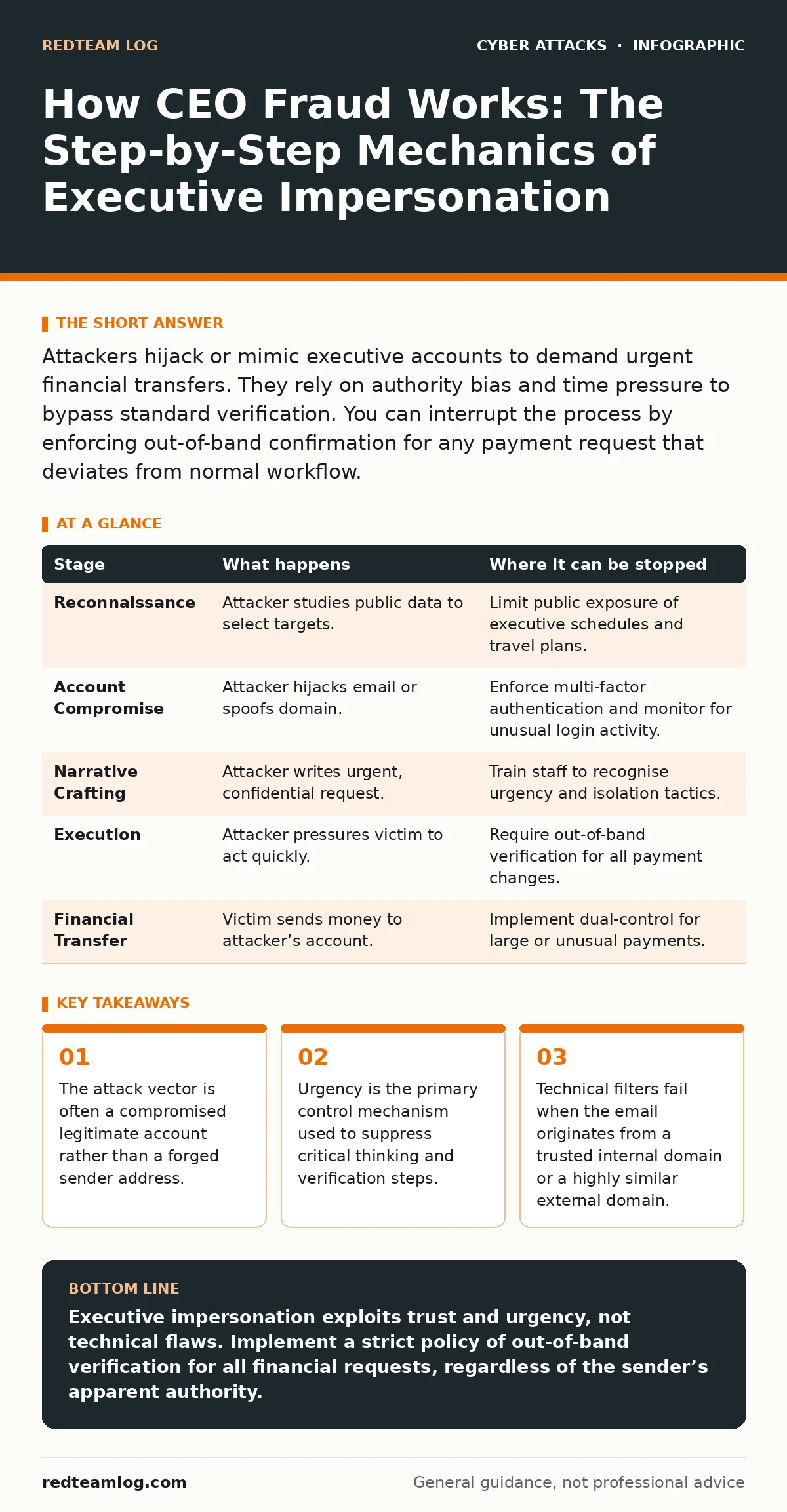
| Stage | What happens | Where it can be stopped |
|---|---|---|
| Reconnaissance | Attacker studies public data to select targets. | Limit public exposure of executive schedules and travel plans. |
| Account Compromise | Attacker hijacks email or spoofs domain. | Enforce multi-factor authentication and monitor for unusual login activity. |
| Narrative Crafting | Attacker writes urgent, confidential request. | Train staff to recognise urgency and isolation tactics. |
| Execution | Attacker pressures victim to act quickly. | Require out-of-band verification for all payment changes. |
| Financial Transfer | Victim sends money to attacker’s account. | Implement dual-control for large or unusual payments. |
Long-Term Resilience and Culture
Building resilience against executive impersonation requires a cultural shift. Staff must feel empowered to question authority. This is difficult in hierarchical organisations. Leaders must explicitly encourage verification. They should model this behaviour by verifying requests themselves.
Regular training is necessary. But it must go beyond simple awareness. It should include simulations and role-playing. Staff need to practice saying no to urgent requests. They need to understand the specific tactics used by attackers. This practice builds muscle memory for the right response.
Integrate these practices into your incident response plans. Treat executive impersonation as a specific threat scenario. Define clear procedures for verification and reporting. Ensure that your cyber incident response team is aware of the social engineering aspect. They need to be prepared to investigate these incidents quickly.
Consider the role of web filtering in blocking access to malicious sites that might be used in the attack. While intrusion prevention systems focus on network traffic, they do not stop social engineering. You need a layered approach. Combine technical controls with human vigilance. This combination creates a defence that is difficult to bypass.
Be aware of related threats. Baiting attacks often serve as the initial hook for account compromise. Deepfake scams are an emerging variant that uses audio or video to mimic executives. Gift card scams are a common payment method in these frauds. Understanding these related tactics helps you build a more comprehensive defence.
Key takeaways
- The attack vector is often a compromised legitimate account rather than a forged sender address.
- Urgency is the primary control mechanism used to suppress critical thinking and verification steps.
- Technical filters fail when the email originates from a trusted internal domain or a highly similar external domain.
Executive impersonation exploits trust and urgency, not technical flaws. Implement a strict policy of out-of-band verification for all financial requests, regardless of the sender’s apparent authority.
Frequently asked questions
How do I know if an email from my boss is fake?
Check for unusual urgency, requests for secrecy, or deviations from normal payment procedures. Verify the request through a separate, trusted communication channel.
Can multi-factor authentication stop CEO fraud?
It prevents account takeover, which is one method of attack. It does not stop domain spoofing or social engineering tactics that manipulate the victim directly.
What should I do if I have already sent money?
Contact your bank immediately to attempt a recall. Report the incident to your IT security team and law enforcement. Preserve all evidence of the communication.
Is it safe to use instant messaging for urgent requests?
Instant messaging is often less secure and harder to audit than email. Treat urgent requests via messaging with the same suspicion as email. Always verify through a secondary channel.
How this guide was produced: written by the RedTeam Log editorial team with AI assistance, checked against the public references listed below, and reviewed when the facts change. See our editorial policy or report an error.