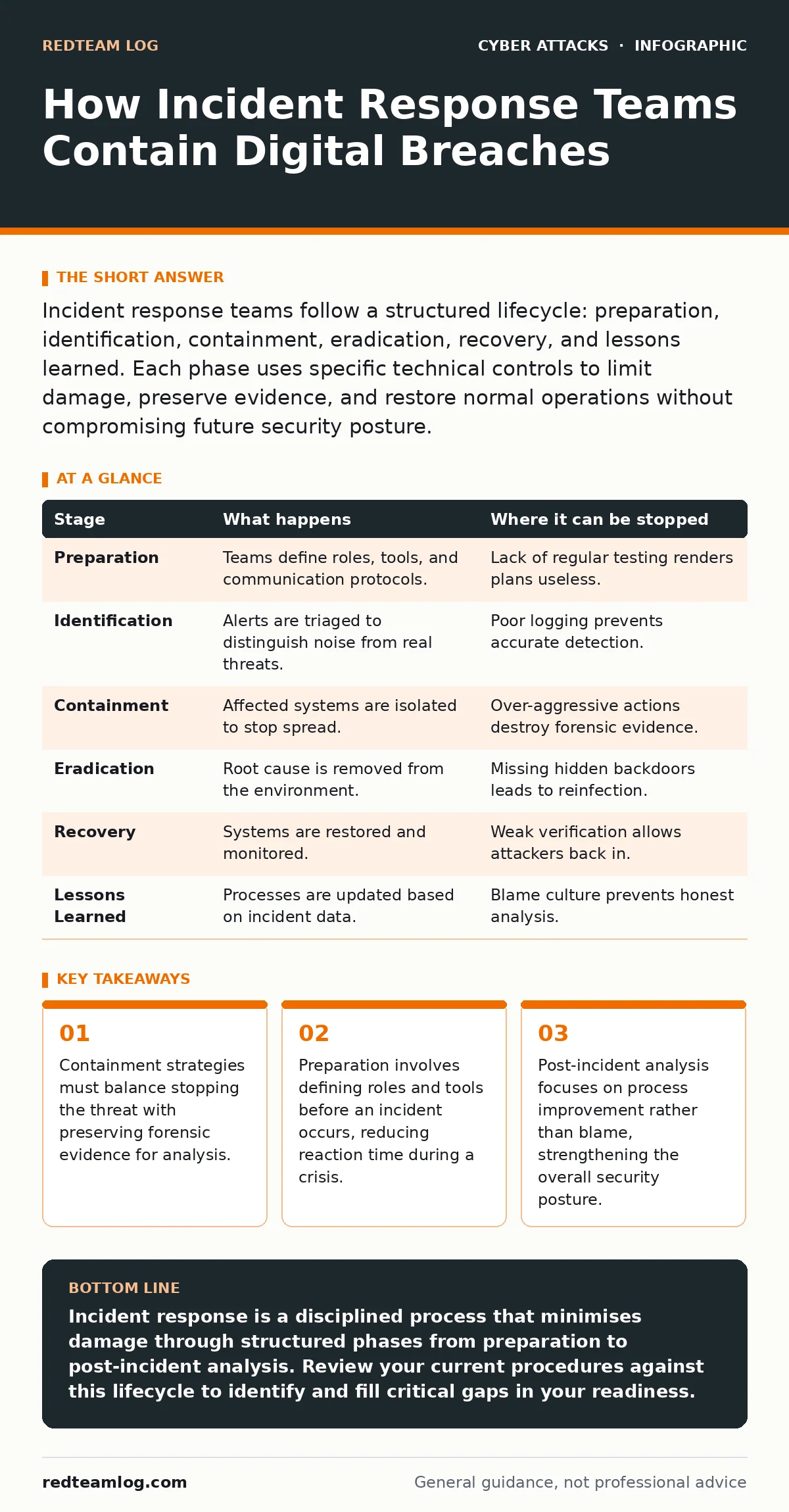
Incident response teams follow a structured lifecycle: preparation, identification, containment, eradication, recovery, and lessons learned. Each phase uses specific technical controls to limit damage, preserve evidence, and restore normal operations without compromising future security posture.
The Preparation Phase
You cannot react effectively if you have not prepared. This stage happens long before any alarm sounds. It involves defining the team structure, establishing communication channels, and ensuring you have the right tools ready.
Most organisations neglect this until it is too late. They assume their incident response plans are sufficient on paper. In practice, untested procedures collapse under pressure. You must simulate realistic scenarios to find gaps in your logic and tooling.
| Stage | What happens | Where it can be stopped |
|---|---|---|
| Preparation | Teams define roles, tools, and communication protocols. | Lack of regular testing renders plans useless. |
| Identification | Alerts are triaged to distinguish noise from real threats. | Poor logging prevents accurate detection. |
| Containment | Affected systems are isolated to stop spread. | Over-aggressive actions destroy forensic evidence. |
| Eradication | Root cause is removed from the environment. | Missing hidden backdoors leads to reinfection. |
| Recovery | Systems are restored and monitored. | Weak verification allows attackers back in. |
| Lessons Learned | Processes are updated based on incident data. | Blame culture prevents honest analysis. |
The Identification Phase
Detection is not just about seeing an alert. It is about understanding context. Your intrusion prevention systems may flag suspicious traffic, but you must determine if it is a false positive or a genuine breach.
This stage requires correlating data from multiple sources. Log files, network traffic, and endpoint behaviour must align. If they do not, you risk wasting resources on a phantom threat. Speed matters, but accuracy matters more.
The Containment Phase
This is the most delicate stage. You must stop the attacker from moving laterally without destroying the evidence needed to understand their methods. Short-term containment might involve disconnecting a single server. Long-term containment may require segmenting the network.
Imagine a scenario where malware has infected a file server. Pulling the plug immediately stops the spread but wipes volatile memory containing critical clues. Instead, you isolate the server from the network while keeping it powered on. This preserves the state for forensic analysis.
The Eradication Phase
Containment buys you time; eradication removes the threat. You must identify the root cause and eliminate all traces of the attacker. This includes removing malware, closing exploited vulnerabilities, and resetting compromised credentials.
Many teams fail here by only addressing the symptom. If an attacker used a weak password to gain entry, changing that password is not enough. You must enforce stronger authentication policies across the organisation. Otherwise, the same door remains open.
The Recovery Phase
Restoring systems is not just about turning them back on. You must verify that the environment is clean before reconnecting to the network. This involves scanning for residual malware and monitoring for unusual activity.
Gradual restoration is safer than a big bang approach. Bring critical systems back first, then secondary ones. Monitor each step closely. If anomalies appear, pause and investigate. Rushing recovery can reintroduce the very threat you just removed.
See also: Should I Invest in SOAR? The Truth About Automation ROI · Emergency Patching: Correcting Five Common Operational Errors
The Lessons Learned Phase
The incident is over, but the work continues. You must analyse what went wrong and what went right. Did your detection tools work? Was communication clear? Did the team follow the plan?
This stage is often skipped due to pressure to return to normal. However, without this analysis, you are likely to face the same failure again. Document findings and update your procedures. Share insights with relevant teams to improve overall resilience.
The Human Element
Technology alone cannot stop every threat. Human judgement plays a significant role in every stage. Analysts must decide which alerts to pursue. Managers must allocate resources. Leadership must support the process.
Training is not a one-time event. It is an ongoing discipline. Your team must stay updated on new tactics and techniques. Regular exercises keep skills sharp and reveal weaknesses in your approach.
Limits of the Process
No process is perfect. Incident response teams operate within constraints. Time, resources, and information are always limited. You may not have full visibility into all systems. Some attackers leave no trace.
Accepting these limits allows you to focus on what you can control. Improve your logging. Enhance your monitoring. Strengthen your defences. You cannot stop every attack, but you can reduce the impact and recover faster.
Key takeaways
- Containment strategies must balance stopping the threat with preserving forensic evidence for analysis.
- Preparation involves defining roles and tools before an incident occurs, reducing reaction time during a crisis.
- Post-incident analysis focuses on process improvement rather than blame, strengthening the overall security posture.
Incident response is a disciplined process that minimises damage through structured phases from preparation to post-incident analysis. Review your current procedures against this lifecycle to identify and fill critical gaps in your readiness.
Frequently asked questions
How long does incident response typically take?
Duration varies widely based on complexity and preparation. Simple incidents may take hours; complex breaches can span weeks or months.
What is the first step in incident response?
Preparation is the foundational step, involving planning, tooling, and training before any incident occurs.
Can automation replace incident response teams?
Automation aids detection and containment but cannot replace human judgement in complex decision-making and strategy.
How do you measure the success of an incident response?
Success is measured by reduced downtime, limited data loss, and improved processes identified during the lessons learned phase.
How this guide was produced: written by the RedTeam Log editorial team with AI assistance, checked against the public references listed below, and reviewed when the facts change. See our editorial policy or report an error.