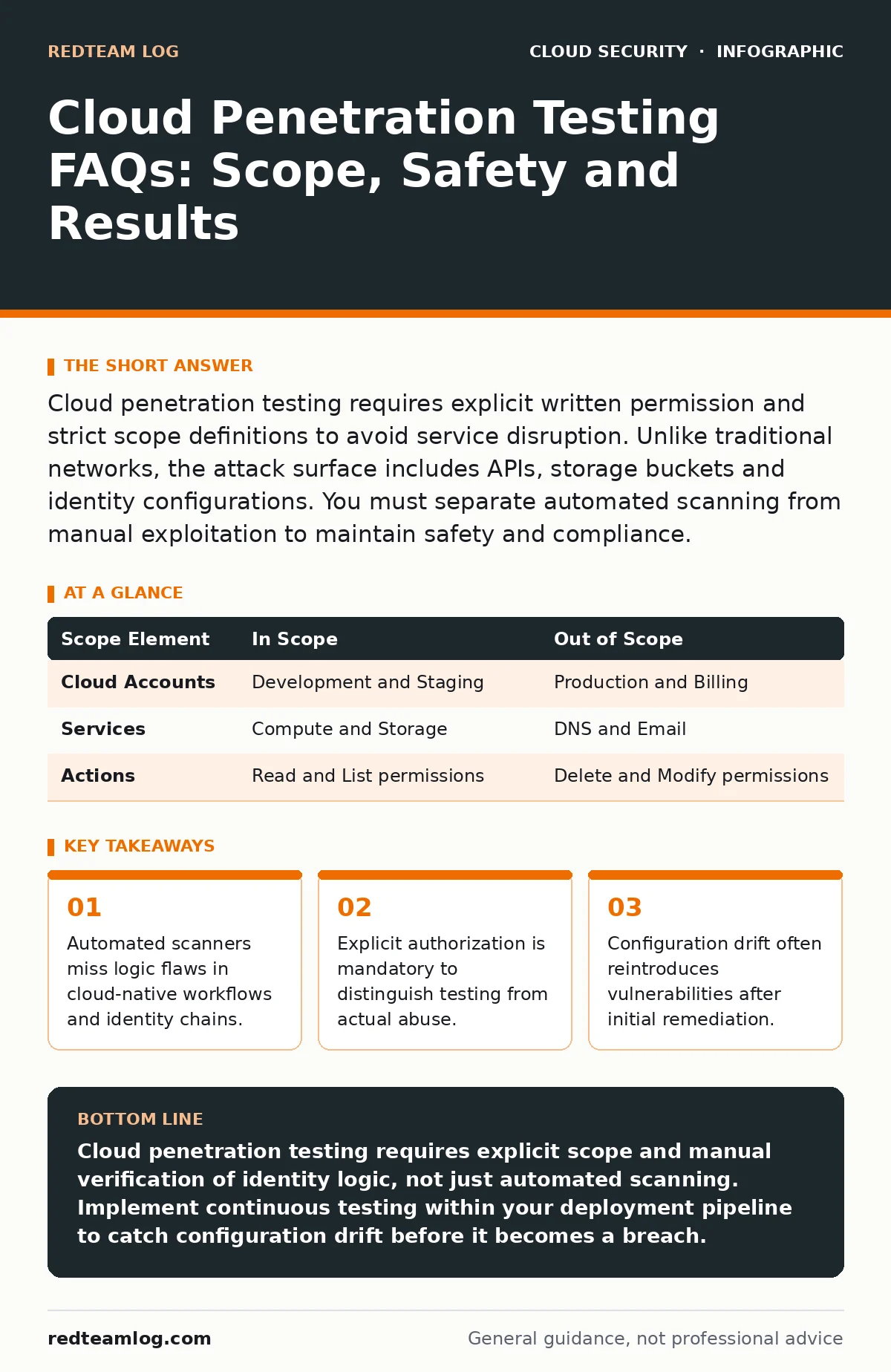
Cloud penetration testing requires explicit written permission and strict scope definitions to avoid service disruption. Unlike traditional networks, the attack surface includes APIs, storage buckets and identity configurations. You must separate automated scanning from manual exploitation to maintain safety and compliance.
Why cannot automated scanners replace manual cloud penetration testing?
Automated tools identify misconfigurations but fail to assess complex identity logic or business workflows. They check for open ports or public storage, yet they cannot determine if a valid user can escalate privileges through chained permissions. Manual testing reveals how these static issues combine to allow unauthorized access.
Imagine a scanner flags an open S3 bucket. It reports a finding and stops. A human tester checks who can write to that bucket, then tests if an uploaded script can execute code in a linked service. This chain of events is invisible to most automated scanners.
How do you define scope without breaking production systems?
You must specify exactly which accounts, regions and services are in scope, and which are explicitly out of scope. Define the testing window and the acceptable risk level for any potential disruption. Without this clarity, testing tools may trigger auto-scaling events or delete critical data by accident.
| Scope Element | In Scope | Out of Scope |
|---|---|---|
| Cloud Accounts | Development and Staging | Production and Billing |
| Services | Compute and Storage | DNS and Email |
| Actions | Read and List permissions | Delete and Modify permissions |
Is it legal to test cloud infrastructure without explicit permission?
No. Cloud providers treat unauthorised access attempts as abuse, regardless of intent. Even if you own the infrastructure, the underlying hardware and virtualisation layer belong to the provider. Unauthorised testing violates terms of service and can lead to immediate account suspension.
You need written consent from the cloud provider for certain actions, particularly those involving Denial of Service tests or fuzzing of public APIs. For standard penetration testing, you usually need permission from the account owner and adherence to the provider’s testing programme rules.
What are the risks of testing identity and access management?
Identity testing carries the highest risk because misconfigurations can grant immediate, broad access. Testing roles and policies requires careful isolation to prevent accidental privilege escalation that could impact other workloads. You must assume that any successful test case could be exploited by a malicious actor.
Suppose you test a role that allows reading logs. If the test script is poorly written, it might accidentally assume a higher-privilege role linked to that log reader. This chain reaction can expose secrets or modify configurations across the entire tenant.
How does cloud testing differ from on-premise penetration testing?
Cloud infrastructure is defined by code and API calls rather than physical cables and static IP ranges. The attack surface is dynamic, with resources spinning up and down based on demand. Traditional network mapping tools often fail because IP addresses are ephemeral and internal routing is abstracted.
You must test the configuration of the control plane, not just the data plane. This means verifying that the policies governing your resources are secure, not just the resources themselves.
See also: Cloud Guardrails: 8 FAQs on Policy Enforcement and Prevention · Confidential Computing: 6 Misconceptions That Compromise Security
Should you test third-party applications in your cloud environment?
Only if they fall within your agreed scope and you have permission from the vendor. Third-party applications often share resources or permissions with your core infrastructure. Testing them can reveal integration flaws or excessive permissions granted to external services.
However, many vendors prohibit penetration testing of their managed components. Violating these terms can void support agreements and disrupt shared services. Always check the vendor’s security policy before proceeding.
How do you handle data privacy during a penetration test?
You must ensure that test data does not contain sensitive customer information. Use synthetic or anonymised data for testing purposes. Real data increases the risk of accidental exposure if test logs are compromised or if data is exfiltrated during the test.
What should you do if a critical vulnerability is found mid-test?
Stop testing immediately and notify the security team. Follow the pre-agreed incident response plan for high-severity findings. Do not attempt to fix the issue yourself unless explicitly authorised, as this may alter evidence or introduce new errors.
Document the steps to reproduce the issue precisely. This allows the remediation team to fix the root cause rather than just patching the symptom.
How do you verify that remediation efforts are effective?
Re-test the specific vulnerability using the same methodology. Verify that the fix addresses the root cause and does not introduce new issues. Do not rely solely on automated scanners to confirm remediation, as they may false-negative.
Why is continuous testing necessary for cloud environments?
Cloud environments change constantly due to deployments, scaling and configuration updates. A one-time test provides only a snapshot in time. Continuous testing ensures that new vulnerabilities are identified before they can be exploited.
You should integrate security checks into your deployment pipeline. This allows you to catch misconfigurations before they reach production. For deeper insights on maintaining visibility, refer to our guide on cloud logging and monitoring.
To ensure your infrastructure remains secure over time, consider adopting principles of immutable infrastructure. This reduces the risk of configuration drift and ensures that each deployment is verified against security standards.
Key takeaways
- Automated scanners miss logic flaws in cloud-native workflows and identity chains.
- Explicit authorization is mandatory to distinguish testing from actual abuse.
- Configuration drift often reintroduces vulnerabilities after initial remediation.
Cloud penetration testing requires explicit scope and manual verification of identity logic, not just automated scanning. Implement continuous testing within your deployment pipeline to catch configuration drift before it becomes a breach.
Frequently asked questions
Can I use the same penetration testing methodology for AWS, Azure and Google Cloud?
The core principles are the same, but each provider has specific APIs and testing programmes you must follow.
Do I need to shut down my services during a penetration test?
No, but you should schedule tests during low-traffic periods and define acceptable performance impacts in the scope.
How often should I perform cloud penetration testing?
At least annually, and after any significant infrastructure change or new service deployment.
What is the difference between a vulnerability assessment and a penetration test?
A vulnerability assessment identifies potential weaknesses, while a penetration test attempts to exploit them to demonstrate impact.
How this guide was produced: written by the RedTeam Log editorial team with AI assistance, checked against the public references listed below, and reviewed when the facts change. See our editorial policy or report an error.