
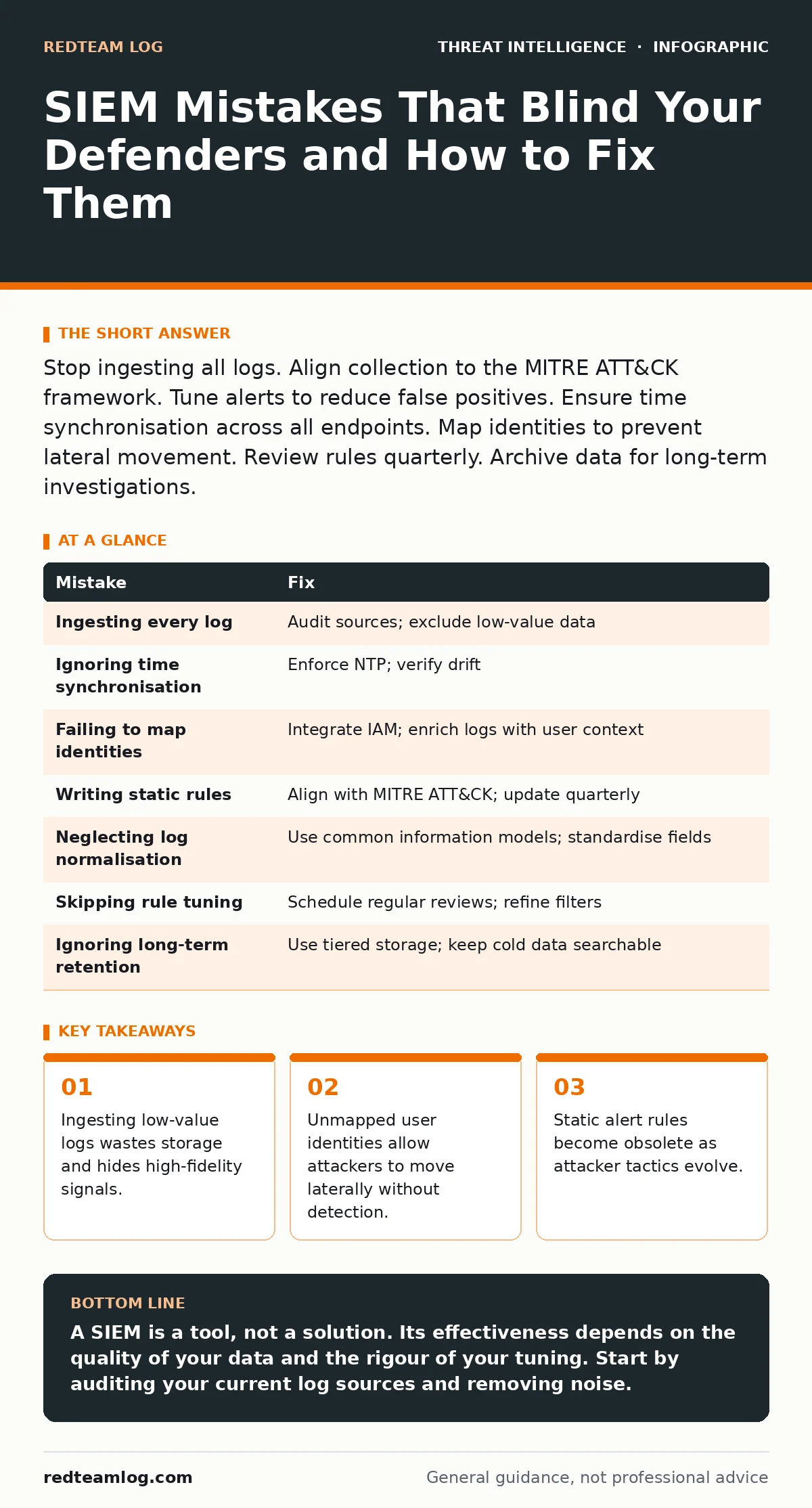
Stop ingesting all logs. Align collection to the MITRE ATT&CK framework. Tune alerts to reduce false positives. Ensure time synchronisation across all endpoints. Map identities to prevent lateral movement. Review rules quarterly. Archive data for long-term investigations.
Security information and event management systems are only as effective as the data you feed them and the rules you write. A poorly configured system creates a false sense of security. You believe you are watching everything, but you are actually watching nothing of value. The following mistakes are common in mature environments. They are not beginner errors. They are structural flaws that degrade detection over time.
Mistake 1: Ingesting Every Log Available
Why it hurts:
Collecting every log from every device sounds thorough. It is not. It floods your storage with low-value data. This increases costs and slows down search queries. More critically, it drowns out high-fidelity signals in a sea of noise. Analysts suffer from alert fatigue. They begin to ignore notifications, assuming most are false positives. You miss the needle because the haystack is too large.
The fix:
Audit your data sources before ingestion. Ask what specific threat each log helps detect. If a log source does not map to a clear detection scenario, exclude it. Focus on high-value sources such as authentication logs and process creation events. Refer to our guide on log management for strategies on balancing coverage and performance. Prioritise quality over quantity.
Mistake 2: Ignoring Time Synchronisation
Why it hurts:
SIEMs correlate events based on timestamps. If your servers, workstations, and network devices do not share the same time, correlation fails. An attacker might log in at 10:00 AM and exfiltrate data at 10:05 AM. If the source system is two hours behind, the SIEM sees these as unrelated events. You cannot reconstruct the attack timeline. This breaks your ability to detect multi-stage attacks.
The fix:
Enforce strict time synchronisation across your entire infrastructure. Use Network Time Protocol (NTP) servers that are internal and secure. Verify that all endpoints sync to the same source. Check for drift regularly. Even small discrepancies can break complex detection rules. Ensure your SIEM ingestion pipeline handles timezone conversions correctly.
Mistake 3: Failing to Map Identities
Why it hurts:
Logs often contain IP addresses or machine names. They rarely contain meaningful user context by default. Without identity mapping, you cannot see who is doing what. An attacker compromises a service account and moves laterally. The SIEM shows activity from "Server-A" to "Database-B". It does not show that "User-X" initiated the jump. You miss the human element of the breach. This is particularly dangerous when attackers abuse privileged accounts.
The fix:
Implement identity and access management integrations with your SIEM. Enrich logs with user identities, group memberships, and privilege levels. Use directory services to resolve machine names to users. This allows you to detect anomalies based on user behaviour, not just machine activity. Read our analysis on remote desktop abuse to understand how identity gaps hide lateral movement.
Mistake 4: Writing Static Alert Rules
Why it hurts:
Attackers change their tactics. Your alert rules do not. A rule that detects a specific command-line string today may be useless tomorrow. Attackers use obfuscation or switch to legitimate tools. Static rules create blind spots. They also generate high false-positive rates when legitimate software updates mimic malicious behaviour. You spend more time triaging noise than hunting threats.
The fix:
Adopt a dynamic approach to rule creation. Align your detections with the MITRE ATT&CK framework. This ensures you cover tactics and techniques, not just specific tools. Review and update rules quarterly. Use behavioural analytics where possible. Look for deviations from baseline activity rather than matching known signatures. Integrate YARA rules for file-based detection to catch new variants of malware.
Mistake 5: Neglecting Log Normalisation
Why it hurts:
Different vendors format logs differently. Windows Event Logs look nothing like Cisco firewall logs. If you do not normalise this data, you cannot search across sources effectively. You create silos of visibility. An attacker might pivot from a network device to a server. If the SIEM cannot correlate these disparate log formats, the connection is lost. You see fragments of the attack, not the whole picture.
The fix:
Use common information models to standardise log fields. Ensure that fields like "source IP", "destination IP", and "username" are mapped consistently across all data sources. This allows for unified querying and correlation. Invest time in parsing configurations during onboarding. Poor normalisation is a hidden cost that compounds over time.
See also: What is polymorphic malware: how it hides and how to stop it · 7 Mistakes That Leave You Open to Advanced Persistent Threats
Mistake 6: Skipping Regular Rule Tuning
Why it hurts:
Alert rules degrade. Business processes change. New applications are deployed. These changes trigger legitimate alerts that look like attacks. If you do not tune your rules, the signal-to-noise ratio worsens. Analysts become desensitised. They start to dismiss alerts without investigation. This is the path to missed breaches. Tuning is not a one-time task. It is a continuous discipline.
The fix:
Schedule regular tuning sessions. Validate alerts against known good activity. Suppress noise by refining filters. Document why each rule exists and what it detects. Use incident response runbooks to streamline the triage process. This reduces the cognitive load on analysts and speeds up response.
Mistake 7: Ignoring Long-Term Retention
Why it hurts:
Many organisations store logs for only 30 days. This is insufficient for many investigations. Threat actors often dwell in networks for months. They may use low-and-slow techniques to avoid detection. If you delete old logs, you lose the historical context needed to identify the initial compromise. You cannot prove what happened, when it started, or what was affected. This hampers forensic analysis and legal compliance.
The fix:
Implement a tiered storage strategy. Keep hot data for immediate analysis. Move cold data to cheaper, long-term storage. Ensure that archived data remains searchable. Define retention periods based on regulatory requirements and threat models. Consider the strategic threat intelligence implications of retaining data for trend analysis. You need history to predict future attacks.
Summary of SIEM Mistakes
| Mistake | Fix |
|---|---|
| Ingesting every log | Audit sources; exclude low-value data |
| Ignoring time synchronisation | Enforce NTP; verify drift |
| Failing to map identities | Integrate IAM; enrich logs with user context |
| Writing static rules | Align with MITRE ATT&CK; update quarterly |
| Neglecting log normalisation | Use common information models; standardise fields |
| Skipping rule tuning | Schedule regular reviews; refine filters |
| Ignoring long-term retention | Use tiered storage; keep cold data searchable |
Key takeaways
- Ingesting low-value logs wastes storage and hides high-fidelity signals.
- Unmapped user identities allow attackers to move laterally without detection.
- Static alert rules become obsolete as attacker tactics evolve.
A SIEM is a tool, not a solution. Its effectiveness depends on the quality of your data and the rigour of your tuning. Start by auditing your current log sources and removing noise.
Frequently asked questions
How do I know if my SIEM is configured correctly?
Check if your alert volume is manageable and if you can correlate events across different data sources. If analysts spend most of their time dismissing false positives, your configuration needs work.
Should I use cloud-based or on-premise SIEM?
The choice depends on your data sovereignty requirements and existing infrastructure. Cloud solutions offer scalability, while on-premise offers control. Both require the same rigorous tuning and data management.
How often should I update my detection rules?
At least quarterly. More frequently if you experience significant changes in your environment or if new threat intelligence becomes available. Regular updates ensure your detections remain relevant.
What is the biggest risk of poor log management?
Missing the initial compromise. If you do not collect or store the right logs, you cannot detect the early stages of an attack. This allows attackers to establish persistence and move laterally undetected.
How this guide was produced: written by the RedTeam Log editorial team with AI assistance, checked against the public references listed below, and reviewed when the facts change. See our editorial policy or report an error.