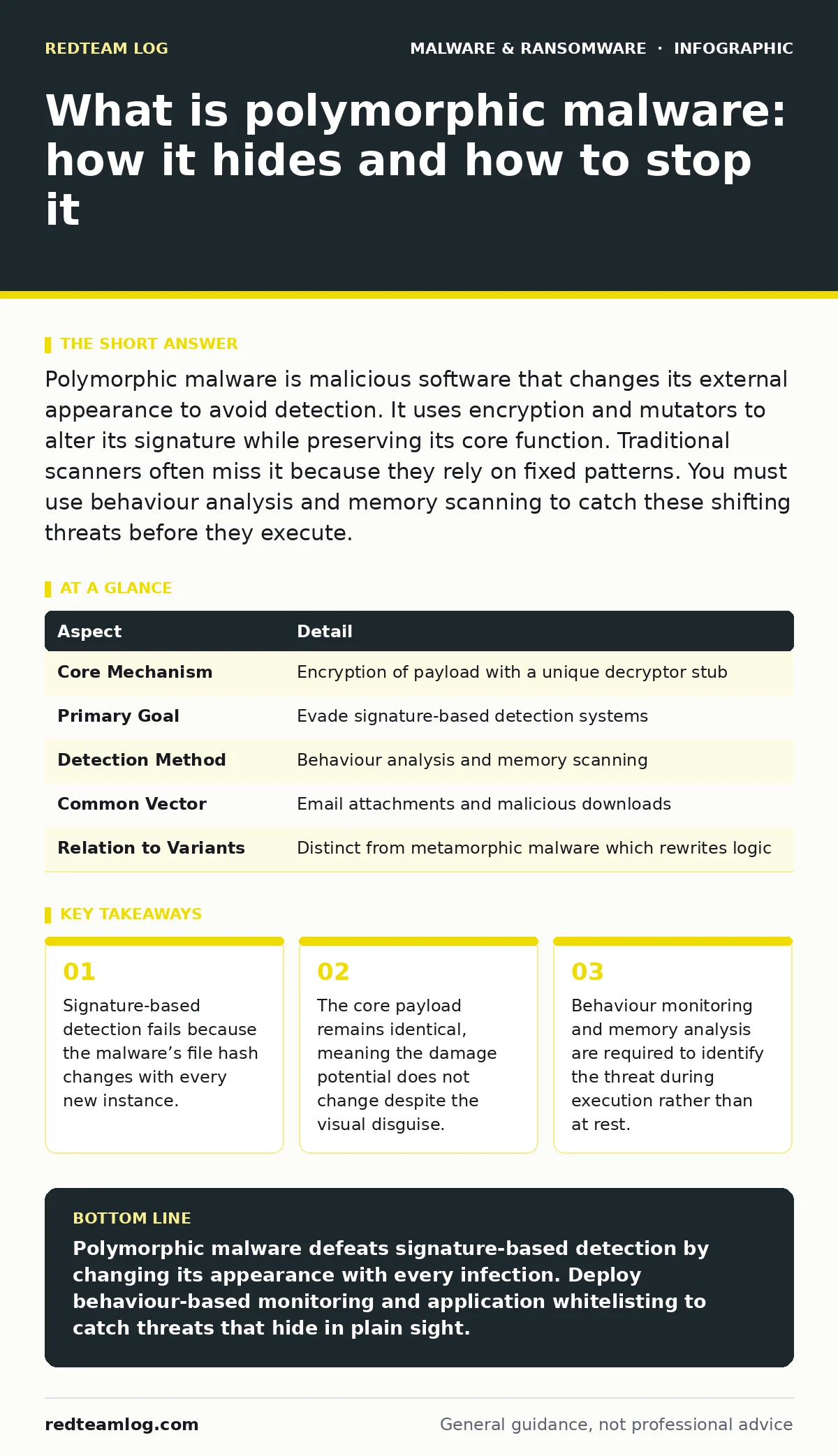
Polymorphic malware is malicious software that changes its external appearance to avoid detection. It uses encryption and mutators to alter its signature while preserving its core function. Traditional scanners often miss it because they rely on fixed patterns. You must use behaviour analysis and memory scanning to catch these shifting threats before they execute.
An everyday analogy for shifting threats
Imagine a burglar who wears a different costume every night. The face underneath remains the same, but the hat, the coat and the shoes change completely. Security cameras trained to spot a specific jacket will miss this intruder every time. Polymorphic malware operates on this exact principle. It changes its outer layer to bypass security filters that look for specific patterns. The underlying criminal intent stays constant.
What is polymorphic malware
Polymorphic malware is a type of malicious code that alters its appearance with each iteration to evade detection. It achieves this by encrypting its main payload and using a unique decryption routine for every new copy. When the malware spreads, it generates a new variant with a different digital signature. The core instructions that cause harm remain unchanged. This distinction separates it from simple obfuscation, which only hides the code without changing its structure.
| Aspect | Detail |
|---|---|
| Core Mechanism | Encryption of payload with a unique decryptor stub |
| Primary Goal | Evade signature-based detection systems |
| Detection Method | Behaviour analysis and memory scanning |
| Common Vector | Email attachments and malicious downloads |
| Relation to Variants | Distinct from metamorphic malware which rewrites logic |
How the mutation engine works
The malware contains two main components: the encrypted payload and the decryptor. The decryptor is the visible part that security tools see first. Before the malware spreads, a mutator engine runs. This engine generates a new encryption key and modifies the decryptor code. It might change variable names, insert dummy instructions or reorder operations. The result is a file that looks entirely different to a static scanner. When executed, the decryptor unlocks the payload in memory. The payload then performs the intended malicious action. This process happens automatically during propagation.
Why traditional defences fail
Signature-based antivirus relies on matching known patterns. It compares files against a database of known bad hashes. Polymorphic malware defeats this by ensuring no two copies share the same hash. The scanner sees a unique file every time. It cannot match the file to a known threat. This creates a blind spot in perimeter defence. The malware sits on the disk, invisible to traditional checks. It only reveals itself when it runs. By then, the damage may already be underway. Relying solely on signature updates leaves a gap that this malware exploits.
What people usually get wrong
Many assume that polymorphic malware is the same as metamorphic malware. They are not. Metamorphic malware rewrites its own logic to change its signature. It alters the actual instructions, not just the encryption. Polymorphic malware keeps the logic identical but changes the wrapper. Another common error is believing that updating signatures solves the problem. It does not. You need a new signature for every variant, which is impossible at scale. The real solution lies in detecting the behaviour, not the file. Misunderstanding this leads to false confidence in outdated tools.
See also: Why Is Adware Considered to Be a Security Threat and How to Stop It
Who it affects and where it hides
This threat targets any system that processes executable files. Servers, workstations and even mobile devices are at risk. It often hides in email attachments or within supply chain updates. Attackers use it to bypass initial security checks. Once inside, it can drop additional payloads. These secondary payloads might include ransomware or data stealers. The initial polymorphic stage is just the key to the door. Organizations with weak endpoint protection face the highest risk. They lack the deep inspection needed to see through the disguise. Mobile malware also employs similar tactics to hide from app store scanners.
How to detect the shifting threat
You must shift from static analysis to dynamic analysis. Static analysis looks at the file at rest. Dynamic analysis watches what the file does when running. Behaviour monitoring tools record system calls and memory changes. They look for suspicious actions like injecting code into other processes. Memory scanning is also critical. The decrypted payload exists only in RAM. File-based scanners miss this stage. Real-time protection must inspect memory for known malicious patterns. This approach catches the malware regardless of its outer disguise. It focuses on the action, not the appearance.
What to do about it
Implement a layered defence strategy. Start with application whitelisting. This allows only approved software to run. It blocks unknown executables regardless of their signature. Next, deploy endpoint detection and response solutions. These tools monitor behaviour and memory. They can isolate infected machines automatically. Keep your systems patched. Many polymorphic worms exploit known vulnerabilities to spread. Regular updates close these entry points. Educate users on phishing risks. Human error remains a primary vector. Finally, review your logs regularly. Look for unusual network traffic or process creation. These are signs of activity that static tools missed.
The role of related protections
Tamper protection helps keep your security tools running. It prevents malware from disabling your defences. Without it, a successful infection could shut down your monitoring. Antivirus quarantine is useful for containment, but only if the threat is detected first. If the malware bypasses initial detection, quarantine never triggers. You also need to watch for SEO poisoning.
Attackers use this to trick users into downloading malware. Search results may lead to fake sites hosting polymorphic payloads. Malicious PyPI packages can also carry hidden code. Developers must verify dependencies carefully. Stalkerware often uses similar hiding techniques to spy on users. Adware may serve as a delivery mechanism for more serious threats. Understanding these connections helps you build a stronger perimeter.
Long-term resilience strategies
Polymorphic malware will continue to evolve. The techniques used today will become standard tomorrow. You must adapt your defence posture accordingly. Invest in security awareness training. Users are the first line of defence. They must recognise suspicious emails and links. Regular security assessments help identify gaps. Penetration testing reveals weaknesses before attackers do. Monitor industry trends for new evasion techniques. Stay informed about emerging threats. Adapt your rules and policies as needed. Security is not a one-time fix. It is an ongoing process of improvement and adaptation.
Key takeaways
- Signature-based detection fails because the malware’s file hash changes with every new instance.
- The core payload remains identical, meaning the damage potential does not change despite the visual disguise.
- Behaviour monitoring and memory analysis are required to identify the threat during execution rather than at rest.
Polymorphic malware defeats signature-based detection by changing its appearance with every infection. Deploy behaviour-based monitoring and application whitelisting to catch threats that hide in plain sight.
Frequently asked questions
Can I remove polymorphic malware with standard antivirus?
Standard antivirus may miss it if it relies only on signatures. You need software that monitors behaviour and memory to detect and remove these threats effectively.
Is polymorphic malware the same as ransomware?
No. Polymorphism is a technique used to hide code. Ransomware is a type of payload. Polymorphic malware can deliver ransomware, but it is not ransomware itself.
How do I know if I have been infected?
Look for unusual system behaviour, slow performance or unexpected network traffic. Check for unknown processes running in memory and review your security logs for anomalies.
Does firewalls stop polymorphic malware?
Firewalls control network traffic but do not inspect file content deeply. They may block command and control traffic, but they cannot stop the malware from executing locally once inside.
How this guide was produced: written by the RedTeam Log editorial team with AI assistance, checked against the public references listed below, and reviewed when the facts change. See our editorial policy or report an error.