
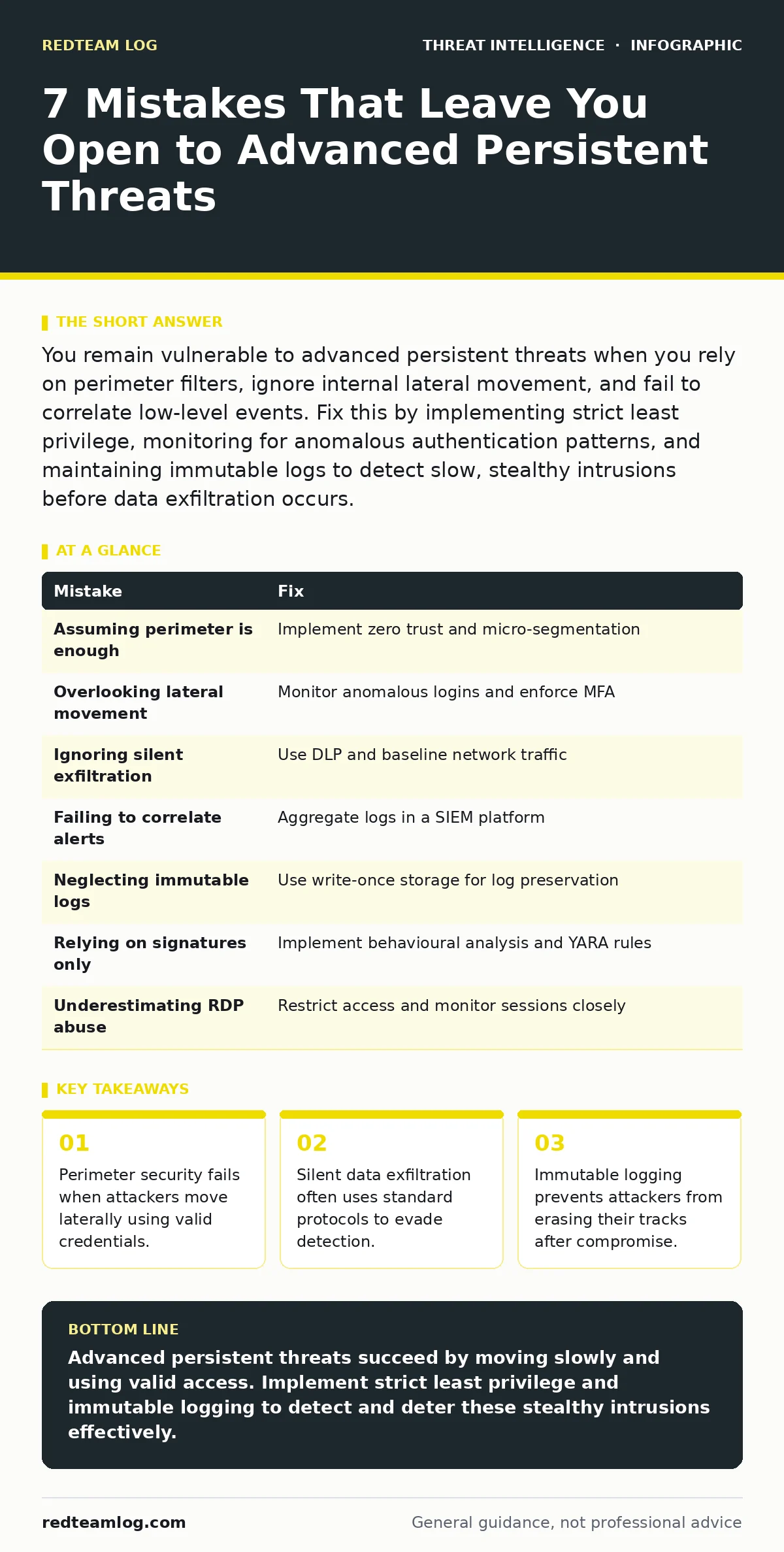
You remain vulnerable to advanced persistent threats when you rely on perimeter filters, ignore internal lateral movement, and fail to correlate low-level events. Fix this by implementing strict least privilege, monitoring for anomalous authentication patterns, and maintaining immutable logs to detect slow, stealthy intrusions before data exfiltration occurs.
Mistake 1: Assuming the Perimeter is Enough
Why it hurts: Advanced persistent threats bypass firewalls by targeting human error or weak remote access points. Once inside, the attacker operates within trusted network zones. Traditional boundary defenses cannot see activity that originates from an authorised user account. The threat actor blends in with normal traffic, rendering perimeter alerts useless against internal movement.
The fix: Adopt a zero trust architecture. Verify every request as if it originates from an untrusted network. Implement micro-segmentation to limit lateral movement. This approach ensures that compromising one workstation does not grant access to critical servers or databases. You must enforce strict identity verification for every connection attempt.
Mistake 2: Overlooking Lateral Movement via Valid Credentials
Why it hurts: Attackers rarely exploit software vulnerabilities to jump between systems. They steal credentials and use them to access other machines. This method leaves no malicious code footprint on the network. Standard intrusion detection systems often miss this because the authentication is technically valid. The attacker becomes a ghost, moving silently through your environment.
The fix: Monitor for anomalous login patterns. Look for logins from unusual locations, at odd hours, or from multiple devices simultaneously. Implement privileged access management to restrict high-level accounts. Regularly rotate credentials and enforce multi-factor authentication for all administrative access. This reduces the value of stolen credentials significantly.
Mistake 3: Ignoring Silent Data Exfiltration Techniques
Why it hurts: Data theft does not always involve large file transfers. Attackers often exfiltrate data in small chunks over long periods. They may use standard protocols like DNS or HTTPS to hide the traffic. This slow-drip approach avoids triggering volume-based alerts. By the time you notice missing data, the attacker has already escaped with sensitive intellectual property or customer records.
The fix: Implement data loss prevention tools that inspect content, not just volume. Establish baselines for normal data flow and alert on deviations. Monitor for large outbound connections during non-business hours. Use network detection and response to identify suspicious patterns in encrypted traffic. You must understand what normal looks like to spot the abnormal.
Mistake 4: Failing to Correlate Low-Severity Alerts
Why it hurts: Security teams drown in noise. Individual alerts often seem benign. A failed login here, a strange process there. Attackers rely on this fragmentation. They perform many small, low-risk actions that individually trigger no alarms. When viewed in isolation, these events appear as mistakes or glitches. The true threat emerges only when you connect the dots across time and systems.
The fix: Use a SIEM platform to aggregate and correlate logs. Create detection use cases that link multiple low-severity events. For example, link a failed login with a subsequent successful login from a different IP. This contextual analysis reveals the attacker’s path. You must shift from reacting to single alerts to analysing behavioural sequences.
Mistake 5: Neglecting Immutable Log Storage
Why it hurts: Attackers know they will be investigated. Their first move after gaining access is often to delete logs. If your logging system allows modification, the attacker erases their trail. You are left with blind spots. Without evidence of the initial breach or lateral movement, you cannot understand the scope. This makes containment and eradication nearly impossible. You are fighting in the dark.
The fix: Store logs in an immutable format. Write-once, read-many storage prevents tampering. Forward logs to a remote, secure destination immediately. Ensure that even administrators cannot delete historical records. This preservation ensures that forensic analysis can reconstruct the attack timeline. You need a single source of truth that the attacker cannot touch.
See also: SIEM Mistakes That Blind Your Defenders and How to Fix Them · Beaconing Detected: Step-by-Step Response and Recovery Plan
Mistake 6: Relying Solely on Signature-Based Detection
Why it hurts: Signature-based tools only recognise known threats. They compare files against a database of hashes. Advanced persistent threats use custom malware or living-off-the-land binaries. These tools do not match any known signature. The detection system sees nothing malicious. The attacker uses standard system utilities to perform malicious tasks, hiding in plain sight. Your defences remain blind to novel attacks.
The fix: Implement behavioural analysis. Focus on what the software does, not what it is called. Detect processes that attempt to access sensitive areas or modify system settings unexpectedly. Use YARA rules to identify suspicious code structures. This approach catches unknown threats by their actions. You must detect intent, not just identity.
Mistake 7: Underestimating the Risk of Remote Desktop Abuse
Why it hurts: Remote desktop protocols provide direct access to systems. Attackers exploit weak configurations or stolen credentials to gain control. Once connected, they have full visibility and control. They can install keyloggers, take screenshots, and manipulate files in real-time. This direct access bypasses many application-layer controls. The attacker becomes a user with eyes on the screen, making detection extremely difficult.
The fix: Restrict remote desktop access to specific, secured networks. Disable it where not strictly necessary. Implement jump servers with strict access controls. Monitor all remote desktop sessions for unusual activity. Record sessions for audit purposes. This reduces the attack surface and provides a record of all remote interactions. You must treat remote access as a high-risk vector.
| Mistake | Fix |
|---|---|
| Assuming perimeter is enough | Implement zero trust and micro-segmentation |
| Overlooking lateral movement | Monitor anomalous logins and enforce MFA |
| Ignoring silent exfiltration | Use DLP and baseline network traffic |
| Failing to correlate alerts | Aggregate logs in a SIEM platform |
| Neglecting immutable logs | Use write-once storage for log preservation |
| Relying on signatures only | Implement behavioural analysis and YARA rules |
| Underestimating RDP abuse | Restrict access and monitor sessions closely |
Key takeaways
- Perimeter security fails when attackers move laterally using valid credentials.
- Silent data exfiltration often uses standard protocols to evade detection.
- Immutable logging prevents attackers from erasing their tracks after compromise.
Advanced persistent threats succeed by moving slowly and using valid access. Implement strict least privilege and immutable logging to detect and deter these stealthy intrusions effectively.
Frequently asked questions
How do I detect living-off-the-land attacks?
Monitor for standard system tools accessing unusual files or network locations. Behavioural analysis catches these anomalies better than signature scans.
What is the first step in zero trust?
Map your data flows and identify critical assets. Then enforce strict identity verification for every access request, regardless of network location.
Can encryption prevent data exfiltration?
Encryption protects data at rest and in transit. It does not stop an authorised user from copying and sending encrypted files to an external destination.
How often should I review detection rules?
Review rules monthly. Attack techniques evolve rapidly. Regular updates ensure your detection logic remains effective against new tactics and strategies.
How this guide was produced: written by the RedTeam Log editorial team with AI assistance, checked against the public references listed below, and reviewed when the facts change. See our editorial policy or report an error.