
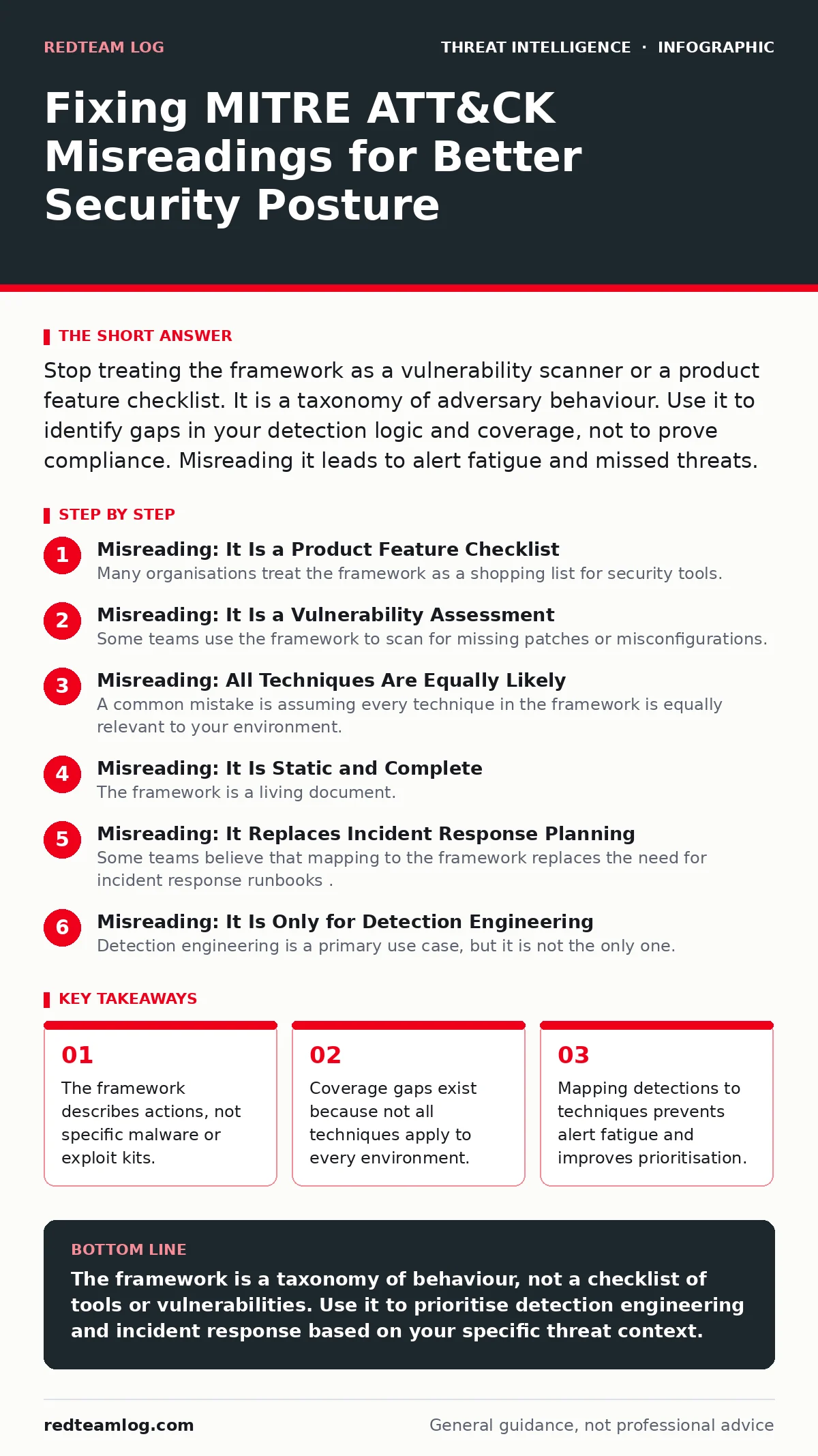
Stop treating the framework as a vulnerability scanner or a product feature checklist. It is a taxonomy of adversary behaviour. Use it to identify gaps in your detection logic and coverage, not to prove compliance. Misreading it leads to alert fatigue and missed threats.
Misreading: It Is a Product Feature Checklist
Many organisations treat the framework as a shopping list for security tools. They assume that if their firewall blocks a technique, they are secure against it. This is a fundamental error. The framework describes adversary behaviour, not the capabilities of defensive products.
Security tools rarely map one-to-one with techniques. A single technique, such as phishing, may require email filtering, user training, and endpoint detection to mitigate. Conversely, a single tool, like a SIEM, may help detect dozens of techniques across multiple tactics.
When you buy tools to "cover" techniques, you create a false sense of security. You might block the initial access but miss the lateral movement that follows. The framework helps you understand what the adversary does, not which button to press on your console.
Correct reading: Use the framework to define your detection requirements. Ask what behaviour you need to see, then determine which tools can observe that behaviour. Do not assume a tool’s marketing claims align with the framework’s granularity.
Misreading: It Is a Vulnerability Assessment
Some teams use the framework to scan for missing patches or misconfigurations. They equate a "covered" technique with a patched system. This confuses risk with exposure. The framework does not tell you if your servers are vulnerable to a specific exploit.
A technique like exploit public-facing applications depends on the software you run and how it is configured. The framework tells you that this is a common entry point. It does not tell you if your web server has the specific flaw that allows it.
Relying on the framework for vulnerability management leaves you blind to unknown weaknesses. You might have full coverage on paper but remain exposed to zero-day flaws. You need separate vulnerability management processes to find the holes the adversary will use.
Correct reading: Treat the framework as a map of the battlefield, not a survey of your fortifications. It shows where attacks happen. You still need to inspect your walls for cracks. Combine framework coverage with regular vulnerability scanning.
Misreading: All Techniques Are Equally Likely
A common mistake is assuming every technique in the framework is equally relevant to your environment. Teams often try to detect every single technique, leading to massive alert fatigue. This is inefficient and distracting.
Threat actor profiling helps you understand who targets your industry and what they prefer. Some actors rarely use initial access brokers. Others rely heavily on beaconing for command and control. Your environment determines which techniques matter.
If you run no mail servers, email-based initial access is less relevant. If you have no internet-facing assets, certain exploitation techniques are impossible. Prioritising techniques based on your context reduces noise and improves response times.
Correct reading: Filter the framework through your threat model. Identify the actors most likely to target you. Focus your detection engineering on the techniques they actually use. Ignore the rest for now.
Misreading: It Is Static and Complete
The framework is a living document. It changes as new adversary behaviours are observed. Treating it as a static standard leads to outdated defences. New techniques emerge regularly. Old ones are retired or merged.
Using an outdated version of the framework means you are missing new adversary methods. You might build detections for techniques that are no longer used. You might miss new ways attackers persist in systems.
Regular updates are necessary. You must review your mappings when the framework changes. You must also review your own environment. New software introduces new attack surfaces. New processes introduce new risks.
Correct reading: Schedule regular reviews of your framework mappings. Check for new techniques that apply to your environment. Update your detection logic accordingly. Treat the framework as a dynamic reference, not a fixed rulebook.
Misreading: It Replaces Incident Response Planning
Some teams believe that mapping to the framework replaces the need for incident response runbooks. They think that knowing the technique is enough to respond. This is dangerous. Knowing the technique does not tell you how to contain it.
A runbook provides step-by-step instructions for specific scenarios. The framework provides the context for those scenarios. You need both. The framework tells you what happened. The runbook tells you what to do next.
Without runbooks, your team will waste time deciding on actions during an incident. This delay allows the adversary to expand their foothold. You need pre-defined actions for common techniques. You need clear roles and responsibilities.
Correct reading: Integrate the framework into your incident response planning. Use it to identify potential attack paths. Write runbooks for the most likely and damaging techniques. Test these runbooks regularly.
See also: Log Management Checklist: Secure Evidence Before It Expires · Initial Access Brokers: How They Operate and How to Detect Them
Misreading: It Is Only for Detection Engineering
Detection engineering is a primary use case, but it is not the only one. The framework also helps with log management, purple teaming, and security awareness. Ignoring these other uses limits its value.
Log management benefits from the framework. You can ensure you are collecting logs that support detection of specific techniques. If you do not log certain events, you cannot detect certain behaviours. The framework highlights these gaps.
Purple teaming uses the framework to design realistic tests. You can simulate specific techniques to validate your detections. This provides empirical evidence of your security posture. It is more valuable than theoretical coverage.
Correct reading: Use the framework across multiple security disciplines. Ensure your logging supports detection. Use it to design realistic tests. Educate your team on adversary behaviour. The framework is a shared language for security.
Key takeaways
- The framework describes actions, not specific malware or exploit kits.
- Coverage gaps exist because not all techniques apply to every environment.
- Mapping detections to techniques prevents alert fatigue and improves prioritisation.
- The framework is a living document that requires regular maintenance and review.
The framework is a taxonomy of behaviour, not a checklist of tools or vulnerabilities. Use it to prioritise detection engineering and incident response based on your specific threat context.
Frequently asked questions
How often should I update my MITRE ATT&CK mappings?
Review your mappings quarterly or whenever the framework releases a major update. Align reviews with your risk assessment cycle.
Can I use the framework for cloud environments?
Yes. The framework has specific matrices for cloud environments like AWS, Azure, and GCP. Use the relevant matrix for your infrastructure.
Do I need to cover every technique?
No. Focus on techniques relevant to your threat model and environment. Covering every technique is inefficient and often impossible.
How do I start using the framework?
Begin by identifying your top threat actors. Map their common techniques to your environment. Prioritise detection for the most likely and impactful techniques.
How this guide was produced: written by the RedTeam Log editorial team with AI assistance, checked against the public references listed below, and reviewed when the facts change. See our editorial policy or report an error.