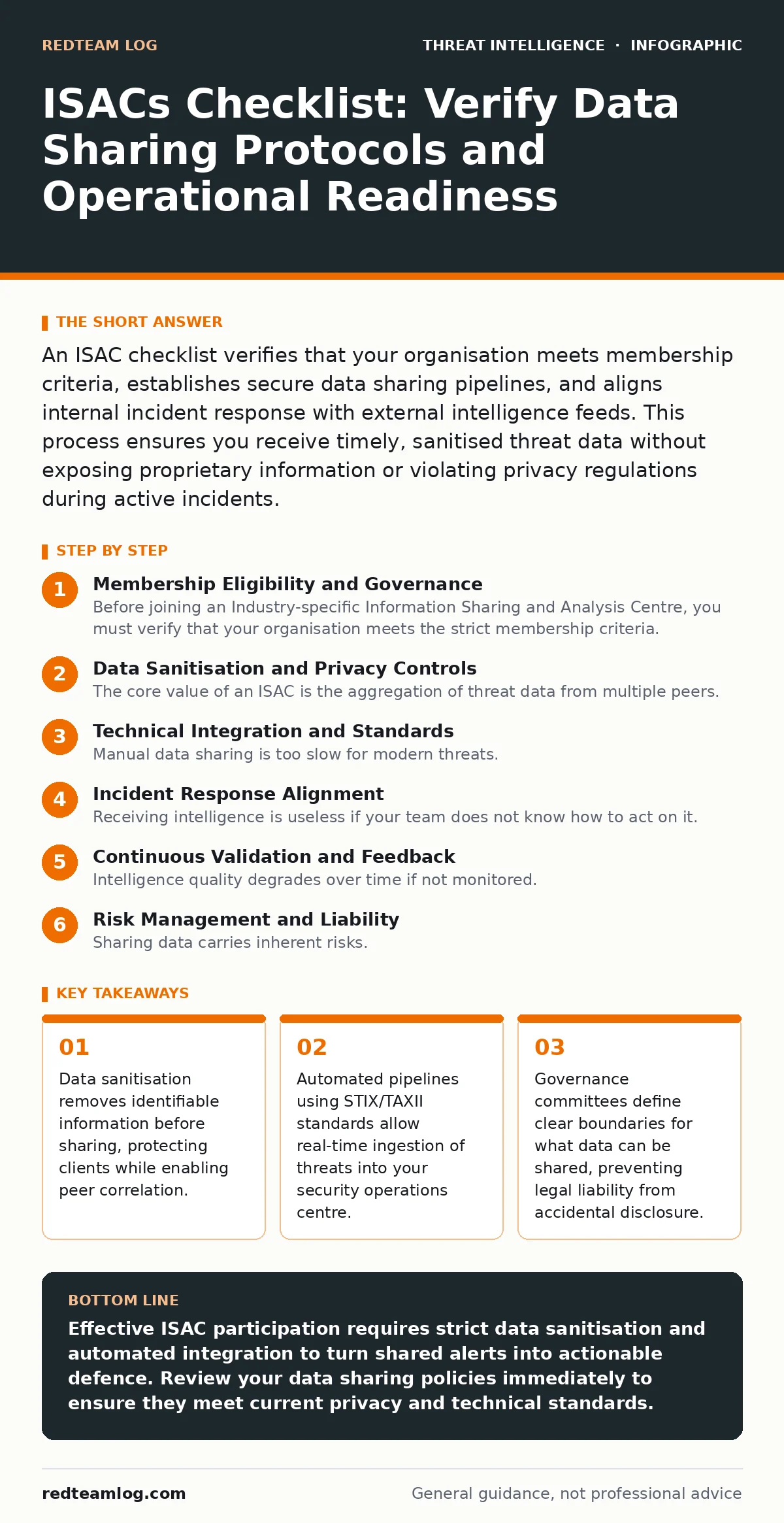
An ISAC checklist verifies that your organisation meets membership criteria, establishes secure data sharing pipelines, and aligns internal incident response with external intelligence feeds. This process ensures you receive timely, sanitised threat data without exposing proprietary information or violating privacy regulations during active incidents.
Membership Eligibility and Governance
Before joining an Industry-specific Information Sharing and Analysis Centre, you must verify that your organisation meets the strict membership criteria. Most centres require proof of operational status and a commitment to reciprocal data sharing. Governance structures within the ISAC determine how decisions are made and how disputes are resolved. You need to understand the voting rights and committee structures to ensure your sector has adequate representation. This prevents a scenario where a single large entity dominates the intelligence direction.
- Confirm membership eligibility requirements: ensures your organisation qualifies for entry and avoids application rejection.
- Review governance committee charters: clarifies decision-making authority and prevents unexpected policy shifts.
- Identify sector-specific focus areas: aligns your security priorities with the collective intelligence goals of the group.
Data Sanitisation and Privacy Controls
The core value of an ISAC is the aggregation of threat data from multiple peers. This aggregation is impossible if members fear legal repercussions from sharing sensitive data. You must implement robust data sanitisation procedures. These procedures strip personally identifiable information and proprietary system details from alerts before they leave your network. Without this step, the trust model collapses. Members will withhold critical data if they believe it could be traced back to their specific infrastructure or clients.
- Define data classification levels: separates shareable threat indicators from confidential business or client data.
- Implement automated redaction tools: removes sensitive details at speed, preventing human error during high-pressure incidents.
- Establish privacy review protocols: ensures legal compliance before any external data transmission occurs.
Technical Integration and Standards
Manual data sharing is too slow for modern threats. You need technical integration with the ISAC’s feeds. Most centres use open standards like STIX and TAXII for this purpose. These standards allow your SIEM or SOAR platform to ingest threats automatically. You must configure these integrations to filter noise. Not all alerts are relevant to your specific environment. Poor configuration leads to alert fatigue, where your analysts ignore genuine warnings because of the volume.
- Configure STIX/TAXII connectors: enables automated, real-time ingestion of threat intelligence into your tools.
- Map indicators to MITRE ATT&CK framework: provides context for threats, helping you understand attacker tactics.
- Set up filtering rules: reduces noise by discarding irrelevant data based on your asset inventory.
Incident Response Alignment
Receiving intelligence is useless if your team does not know how to act on it. Your internal incident response plans must reference ISAC data sources. Analysts need clear workflows for handling shared indicators. This includes steps for verification and containment. If an ISAC alert indicates a widespread vulnerability, your team must be able to scan for it immediately. Delaying response because of unclear procedures gives attackers time to pivot.
- Update playbooks with ISAC triggers: ensures analysts know exactly how to react to specific threat types.
- Conduct joint tabletop exercises: tests your ability to coordinate with peers during a simulated crisis.
- Define escalation paths for shared threats: ensures critical alerts reach the right decision-makers quickly.
Continuous Validation and Feedback
Intelligence quality degrades over time if not monitored. You must validate the indicators you receive. Not all shared data is accurate. False positives can disrupt your operations. You need a feedback loop to report errors back to the ISAC. This improves the overall quality of the collective intelligence. Without feedback, the system becomes polluted with bad data. Your contribution to the feedback loop is as valuable as your data sharing.
- Monitor false positive rates: identifies noisy sources that require adjustment or exclusion.
- Report errors to the ISAC: helps improve the quality of data for all members.
- Review sharing policies annually: ensures your practices remain aligned with evolving regulations and threats.
See also: Initial Access Brokers: How They Operate and How to Detect Them
Risk Management and Liability
Sharing data carries inherent risks. You must understand the liability limits of the ISAC agreement. Most centres provide some legal protection, but it is not absolute. You need to know what happens if shared data leads to a breach elsewhere. Insurance coverage may also need to be reviewed. Some policies exclude losses related to third-party data sharing. Ignoring this aspect leaves you exposed to financial risk.
- Review liability clauses in agreements: clarifies your legal exposure in case of data misuse or errors.
- Consult legal counsel on sharing limits: ensures compliance with local data protection laws.
- Update insurance coverage if needed: protects your organisation from financial loss related to shared data incidents.
Strategic Value Assessment
Finally, measure the value you receive. Intelligence sharing should improve your security posture. Track metrics like detection time and containment speed. If the ISAC data does not help you, reconsider your engagement. You might need to adjust your filtering rules or seek different sources. The goal is actionable intelligence, not just data volume. A strategic approach ensures you get a return on your investment.
- Track detection time improvements: measures the real-world impact of shared intelligence on your operations.
- Assess analyst productivity: ensures the data helps rather than hinders your team's workflow.
- Review cost-benefit ratio annually: confirms the membership remains financially and operationally justified.
Key takeaways
- Data sanitisation removes identifiable information before sharing, protecting clients while enabling peer correlation.
- Automated pipelines using STIX/TAXII standards allow real-time ingestion of threats into your security operations centre.
- Governance committees define clear boundaries for what data can be shared, preventing legal liability from accidental disclosure.
Effective ISAC participation requires strict data sanitisation and automated integration to turn shared alerts into actionable defence. Review your data sharing policies immediately to ensure they meet current privacy and technical standards.
Frequently asked questions
Can I share customer data with an ISAC?
No, you must sanitise all data to remove personally identifiable information and proprietary details before sharing.
How do I automate ISAC data ingestion?
Use standard protocols like STIX and TAXII to connect your SIEM or SOAR platform to the ISAC feed.
What if I receive a false positive?
Report it back to the ISAC through their feedback mechanism to help improve data quality for all members.
Does ISAC membership protect me legally?
Membership agreements often include liability protections, but you must review the specific terms and consult legal counsel.
How this guide was produced: written by the RedTeam Log editorial team with AI assistance, checked against the public references listed below, and reviewed when the facts change. See our editorial policy or report an error.