
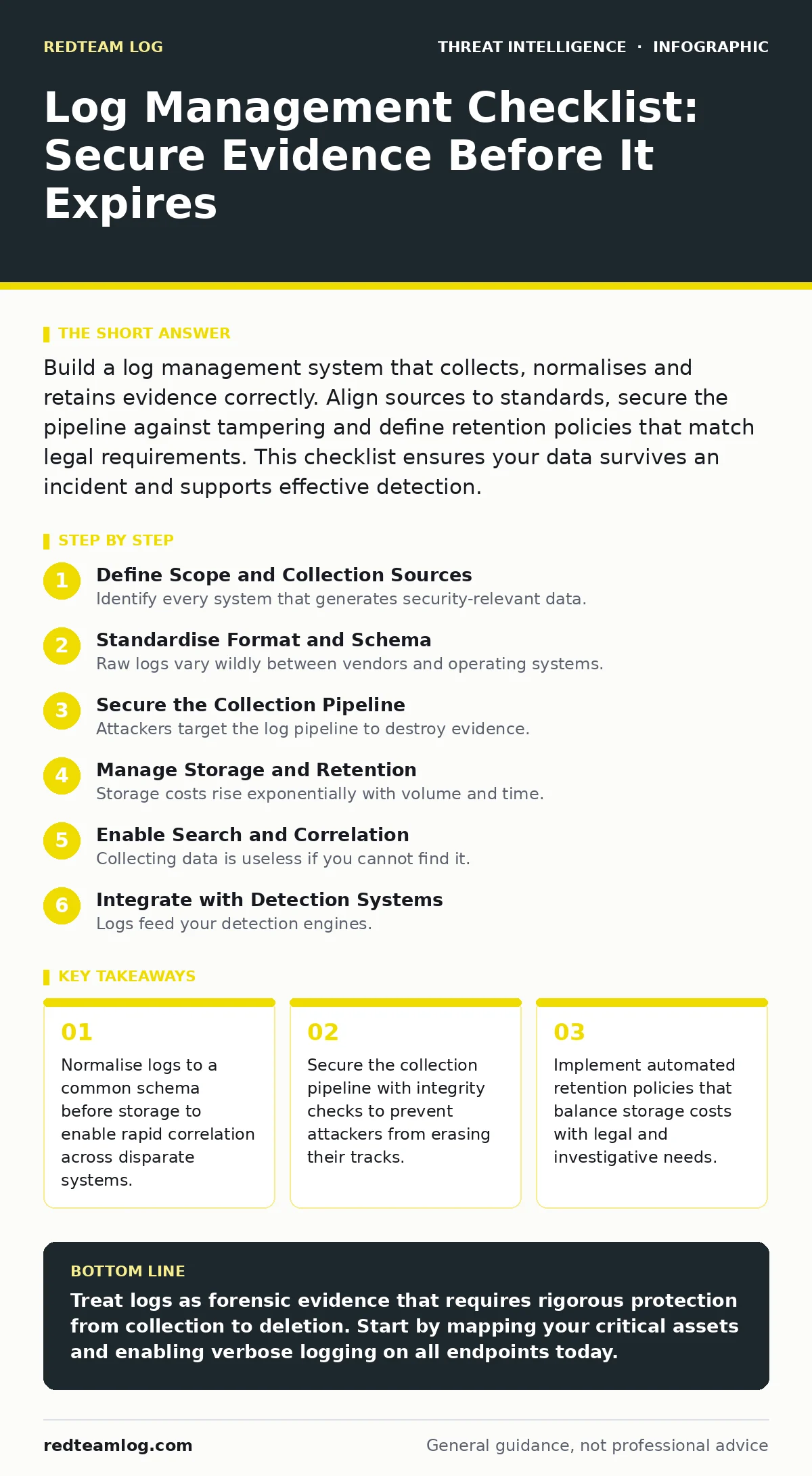
Build a log management system that collects, normalises and retains evidence correctly. Align sources to standards, secure the pipeline against tampering and define retention policies that match legal requirements. This checklist ensures your data survives an incident and supports effective detection.
Define Scope and Collection Sources
Identify every system that generates security-relevant data. You must capture authentication events, network traffic metadata, process creation logs and file access records. Missing a single source creates blind spots that attackers exploit to move laterally.
- Map all critical assets: Ensure every server, endpoint and network device is accounted for in the collection scope.
- Enable verbose logging: Default settings often omit details needed for forensic analysis of complex attacks.
- Capture network flow data: Packet headers reveal connections that endpoint logs might miss or misinterpret.
- Monitor identity providers: Authentication logs are the primary indicator of credential theft and abuse.
Standardise Format and Schema
Raw logs vary wildly between vendors and operating systems. You must normalise these streams into a common schema. This allows your detection engine to correlate events without writing custom parsers for every new device type. Consistency reduces noise and speeds up investigation.
- Adopt a standard schema: Use open formats like CEF or OCSF to ensure compatibility with analysis tools.
- Enforce timestamp synchronisation: All systems must use NTP to align events accurately for timeline reconstruction.
- Validate field mapping: Regularly check that critical fields like user ID and IP address map correctly.
- Document data dictionary: Define what each field means to avoid misinterpretation during urgent investigations.
Secure the Collection Pipeline
Attackers target the log pipeline to destroy evidence. If an adversary can modify or delete logs before they reach your storage, your entire security posture is compromised. You must treat the collection path as a critical security boundary, not just a data conduit.
- Use encrypted transport: TLS protects logs in transit from interception and modification by network attackers.
- Implement integrity hashing: Add hash checks to detect any alteration of log data during transfer.
- Restrict pipeline access: Only authorised collectors should write to the ingestion endpoints to prevent injection.
- Monitor collector health: Alert on collector failures immediately to identify potential tampering or denial of service.
Manage Storage and Retention
Storage costs rise exponentially with volume and time. You need a tiered strategy that keeps recent data hot for immediate analysis and moves older data to cold storage. Retention periods must align with legal obligations and incident response needs. Premature deletion destroys evidence.
- Define retention tiers: Keep active logs online for rapid search and archive older data for compliance.
- Align with legal requirements: Understand jurisdictional rules for data privacy and evidence preservation durations.
- Automate lifecycle policies: Use automated rules to move or delete data, reducing manual administrative overhead.
- Monitor storage capacity: Alert when storage approaches limits to prevent data loss from full disks.
Enable Search and Correlation
Collecting data is useless if you cannot find it. You need a search interface that supports complex queries across normalised fields. Correlation rules must link related events across different sources to reveal attack patterns. Slow search times delay containment efforts.
- Index critical fields: Ensure user IDs, IP addresses and event types are indexed for fast retrieval.
- Build correlation rules: Link authentication failures with process executions to detect lateral movement attempts.
- Optimise query performance: Tune the search engine to handle complex joins without excessive latency.
- Test search scenarios: Regularly run simulated queries to verify that relevant data is retrievable quickly.
See also: Dark web search engines: how indexing works and what you find · ISACs Checklist: Verify Data Sharing Protocols and Operational Readiness
Integrate with Detection Systems
Logs feed your detection engines. You must integrate your log management system with your SIEM or threat detection platform. This integration allows for real-time alerting based on log content. Without this link, logs remain passive records rather than active security assets.
- Connect to SIEM: Stream normalised logs into your security information and event management system.
- Tune alert thresholds: Adjust sensitivity to reduce false positives while catching true anomalies.
- Validate detection logic: Ensure alerts trigger on expected log patterns from your test environments.
- Review missed detections: Regularly analyse logs for attacks that bypassed current detection rules.
Validate and Test Integrity
Assume your logs are incomplete or tampered with. You must regularly test the entire pipeline from generation to storage. Simulate attacks and verify that the corresponding logs are captured, normalised and searchable. This validation confirms your system works when you need it most.
- Run log integrity tests: Verify that hashes match between source and storage to detect tampering.
- Simulate attack scenarios: Generate fake malicious events and trace them through the entire pipeline.
- Check for gaps: Identify any time periods or systems where logs are missing or delayed.
- Document test results: Keep records of validation tests to demonstrate compliance and operational readiness.
Key takeaways
- Normalise logs to a common schema before storage to enable rapid correlation across disparate systems.
- Secure the collection pipeline with integrity checks to prevent attackers from erasing their tracks.
- Implement automated retention policies that balance storage costs with legal and investigative needs.
Treat logs as forensic evidence that requires rigorous protection from collection to deletion. Start by mapping your critical assets and enabling verbose logging on all endpoints today.
Frequently asked questions
How long should I keep security logs?
Retention depends on legal requirements and investigative needs. Keep active logs online for months and archive older data for years to satisfy compliance and support long-term incident response.
What is the difference between SIEM and log management?
Log management handles collection, storage and retrieval of raw data. SIEM adds real-time analysis, correlation and alerting. You need both for effective security operations and threat detection.
Can attackers hide in normalised logs?
Normalisation reduces noise but does not hide activity. Attackers may use legitimate processes to blend in. You must tune detection rules to identify anomalous behaviour within normalised data streams.
How do I handle log volume spikes?
Implement throttling and sampling for high-volume, low-value logs. Prioritise security-critical events. Use tiered storage to manage costs during unexpected traffic surges without losing essential data.
How this guide was produced: written by the RedTeam Log editorial team with AI assistance, checked against the public references listed below, and reviewed when the facts change. See our editorial policy or report an error.