
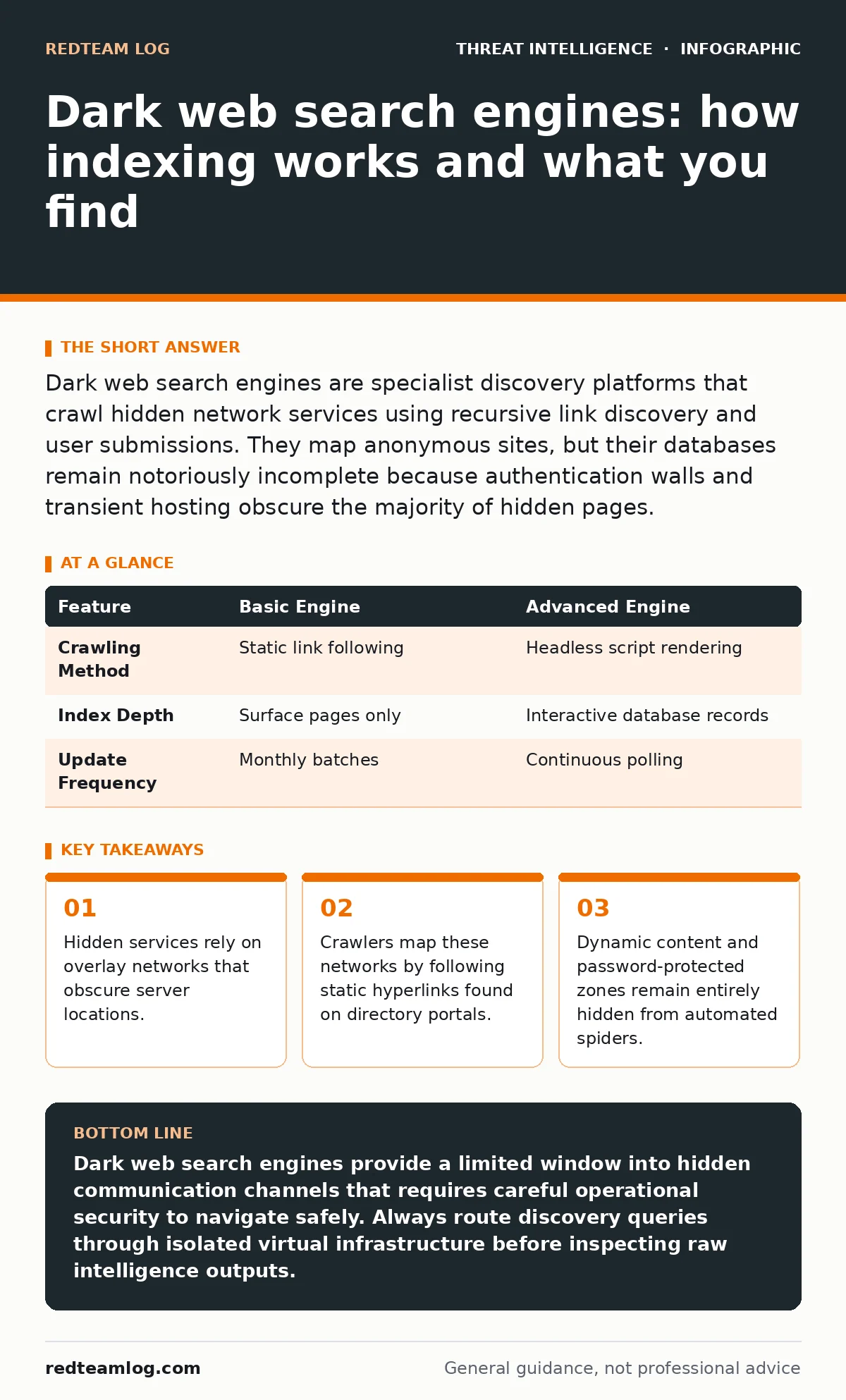
Dark web search engines are specialist discovery platforms that crawl hidden network services using recursive link discovery and user submissions. They map anonymous sites, but their databases remain notoriously incomplete because authentication walls and transient hosting obscure the majority of hidden pages.
What are dark web search engines?
Dark web search engines are specialist discovery platforms designed to index websites hosted on anonymous overlay networks. These platforms operate 2 primary phases of data collection, yet they must negotiate protocol-specific routing layers to reach their targets. Analysts use them during threat actor profiling to locate leaked corporate assets and exposed credentials without tipping off malicious operators.
How do dark web search engines crawl hidden sites?
Dark web search engines crawl hidden sites by following static hyperlinks discovered through directory portals and user submissions. Automated spiders traverse the anonymous network topology across 3 distinct phases, recording page titles and text content into searchable databases. Discovery relies heavily on directory submission because automated random link guessing proves ineffective against large cryptographic address spaces.
Why do dark web search engines miss most hidden pages?
Dark web search engines miss most hidden pages because a vast proportion of overlay network services operate behind strict login prompts or temporary routing configurations. Transient hosting causes links to break rapidly, leaving indexes cluttered with obsolete entries. Automated spiders cannot navigate interactive forms or solve cryptographic challenges presented by modern access control mechanisms.
What kind of data appears in dark web search engine results?
Dark web search engine results feature stolen corporate credentials, illicit marketplaces, discussion forums, and leaked source code repositories. Security teams monitor these indexes to detect early indicators of compromise before stolen data circulates widely. Attackers often stage stolen assets on ephemeral file hosting services that disappear shortly after discovery.
How do authentication walls block dark web search engines?
Authentication walls block dark web search engines by demanding valid credentials or cryptographic tokens before rendering any page content. Automated crawlers lack the credentials required to bypass these login gateways, meaning deep database contents remain completely unindexed. Security analysts investigating advanced persistent threats frequently encounter these gated communities where stolen intellectual property changes hands.
See also: Initial Access Brokers: How They Operate and How to Detect Them
Can you use standard boolean operators on dark web search engines?
Standard boolean operators function inconsistently across dark web search engines due to limited underlying database architectures. Basic keyword matching usually works, but complex nested queries often fail or return excessive false positives. Analysts must refine their search strings manually to filter out the noise generated by poor text parsing routines.
How do administrators hide sites from dark web search engines?
Administrators hide sites from dark web search engines by omitting public hyperlinks, disabling directory listing features, and enforcing strict access controls. Obscuring a service address prevents automated crawlers from discovering the endpoint during routine network sweeps. Network defenders use port scanning techniques on public perimeters, but internal overlay concealment requires entirely different visibility strategies.
What are the operational risks of querying dark web search engines?
Operational risks of querying dark web search engines include exposing investigator metadata, encountering malicious browser exploits, and triggering automated intrusion alerts. Unvetted search interfaces frequently serve compromised JavaScript or malicious downloads designed to compromise visiting workstations. Organisations must route all investigation traffic through isolated virtual environments equipped with strict script blockers.
How do advanced search engines handle dynamic onion content?
Advanced search engines handle dynamic onion content by employing headless browsers that execute client-side scripts to render full page structures. Rendering dynamic elements allows these sophisticated crawlers to index content hidden behind interactive JavaScript applications. Integrating log management pipelines helps analysts track search queries and spot unusual patterns across investigative sessions.
| Feature | Basic Engine | Advanced Engine |
|---|---|---|
| Crawling Method | Static link following | Headless script rendering |
| Index Depth | Surface pages only | Interactive database records |
| Update Frequency | Monthly batches | Continuous polling |
Key takeaways
- Hidden services rely on overlay networks that obscure server locations.
- Crawlers map these networks by following static hyperlinks found on directory portals.
- Dynamic content and password-protected zones remain entirely hidden from automated spiders.
Dark web search engines provide a limited window into hidden communication channels that requires careful operational security to navigate safely. Always route discovery queries through isolated virtual infrastructure before inspecting raw intelligence outputs.
Frequently asked questions
Can these engines index password-protected forums?
Protected forums remain entirely invisible because crawlers cannot authenticate without valid user credentials.
Do hidden service addresses change frequently?
Addresses change often due to server migrations and hosting instability, which breaks search index links rapidly.
Are queries logged by dark web search providers?
Many engines log search terms and client metadata, creating significant tracking risks for unmasked investigators.
Why do some results lead to dead links?
Ephemeral hosting practices cause many hidden services to vanish shortly after creation, leaving obsolete index entries behind.
How this guide was produced: written by the RedTeam Log editorial team with AI assistance, checked against the public references listed below, and reviewed when the facts change. See our editorial policy or report an error.