
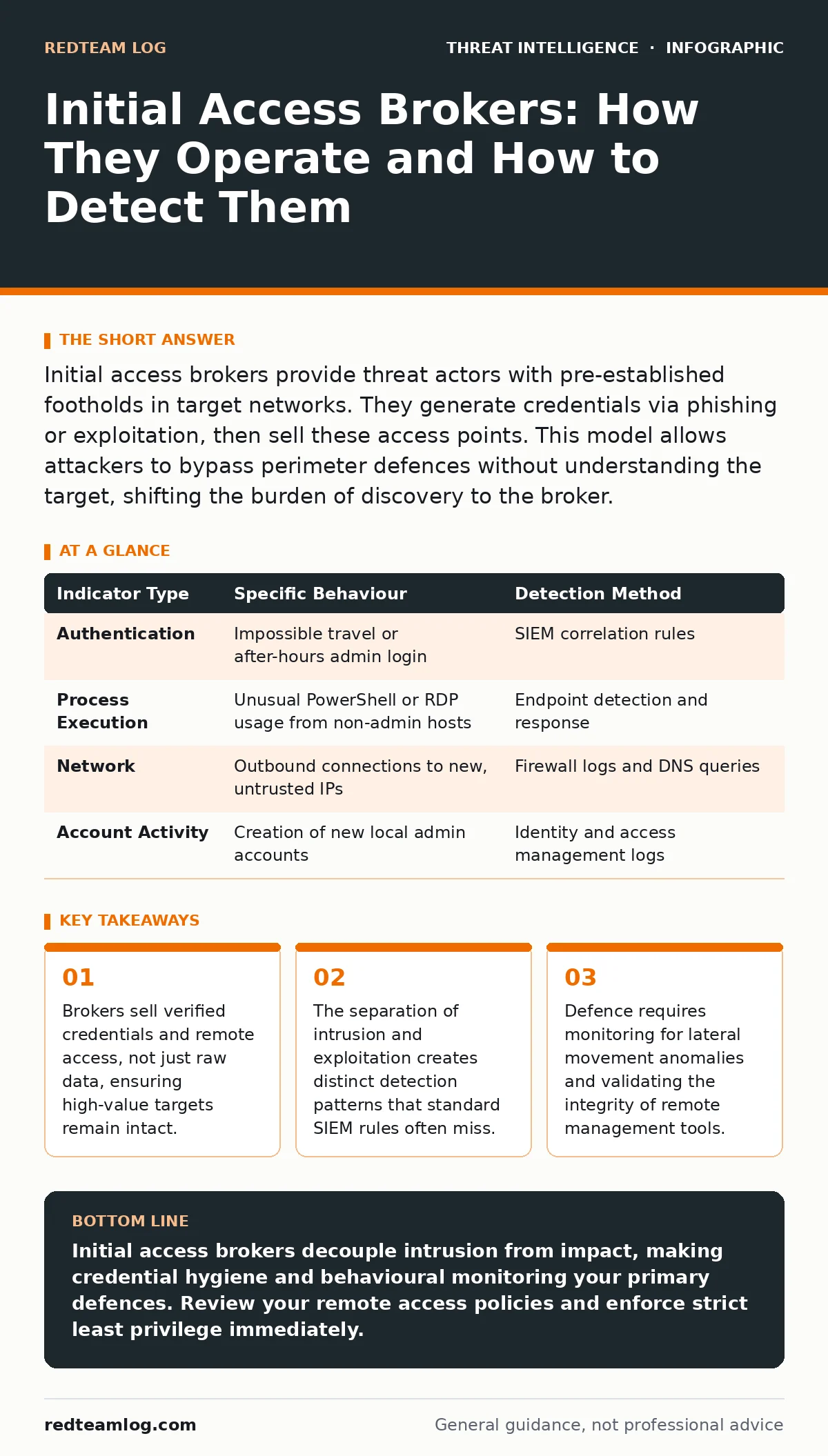
Initial access brokers provide threat actors with pre-established footholds in target networks. They generate credentials via phishing or exploitation, then sell these access points. This model allows attackers to bypass perimeter defences without understanding the target, shifting the burden of discovery to the broker.
What is an initial access broker?
An initial access broker is a cybercriminal entity that specialises in infiltrating corporate networks and selling the resulting access to other threat groups. These brokers do not typically steal data or deploy ransomware themselves. Instead, they focus on maintaining persistent, undetected presence within high-value environments. They act as a marketplace intermediary, verifying that the access works and providing remote control capabilities to the buyer. This specialisation allows less technical actors to compromise sophisticated targets by purchasing proven entry points rather than developing their own intrusion capabilities.
How do initial access brokers gain entry?
Brokers primarily use targeted phishing campaigns and exploited remote access vulnerabilities to establish footholds. They send spear-phishing emails containing malicious attachments or links designed to harvest credentials or install backdoors. Alternatively, they scan for unpatched vulnerabilities in remote desktop services or virtual private network gateways. Once inside, they deploy command and control infrastructure to maintain communication. They carefully avoid triggering alarms, often using legitimate administrative tools to blend in with normal network traffic. This stealth approach ensures the access remains viable for sale.
What exactly do they sell to attackers?
Brokers sell verified administrative credentials, remote desktop protocol access, and shell sessions. They provide details about the target organisation, including its industry, size, and security posture. Listings often include screenshots of the compromised environment to prove access validity. Some brokers offer "escrow" services, holding payment until the buyer confirms the access works. They may also sell specific privileges, such as domain administrator rights or access to critical servers. This granularity allows buyers to select the exact level of access required for their specific campaign, whether it is data theft or ransomware deployment.
Why do threat actors buy access instead of hacking themselves?
Purchasing access reduces the time, cost, and risk associated with independent intrusion campaigns. Developing custom exploits or running large-scale phishing operations requires significant resources and technical expertise. Buying access allows threat actors to bypass the most difficult phase of the kill chain: initial compromise. It also provides anonymity, as the broker handles the direct interaction with the target’s perimeter. This separation of labour means the attacker never touches the victim’s network during the intrusion phase, reducing the digital footprint that could lead to attribution. It turns cybercrime into a scalable service industry.
How can you detect broker-sold access in your environment?
Detection requires monitoring for anomalous authentication patterns and unexpected remote management activity. Look for logins from unusual geographical locations or at atypical times. Pay attention to accounts that suddenly gain elevated privileges without a corresponding change request. Monitor for the creation of new remote management sessions from known administrative workstations. Analyse network flows for connections to unknown external IP addresses that resemble command and control traffic. Integrating these signals into your SIEM allows for correlation of seemingly benign events into a coherent attack narrative.
| Indicator Type | Specific Behaviour | Detection Method |
|---|---|---|
| Authentication | Impossible travel or after-hours admin login | SIEM correlation rules |
| Process Execution | Unusual PowerShell or RDP usage from non-admin hosts | Endpoint detection and response |
| Network | Outbound connections to new, untrusted IPs | Firewall logs and DNS queries |
| Account Activity | Creation of new local admin accounts | Identity and access management logs |
See also: Log Management Checklist: Secure Evidence Before It Expires
What is the difference between a broker and an APT?
An advanced persistent threat group typically conducts the entire attack lifecycle, from reconnaissance to exfiltration, for strategic goals. An initial access broker only performs the intrusion phase and sells the result. APTs may use brokers to gain entry, but they maintain long-term operational security and custom tooling. Brokers prioritise volume and reliability, selling access to multiple buyers simultaneously. This means a single compromised account might be used by different threat actors for different purposes, such as espionage and financial fraud, within the same timeframe. The broker’s goal is profit from access; the APT’s goal is strategic advantage.
How do brokers maintain persistence without detection?
Brokers use low-and-slow techniques to avoid triggering security alerts. They create hidden user accounts with names that resemble legitimate service accounts. They modify registry keys or scheduled tasks to ensure their backdoors survive reboots. They often use living-off-the-land binaries, which are standard system tools repurposed for malicious activity. This makes their activity look like normal administrative work. They also rotate credentials and change command and control infrastructure regularly to disrupt tracking. This persistence strategy ensures the access remains valid for weeks or months, increasing its value on the black market.
How does this model change defensive strategies?
Defences must shift from perimeter protection to continuous verification of internal state. Since brokers sell valid credentials, firewalls and intrusion prevention systems are less effective. You must assume that some credentials are compromised and monitor for misuse. Implement strict least privilege principles to limit the damage of a stolen account. Use multi-factor authentication to render stolen passwords useless. Regularly audit administrative accounts and remote access configurations. This approach aligns with the principles of threat actor profiling, where you anticipate the methods of those who buy access, not just those who create it.
Can automation stop initial access brokers?
Automation can accelerate response but cannot fully prevent broker-sold access. Automated playbooks can isolate compromised hosts and reset credentials rapidly. However, the initial compromise often happens before automation can react. You need automated monitoring to detect the subtle signs of broker activity, such as unusual process trees or network connections. Integrating YARA rules into your endpoint detection can help identify known backdoor signatures. But the human element remains critical for analysing complex incidents and determining the true scope of the breach. Automation supports detection; it does not replace strategic defence.
Key takeaways
- Brokers sell verified credentials and remote access, not just raw data, ensuring high-value targets remain intact.
- The separation of intrusion and exploitation creates distinct detection patterns that standard SIEM rules often miss.
- Defence requires monitoring for lateral movement anomalies and validating the integrity of remote management tools.
Initial access brokers decouple intrusion from impact, making credential hygiene and behavioural monitoring your primary defences. Review your remote access policies and enforce strict least privilege immediately.
Frequently asked questions
Do initial access brokers target small businesses?
They primarily target large enterprises with valuable data and high ransom payouts, but mid-sized companies with poor security hygiene are also frequent victims.
How long does broker-sold access last?
Access can last from a few days to several months, depending on the broker’s ability to maintain persistence and the target’s detection capabilities.
Is multi-factor authentication enough to stop them?
MFA significantly reduces the value of stolen passwords, but brokers may use session hijacking or phishing to bypass MFA. It is a strong layer, not a complete solution.
How do I report a suspected broker incident?
Report the incident to your national cybersecurity agency and relevant industry **ISACs** to share indicators of compromise with peers and law enforcement.
How this guide was produced: written by the RedTeam Log editorial team with AI assistance, checked against the public references listed below, and reviewed when the facts change. See our editorial policy or report an error.