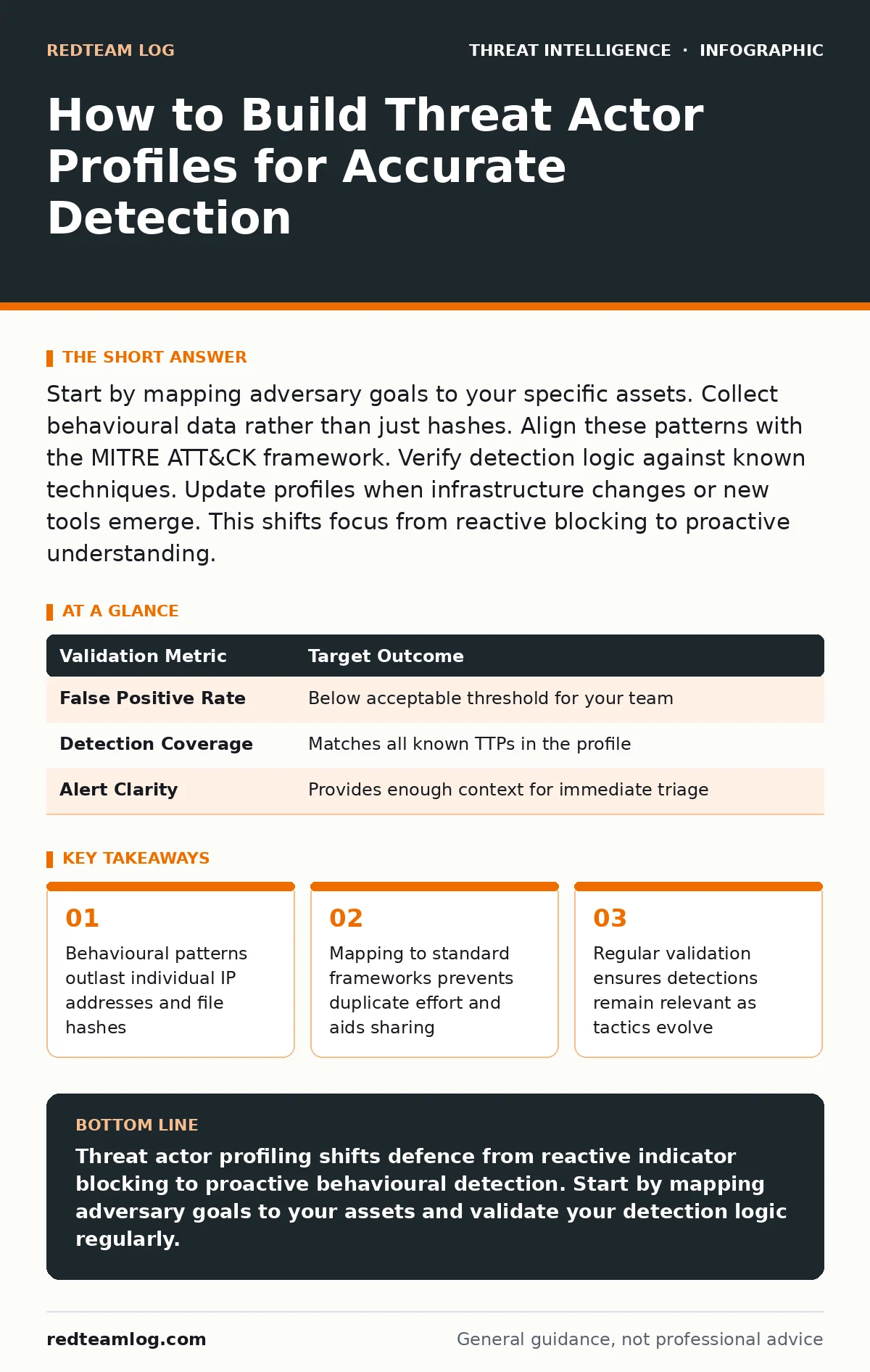
Start by mapping adversary goals to your specific assets. Collect behavioural data rather than just hashes. Align these patterns with the MITRE ATT&CK framework. Verify detection logic against known techniques. Update profiles when infrastructure changes or new tools emerge. This shifts focus from reactive blocking to proactive understanding.
Define the Scope of Adversary Motivation
You cannot profile a threat actor if you do not know what they want. Start by identifying the specific assets within your environment that hold value. Financial systems, intellectual property, and customer databases attract different adversaries than operational technology or email servers. This alignment prevents you from chasing noise from actors who have no interest in your specific sector.
Imagine a group that targets healthcare providers for ransomware. They rarely care about your marketing website. If you profile them against your public-facing web applications, you will waste resources. Instead, focus on their preference for initial access brokers and their movement through clinical data stores. This narrowing allows you to build a precise behavioural signature rather than a broad, useless net.
Collect Multi-Source Intelligence Data
Gather information from multiple independent sources to build a complete picture. Do not rely on a single feed or a single internal log source. Combine open-source intelligence, commercial feeds, and your own internal telemetry. Each source has blind spots. Open sources lack context about your specific environment. Internal logs lack context about broader adversary campaigns.
When you combine these streams, you see connections that remain hidden in isolation. You might notice that a domain seen in your logs also appears in public reports about a specific campaign. This correlation strengthens your profile. Ensure your data collection respects privacy laws and minimizes the footprint of your own monitoring activities.
Map Behaviours to Standard Frameworks
Raw data is difficult to analyse without structure. Map the collected behaviours to a standard model like the MITRE ATT&CK framework. This framework catalogues adversary tactics and techniques based on real-world observations. It provides a common language for describing what an actor does, regardless of the specific tools they use.
This mapping forces you to look beyond the surface. Instead of noting that a script was executed, you identify it as a lateral movement technique. This abstraction allows you to detect variations of the same attack. If the actor changes their scripting language, your detection logic remains valid because it targets the underlying behaviour, not the specific code. This approach also simplifies the sharing of intelligence with other organisations.
Identify Infrastructure and Tooling Reuse
Adversaries often reuse infrastructure and tools across multiple campaigns. Identifying this reuse is a powerful way to link disparate incidents. Look for recurring IP ranges, domain registration patterns, and certificate fingerprints. Also, track the specific software they develop or modify. Custom tools often have unique signatures that persist even when the actor changes their tactics.
Suppose you see a new malware variant in your network. By analysing its code structure, you might find similarities to a tool used in an attack six months ago. This link allows you to apply existing detection rules and response playbooks. It also helps you anticipate their next move, as actors often follow a predictable progression when they feel confident in their foothold.
Build and Test Detection Logic
Translate your profiles into actionable detection rules. Use your SIEM to correlate events and identify the sequences described in your profiles. Do not just look for single indicators. Look for the chain of actions that constitutes the attack. This sequence-based approach reduces false positives significantly. A single suspicious event is often benign. A sequence of events matching the actor’s profile is rarely accidental.
Create detection use cases that align with your profiles. Test these rules against benign traffic to ensure they do not disrupt operations. Then, test them against simulated attacks to confirm they trigger correctly. This validation step is critical. A detection rule that generates too many false positives will be ignored by analysts. A rule that misses the attack is worse than useless.
Step 1: Draft the initial detection rules
Write rules that target the specific behaviours identified in your profile. Focus on the most reliable indicators first.
Step 2: Tune thresholds and filters
Adjust the sensitivity of your rules to balance coverage and noise. Exclude known benign activities that match the pattern.
Step 3: Validate against historical data
Run your new rules against past log data. Check for missed detections and false positives. Refine the logic based on these findings.
| Validation Metric | Target Outcome |
|---|---|
| False Positive Rate | Below acceptable threshold for your team |
| Detection Coverage | Matches all known TTPs in the profile |
| Alert Clarity | Provides enough context for immediate triage |
See also: Fixing MITRE ATT&CK Misreadings for Better Security Posture · Dark web search engines: how indexing works and what you find
Establish a Maintenance Cycle
Threat actor profiles are not static. Adversaries adapt their methods to avoid detection. You must update your profiles regularly. Schedule periodic reviews to incorporate new intelligence and adjust for changes in your environment. This upkeep ensures your detection logic remains effective.
Integrate profile updates into your incident response runbooks. When you encounter a new incident, assess whether it fits an existing profile or requires a new one. Document the findings and update your detection rules accordingly. This continuous loop keeps your defence aligned with the current threat environment.
Verify Profile Effectiveness
You must know if your profiling effort is working. Review your detection logs regularly. Look for trends in alert volume and accuracy. If you see a sudden drop in alerts for a known actor, investigate why. They may have changed their tactics, or your detection may have broken.
Use tabletop exercises to test your response. Simulate an attack by a profiled actor and walk through your detection and response steps. This exercise reveals gaps in your knowledge and your procedures. It also trains your team to recognise the specific patterns you have profiled.
- Review detection accuracy metrics weekly
- Update profiles with new intelligence monthly
- Test detection rules against simulated attacks quarterly
- Document changes to adversary behaviour explicitly
Key takeaways
- Behavioural patterns outlast individual IP addresses and file hashes
- Mapping to standard frameworks prevents duplicate effort and aids sharing
- Regular validation ensures detections remain relevant as tactics evolve
Threat actor profiling shifts defence from reactive indicator blocking to proactive behavioural detection. Start by mapping adversary goals to your assets and validate your detection logic regularly.
Frequently asked questions
How often should I update threat actor profiles?
Update profiles whenever new intelligence emerges or when you observe a change in adversary behaviour. Regular monthly reviews ensure your detections remain relevant and effective.
Can I use threat actor profiling for internal threats?
Yes, but the approach differs. Internal threats often use legitimate credentials and known tools. Focus on behavioural anomalies and deviations from normal user patterns rather than external infrastructure.
What is the biggest challenge in profiling?
The biggest challenge is distinguishing between normal activity and adversarial behaviour. This requires deep knowledge of your environment and careful tuning of detection rules to minimise false positives.
Do I need expensive tools for profiling?
No, effective profiling relies on good data and careful analysis. Open-source tools and standard frameworks can support profiling. The key is consistent process and skilled analysis, not expensive software.
How this guide was produced: written by the RedTeam Log editorial team with AI assistance, checked against the public references listed below, and reviewed when the facts change. See our editorial policy or report an error.