
SOC 2 is not a security score or a compliance certificate you can buy. It is an audit report verifying that your security, availability, processing integrity, confidentiality, and privacy controls operate effectively. You must maintain these controls continuously, not just during the audit window, to satisfy client requirements and regulatory expectations.
Misreading: SOC 2 is a security certification you can pass
Many organisations treat SOC 2 like a product certification, assuming there is a final grade or a seal they can display after a successful audit. This view is incorrect because SOC 2 is not a standard with pass/fail criteria issued by a governing body. It is a reporting framework developed by the American Institute of Certified Public Accountants (AICPA).
Correct reading: You do not "pass" SOC 2. You undergo an examination where an independent auditor evaluates your controls against the Trust Services Criteria. The output is a report, not a certificate. This report describes the system, the criteria applied, and the auditor’s opinion on whether the controls were designed and operated effectively. There is no central registry of "SOC 2 compliant" companies. The value lies in the detailed findings within the report, which allow clients to assess your risk posture based on evidence, not marketing claims.
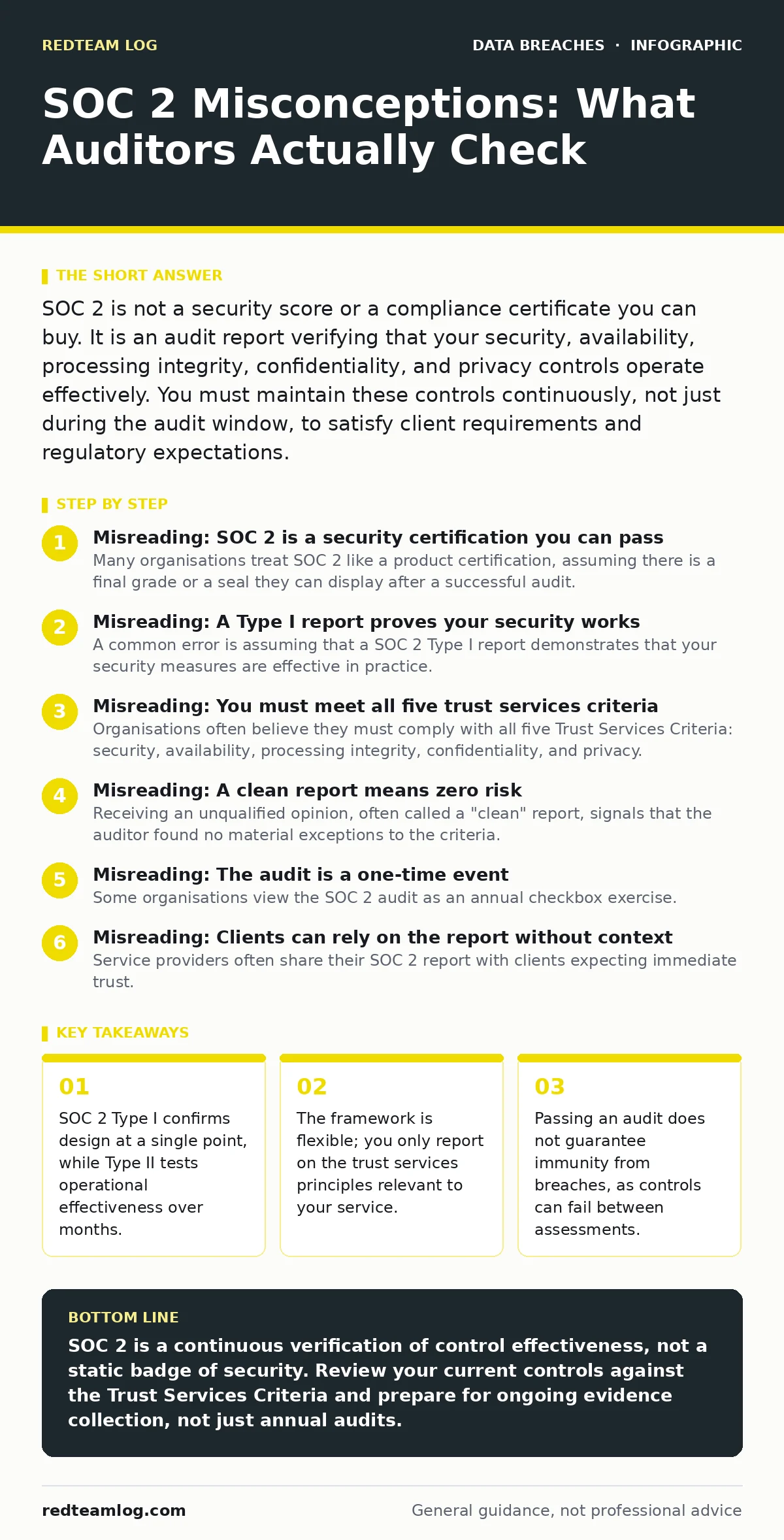
Misreading: A Type I report proves your security works
A common error is assuming that a SOC 2 Type I report demonstrates that your security measures are effective in practice. Type I reports only assess the design of controls at a specific point in time. They confirm that your policies and technical configurations are structured correctly to meet the criteria.
Correct reading: Type I is a snapshot of your intended state, not your operational reality. It tells a reader that you have defined procedures for unauthorized access prevention, but it does not prove those procedures catch every intrusion attempt. For assurance that controls work over time, you need a Type II report. Type II examines the same controls but tests their operating effectiveness over a period, typically six to twelve months. This duration allows auditors to sample transactions and events, verifying that your principle of least privilege is consistently enforced, not just documented.
Misreading: You must meet all five trust services criteria
Organisations often believe they must comply with all five Trust Services Criteria: security, availability, processing integrity, confidentiality, and privacy. This misconception leads to unnecessary effort and cost when certain criteria do not apply to their service model.
Correct reading: SOC 2 is tailored to your service. You only report on the criteria relevant to your commitments to clients. Security, also known as the Common Criteria, is mandatory for all SOC 2 reports because it underpins the others. However, if you do not handle personally identifiable information, you would not include the Privacy criteria. If your service is a simple storage bucket with no processing logic, Processing Integrity may be irrelevant. You define the scope based on your system description and client contracts. Including irrelevant criteria adds noise to the report and distracts from the controls that actually protect your users' data.
Misreading: A clean report means zero risk
Receiving an unqualified opinion, often called a "clean" report, signals that the auditor found no material exceptions to the criteria. Many stakeholders interpret this as a guarantee of safety or a promise that no breaches will occur. This is a dangerous overreach of what the report signifies.
Correct reading: An unqualified opinion means your controls operated effectively during the audit period, not that your system is invulnerable. Auditors test samples, not every single transaction. Furthermore, new threats emerge daily. A report reflects the past, not the future. You must maintain data encryption standards and monitor for data leaks continuously. The report is a baseline for trust, not a shield against future incidents. It provides comfort, but it does not eliminate the need for active defence and incident communication plans.
Misreading: The audit is a one-time event
Some organisations view the SOC 2 audit as an annual checkbox exercise. They ramp up documentation and monitoring only when the auditor arrives, then relax controls until the next cycle. This approach fails to address the continuous nature of cyber risk.
Correct reading: SOC 2 requires continuous control operation. Auditors look for evidence of ongoing processes, such as regular access reviews, patch management logs, and backup tests. If you only tighten controls during the audit window, the auditor may note this as a lack of sustainability or consistency. A Type II report specifically penalises gaps in operational effectiveness. If your employee data breaches policy is only enforced when the auditor is watching, the report will reflect that inconsistency. You must embed these practices into your daily operations. The audit validates your routine, it should not dictate it.
See also: Data Sovereignty Explained: Where Your Data Legally Lives · Data Masking Misconceptions That Leave Sensitive Records Exposed
Misreading: Clients can rely on the report without context
Service providers often share their SOC 2 report with clients expecting immediate trust. However, clients may lack the expertise to interpret the nuances of the auditor’s opinion or the system description. They may overlook exceptions or misunderstand the scope.
Correct reading: The report is a technical document that requires careful review. Clients should check the system description to ensure it matches the services they are purchasing. They must read the auditor’s opinion for any qualifications or exceptions. A qualified opinion indicates a material deviation from the criteria.
Clients should also review the complementary user entity controls, which are responsibilities the client must perform for the provider’s controls to be effective. For example, if the provider secures the platform but the client manages user passwords, the client is responsible for data subject rights requests and password complexity. Relying on the report without this context leaves blind spots in the security chain.
Key takeaways
- SOC 2 Type I confirms design at a single point, while Type II tests operational effectiveness over months.
- The framework is flexible; you only report on the trust services principles relevant to your service.
- Passing an audit does not guarantee immunity from breaches, as controls can fail between assessments.
- Third-party reliance on SOC 2 requires understanding the scope and any noted exceptions in the report.
SOC 2 is a continuous verification of control effectiveness, not a static badge of security. Review your current controls against the Trust Services Criteria and prepare for ongoing evidence collection, not just annual audits.
Frequently asked questions
How long does it take to get SOC 2 certified?
There is no certification. Preparing for a Type I audit can take three to six months depending on your maturity. A Type II audit requires an additional six to twelve months of evidence collection to prove operational effectiveness.
Can I share my SOC 2 report with customers?
Yes, but you must ensure the report does not contain confidential information about your internal systems. Most auditors provide a public summary or allow you to redact sensitive details. Always check the report’s distribution terms.
What is the difference between SOC 1 and SOC 2?
SOC 1 focuses on financial reporting controls, relevant if your service impacts your client’s financial statements. SOC 2 focuses on security, availability, processing integrity, confidentiality, and privacy, relevant for most technology and data services.
Do I need a SOC 2 report if I am a small business?
It depends on your clients. If you handle sensitive data or serve enterprise clients, they may require SOC 2 as a vendor risk assessment step. If not, you may start with a security questionnaire or ISO 27001 certification, which also demonstrates control maturity.
How this guide was produced: written by the RedTeam Log editorial team with AI assistance, checked against the public references listed below, and reviewed when the facts change. See our editorial policy or report an error.