
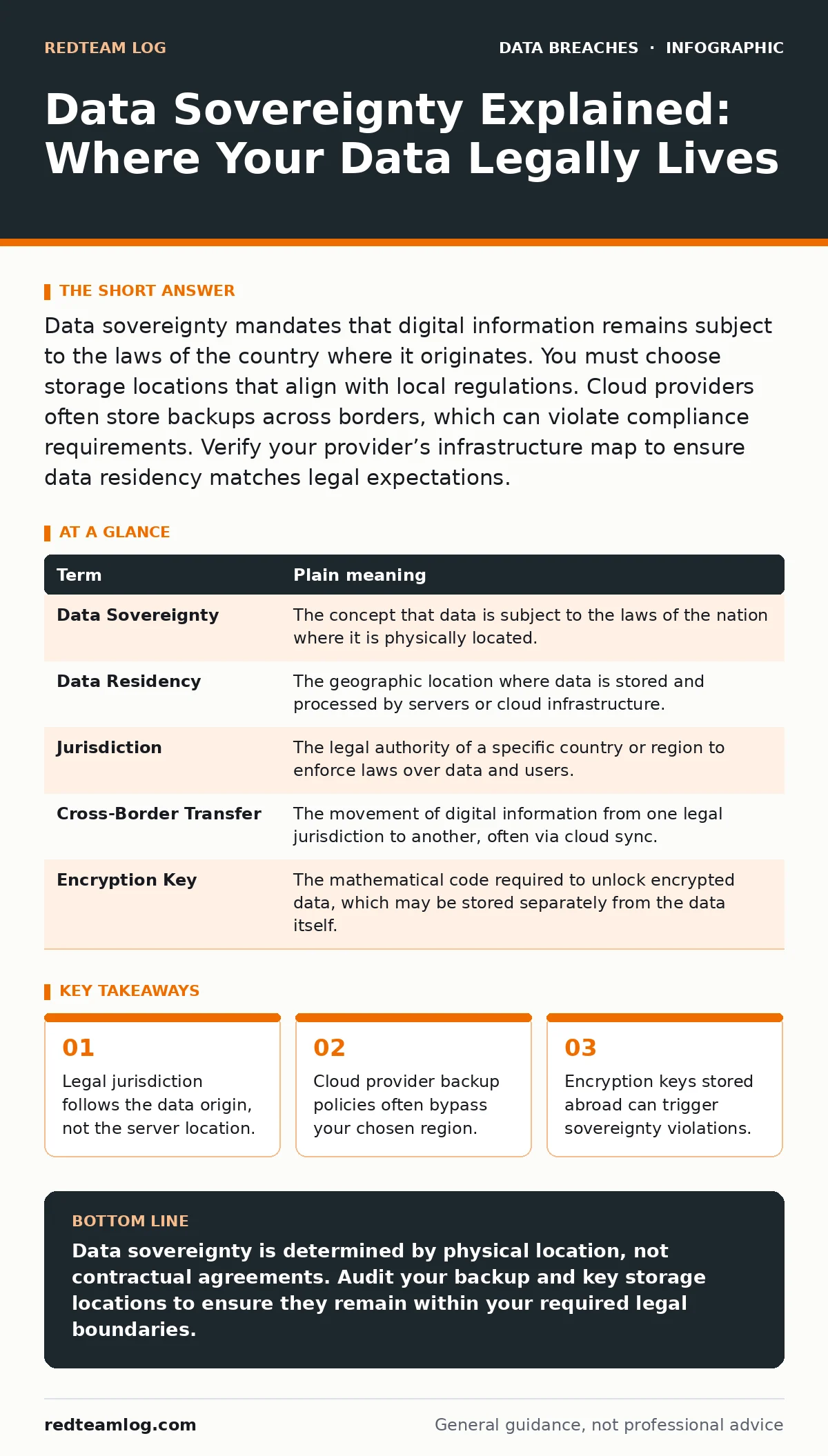
Data sovereignty mandates that digital information remains subject to the laws of the country where it originates. You must choose storage locations that align with local regulations. Cloud providers often store backups across borders, which can violate compliance requirements. Verify your provider’s infrastructure map to ensure data residency matches legal expectations.
The Library Analogy for Digital Borders
Imagine you write a diary entry in your home country. You hand that page to a courier service for safekeeping. The courier stores the page in a warehouse in a neighbouring nation. Even though you paid for the service, the local laws of that warehouse country now apply to your words. If that nation demands access to private journals, the courier must comply. Data sovereignty operates on this same principle. The physical location of the storage determines the legal framework.
Defining the Core Terminology
Confusion arises when people mix up where data sits with who controls it. These concepts are distinct but interact constantly in compliance frameworks. Understanding the difference prevents costly architectural errors.
| Term | Plain meaning |
|---|---|
| Data Sovereignty | The concept that data is subject to the laws of the nation where it is physically located. |
| Data Residency | The geographic location where data is stored and processed by servers or cloud infrastructure. |
| Jurisdiction | The legal authority of a specific country or region to enforce laws over data and users. |
| Cross-Border Transfer | The movement of digital information from one legal jurisdiction to another, often via cloud sync. |
| Encryption Key | The mathematical code required to unlock encrypted data, which may be stored separately from the data itself. |
The Hidden Cost of Cloud Backups
Many organisations assume that selecting a specific cloud region ensures compliance. This assumption fails when backup policies are examined. Cloud providers often replicate data automatically to secondary sites for disaster recovery. These secondary sites may sit in different countries. If your primary storage is in London but backups drift to Virginia, your data is now subject to US laws. This happens without your direct intervention.
Encryption Keys and Sovereignty Risks
Storing data locally does not guarantee sovereignty if the decryption mechanism resides elsewhere. Imagine locking your diary in a safe at home. You keep the key in a bank vault in another country. Authorities in that second country can demand the key. Once they have the key, they can read your diary, even though the safe remains in your home. This is a critical edge case in database security. The data itself might stay put, but the ability to read it crosses borders.
Common Points of Confusion
Readers often confuse sovereignty with privacy. Privacy laws protect the individual’s rights regarding their information. Sovereignty laws protect the state’s interest in controlling information within its borders. A country can have strong privacy laws but weak sovereignty controls, or vice versa. Another confusion involves cloud ownership. Leasing server space does not transfer ownership of the data. However, it does subject that data to the landlord’s local legal obligations.
See also: Data Masking Misconceptions That Leave Sensitive Records Exposed
Practical Steps for Verification
You must actively manage where your data lives. Passive trust in providers leads to compliance gaps. Implement these checks to align your infrastructure with legal requirements.
- Map your data flows. Identify every point where information leaves your primary jurisdiction, including analytics tools and third-party integrations.
- Audit encryption key storage. Ensure keys reside in the same jurisdiction as the data they protect. Use hardware security modules located locally if required.
- Review disaster recovery plans. Confirm that backup sites are within approved regions. Disable automatic cross-border replication if it violates local mandates.
Managing Access and Exposure
Even with correct storage, access controls matter. User access provisioning must reflect the legal boundaries of your data. If a support team in another country can access raw data, you have effectively transferred sovereignty. Use data masking to hide sensitive fields from remote support staff. This reduces the risk of accidental exposure while maintaining operational efficiency. Proper credential exposure management ensures that only authorised personnel can decrypt the information.
Integrating with Compliance Frameworks
Sovereignty is not an isolated concern. It intersects with broader security standards. For instance, SOC 2 audits examine how organisations manage data security, including residency controls. You must demonstrate that your technical controls match your legal commitments. Furthermore, consider how data leaks might occur if sovereignty boundaries are breached. A leak in a foreign jurisdiction may trigger different notification requirements. Align your incident communication plans to address these legal nuances. Protecting personally identifiable information requires both technical safeguards and legal alignment.
Key takeaways
- Legal jurisdiction follows the data origin, not the server location.
- Cloud provider backup policies often bypass your chosen region.
- Encryption keys stored abroad can trigger sovereignty violations.
Data sovereignty is determined by physical location, not contractual agreements. Audit your backup and key storage locations to ensure they remain within your required legal boundaries.
Frequently asked questions
Does data sovereignty apply to cloud storage?
Yes, cloud storage is subject to the laws of the country where the physical servers are located. You must verify the provider’s infrastructure map.
Can encryption solve data sovereignty issues?
Encryption helps, but only if the keys remain in the same jurisdiction. If keys are stored abroad, the data is effectively accessible to foreign authorities.
What is the difference between residency and sovereignty?
Residency is the physical location of the data. Sovereignty is the legal framework that applies to that data based on its location.
How do I check my cloud provider’s regions?
Review the provider’s infrastructure documentation and service level agreements. Look for specific clauses regarding data replication and backup locations.
How this guide was produced: written by the RedTeam Log editorial team with AI assistance, checked against the public references listed below, and reviewed when the facts change. See our editorial policy or report an error.