
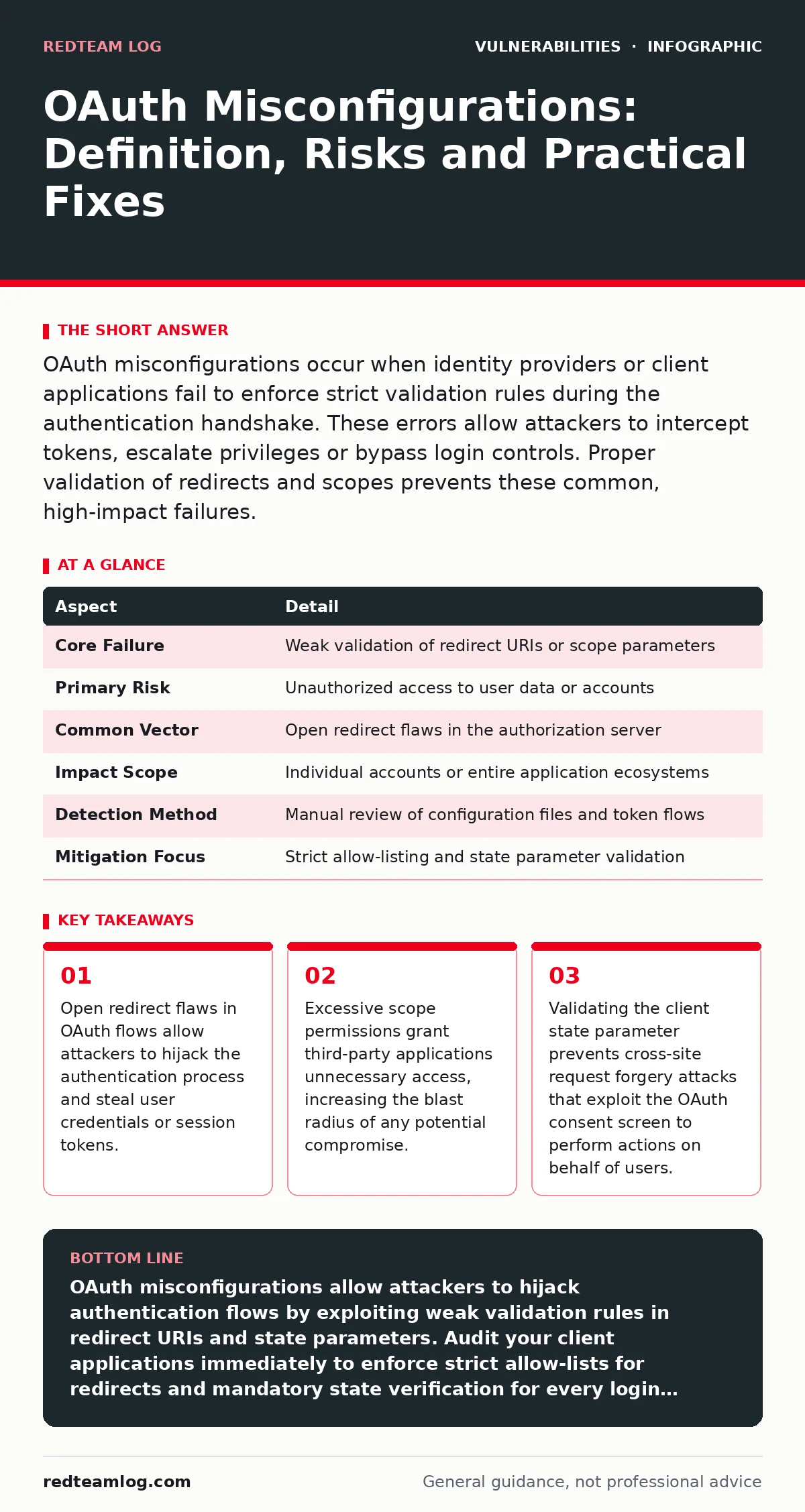
OAuth misconfigurations occur when identity providers or client applications fail to enforce strict validation rules during the authentication handshake. These errors allow attackers to intercept tokens, escalate privileges or bypass login controls. Proper validation of redirects and scopes prevents these common, high-impact failures.
The Library Analogy for Access Control
Imagine a library that issues temporary badges to visitors. The librarian checks your ID, hands you a badge, and lets you enter. This is normal authentication. Now imagine the librarian forgets to check which section of the library the badge allows entry to. A visitor might slip into the restricted archives. OAuth misconfigurations are like that forgotten check. The system grants access, but the rules governing that access are broken. You get in, but you might go where you should not. This analogy highlights the difference between proving identity and defining permission boundaries.
| Aspect | Detail |
|---|---|
| Core Failure | Weak validation of redirect URIs or scope parameters |
| Primary Risk | Unauthorized access to user data or accounts |
| Common Vector | Open redirect flaws in the authorization server |
| Impact Scope | Individual accounts or entire application ecosystems |
| Detection Method | Manual review of configuration files and token flows |
| Mitigation Focus | Strict allow-listing and state parameter validation |
How Misconfigurations Happen in Practice
Developers often prioritise speed over security during initial setup. The OAuth protocol is complex, with many optional parameters. When teams copy configuration examples from documentation without understanding the context, errors slip through. A common mistake is leaving the redirect URI field open. This field tells the identity provider where to send the user after authentication. If this field accepts any URL, an attacker can substitute their own address. The user thinks they are logging in, but they are sending credentials to the attacker. This happens because the application trusts the redirect without verifying it against a pre-approved list.
Another frequent error involves scope creep. Applications request more permissions than they need. If a weather app asks for access to your email contacts, the configuration is flawed. This does not break the login process, but it expands the attack surface. If the weather app is compromised, the attacker inherits those excessive permissions. The identity provider grants the token based on the user’s consent, not the app’s actual requirements. This disconnect creates a hidden liability that persists until the permissions are audited and reduced.
Who Bears the Risk of Broken Flows
The risk falls on three distinct groups. First, end-users suffer direct harm. Their accounts may be hijacked, or their private data may be exposed to unauthorised parties. They often do not realise the breach occurred because the login process looked normal. Second, application developers face reputational damage and legal liability. If their configuration allows token theft, they are responsible for the failure. Third, identity providers must manage the complexity of thousands of client applications. A weak client can reflect poorly on the provider’s security posture.
Imagine a healthcare portal that uses OAuth to let patients access records. A misconfiguration allows a malicious website to impersonate the portal. Patients log in, believing they are viewing their health data. Instead, their tokens are captured. The provider sees normal login traffic. The breach remains hidden until patients report missing data. This scenario illustrates how misconfigurations bypass traditional perimeter defences. The attack occurs within the trusted authentication flow, not from the outside.
Common Forms of OAuth Errors
Several specific patterns repeat across different implementations. Open redirect vulnerabilities remain the most prevalent. These occur when the application accepts user-supplied URLs in the redirect parameter. Attackers craft links that look legitimate but send the authentication token to a domain they control. This is not a bug in the code logic, but a failure in input validation. The application trusts the redirect destination implicitly.
Cross-site request forgery (CSRF) attacks exploit the lack of state validation. The state parameter is a unique string that links the request to the user’s session. If the application ignores this parameter, an attacker can force a user to authorise an action without their knowledge. The user clicks a link, logs in, and the attacker’s application gains access. The user believes they are just logging into their own service. This failure undermines the core promise of OAuth: user consent.
Insecure direct object references (IDOR) can also appear in OAuth implementations. If the application does not verify that the token belongs to the user requesting data, an attacker can swap token IDs. They might access another user’s profile by simply changing a number in the request. This is a secondary flaw that often accompanies poor OAuth configuration. It shows that authentication is only the first step. Authorisation must be equally strict. For deeper analysis of access control failures, review our guide on insecure direct object references (IDOR).
What People Usually Get Wrong
Many teams believe that using a reputable identity provider eliminates risk. This is false. The provider secures the login page, but the client application controls how it uses the tokens. A misconfigured client can undermine the strongest provider. Another common misconception is that HTTPS alone prevents OAuth attacks. Encryption protects data in transit, but it does not stop an open redirect from sending valid tokens to a malicious site. The channel is secure, but the destination is wrong.
Some developers assume that short token lifetimes solve all problems. While shorter expiry times limit the window for theft, they do not prevent the initial capture. If an attacker intercepts the token during the redirect, the lifetime is irrelevant. They have immediate access. This false sense of security leads to neglecting other controls. Teams often skip validating the state parameter because they rely on session cookies. This creates a gap that CSRF attacks exploit. You must treat every parameter as untrusted input.
See also: Principle of Least Privilege Explained for Beginners
How to Reduce the Risk Effectively
Start with strict redirect URI validation. Define a static list of allowed domains in your configuration. Reject any redirect that does not match this list exactly. Do not use wildcards for subdomains unless absolutely necessary. This blocks open redirect attacks at the source. Next, implement state parameter validation. Generate a unique, cryptographically secure random string for each authentication request. Store this string in the user’s session. When the redirect returns, verify that the state matches. If it does not, abort the login. This prevents CSRF attacks.
Limit scope permissions to the minimum required. If your application only needs to display the user’s name, do not request email access. Regularly audit these permissions. Remove access that is no longer needed. This reduces the impact of any future breach. Finally, monitor for anomalies in the authentication flow. Look for unusual redirect destinations or repeated failed state validations. This helps detect active exploitation. For ongoing monitoring strategies, consider our guide on vulnerability scanning.
The Hidden Cost of Trust
OAuth relies on trust between the identity provider, the client and the user. Misconfigurations break this trust. The cost is not just technical debt. It is user confidence. Once users suspect their login flow is unsafe, they abandon the service. Rebuilding trust is difficult. Prevention is cheaper than remediation. By enforcing strict validation rules, you protect your users and your reputation. This is not just about compliance. It is about maintaining a secure ecosystem where every component respects its boundaries.
Beyond Basic Authentication
OAuth misconfigurations are just one part of a broader security strategy. You must also consider other vulnerabilities that can compromise the same systems. For instance, if your application handles input from users, you must prevent injection attacks. Our guide on CRLF injection explains how these flaws can bypass security headers. Additionally, tracking these issues over time is vital for improvement. Refer to our remediation tracking guide to manage your backlog.
Container environments introduce new risks. If your OAuth service runs in a container, you must scan the image for vulnerabilities. See our container image scanning guide for best practices. Mobile applications face unique threats. Our iOS zero-click vulnerabilities guide details how attackers exploit trust chains. Finally, understanding the severity of these risks helps prioritise fixes. The EPSS score provides a probabilistic measure of exploit likelihood. Use these resources to build a layered defence.
Key takeaways
- Open redirect flaws in OAuth flows allow attackers to hijack the authentication process and steal user credentials or session tokens.
- Excessive scope permissions grant third-party applications unnecessary access, increasing the blast radius of any potential compromise.
- Validating the client state parameter prevents cross-site request forgery attacks that exploit the OAuth consent screen to perform actions on behalf of users.
OAuth misconfigurations allow attackers to hijack authentication flows by exploiting weak validation rules in redirect URIs and state parameters. Audit your client applications immediately to enforce strict allow-lists for redirects and mandatory state verification for every login request.
Frequently asked questions
Can a misconfigured OAuth flow leak user passwords?
No, OAuth itself does not transmit passwords. However, if the redirect URI is compromised, attackers can steal session tokens or access codes that grant equivalent access to the user’s account.
Does using HTTPS fix OAuth misconfigurations?
HTTPS encrypts the data in transit but does not validate the destination. An open redirect flaw can still send valid tokens to a malicious server that also uses HTTPS.
How often should I review OAuth configurations?
Review configurations after every major code update or library change. Perform a full audit at least once a year to ensure permissions and redirect lists remain accurate.
What is the difference between an access token and an ID token?
An access token grants permission to access resources, while an ID token contains user profile information. Misconfigurations can expose either, but access tokens pose a higher risk of data theft.
How this guide was produced: written by the RedTeam Log editorial team with AI assistance, checked against the public references listed below, and reviewed when the facts change. See our editorial policy or report an error.