
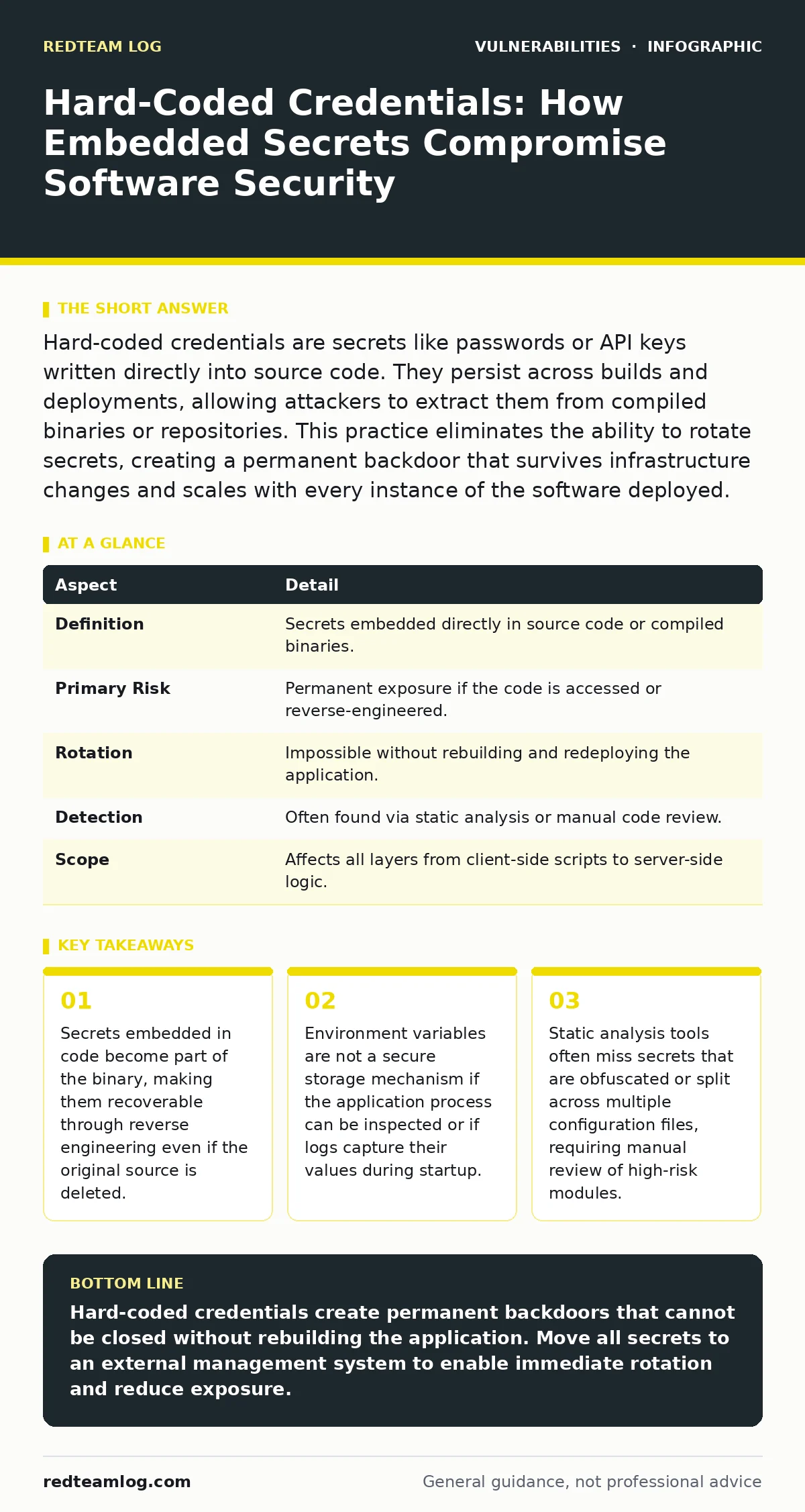
Hard-coded credentials are secrets like passwords or API keys written directly into source code. They persist across builds and deployments, allowing attackers to extract them from compiled binaries or repositories. This practice eliminates the ability to rotate secrets, creating a permanent backdoor that survives infrastructure changes and scales with every instance of the software deployed.
The Analogy of the Hidden Key
Imagine you build a house with a master key hidden inside the door frame. You can change the locks on the front door, install an alarm system, and hire a guard, but anyone who examines the door itself will find immediate entry. This is the fundamental flaw of hard-coded credentials. The security perimeter shifts from the network boundary to the code itself, where attackers have persistent access if they can obtain the software.
This analogy illustrates why traditional perimeter defenses fail. The secret is not stored in a vault; it is part of the structure. Once the structure is exposed, the secret is exposed. You cannot revoke the key without rebuilding the house, which is rarely an option for live systems.
What Hard-Coded Credentials Actually Are
Hard-coded credentials occur when developers embed sensitive data directly into the source code. This data includes passwords, API keys, encryption keys, and tokens. Instead of fetching these values from a secure external source at runtime, the application reads them from a static string within the codebase. This practice treats secrets as configuration data rather than protected assets.
The definition extends beyond simple password strings. It includes any value that grants access to a system, service, or data store. If an attacker can read the code, they can read the access rights. This creates a direct line of sight from the software binary to the protected resource, bypassing authentication logic that relies on dynamic secret retrieval.
| Aspect | Detail |
|---|---|
| Definition | Secrets embedded directly in source code or compiled binaries. |
| Primary Risk | Permanent exposure if the code is accessed or reverse-engineered. |
| Rotation | Impossible without rebuilding and redeploying the application. |
| Detection | Often found via static analysis or manual code review. |
| Scope | Affects all layers from client-side scripts to server-side logic. |
How Developers Introduce These Secrets
Developers rarely intend to create security flaws. They embed secrets for convenience during the development phase. Testing against a local database or a third-party API requires quick access. Writing the credential directly into the code is the fastest way to make it work. This friction-free path becomes the default behaviour when secure alternatives seem complex.
The problem persists because the code works. There is no immediate error message or security alert when the application runs. The secret functions correctly, reinforcing the bad habit. Over time, these temporary solutions become permanent fixtures. They are carried through code reviews, merged into main branches, and deployed to production environments without scrutiny.
Common Forms of Embedded Secrets
Hard-coded credentials appear in many disguises. The most obvious form is a plaintext password string assigned to a variable. However, more subtle forms exist that evade basic checks. Developers may split a key into multiple parts and concatenate them at runtime, believing this hides the secret. This technique, known as string obfuscation, does not prevent determined attackers from reconstructing the key.
Another common form is the inclusion of certificate files or private keys directly in the repository. These files are often large and binary, making them harder to spot in text-based searches. Configuration files that are checked into version control are also frequent carriers. If the configuration file is not excluded from the repository, the secrets within it become public history.
Who Is Affected and Why It Matters
This vulnerability affects every organisation that develops or maintains software. It is not limited to large enterprises with complex architectures. Small teams and individual developers are equally vulnerable because the root cause is human convenience, not organisational scale. The impact scales with the sensitivity of the data accessed by the credential.
For managed service providers, the risk is compounded. You may inherit codebases where the original developers are no longer present. The secrets may be buried in legacy modules that are rarely touched. When you deploy these applications, you are deploying the embedded secrets. A single compromised instance can lead to lateral movement across your entire client’s infrastructure, as the same credentials may be reused across multiple environments.
What People Usually Get Wrong
Many teams believe that using environment variables solves the problem. While better than hard-coding, environment variables are not secure storage. They exist in the process memory and are often visible in system logs or process listings. If an attacker gains code execution, they can read the environment variables just as easily as they can read a string in the code.
Another misconception is that obfuscation provides security. Encoding a password in Base64 or reversing a string does not encrypt it. It only adds a trivial step for the attacker. Security through obscurity fails when the attacker has full visibility of the application logic. True security requires keeping the secret out of the application’s address space entirely, using external secret management systems that handle rotation and access control.
Reducing the Risk in Practice
The primary defence is to treat secrets as external entities. Use a dedicated secret management service to store and retrieve credentials at runtime. These services provide APIs for the application to fetch secrets, ensuring they never reside in the code or configuration files. This approach allows for immediate rotation without touching the application code.
Integrate static analysis tools into your development pipeline. These tools scan code for patterns that resemble secrets, such as long alphanumeric strings or known key formats. While not perfect, they provide an automated check that catches many obvious cases. Combine this with manual reviews for high-risk modules, particularly those handling authentication or external integrations.
- Audit existing codebases for plaintext secrets using automated scanners.
- Implement a secret management solution for all new development.
- Ensure version control systems are configured to ignore configuration files containing sensitive data.
- Rotate any secrets discovered in code immediately, even if the code is not yet in production.
The Hidden Cost of Convenience
The hidden cost of hard-coded credentials is not just the initial breach. It is the operational debt incurred when secrets must be rotated. If a secret is compromised, you must identify every instance of the code that contains it. This often requires rebuilding and redeploying multiple applications, causing downtime and resource expenditure.
This debt accumulates silently. Each embedded secret is a potential point of failure that cannot be fixed remotely. It forces you to treat code changes as security incidents. By externalising secrets, you decouple security from deployment. You can change a password without restarting the application or touching the code. This flexibility is the true value of proper secret management.
Key takeaways
- Secrets embedded in code become part of the binary, making them recoverable through reverse engineering even if the original source is deleted.
- Environment variables are not a secure storage mechanism if the application process can be inspected or if logs capture their values during startup.
- Static analysis tools often miss secrets that are obfuscated or split across multiple configuration files, requiring manual review of high-risk modules.
Hard-coded credentials create permanent backdoors that cannot be closed without rebuilding the application. Move all secrets to an external management system to enable immediate rotation and reduce exposure.
Frequently asked questions
Can I use a configuration file to store secrets safely?
No, if the configuration file is stored with the application code or deployed to the server, it is still accessible to attackers. Configuration files must be kept separate and protected with strict access controls, or better, replaced by a secret management service.
Does encrypting the source code prevent secret extraction?
No, the application must decrypt the code or secrets to run. If the decryption key is also embedded, the attacker can extract both. Encryption does not solve the problem of where the key is stored.
How do I find hard-coded credentials in legacy code?
Use static analysis tools designed to detect secret patterns. Additionally, search the version control history for commits that added large strings or configuration files. Manual review of authentication modules is also necessary.
Is it safe to use environment variables for secrets?
Environment variables are not secure storage. They can be read by any process with access to the environment and may appear in logs. They are better than hard-coding but should be replaced by a dedicated secret manager for production systems.
How this guide was produced: written by the RedTeam Log editorial team with AI assistance, checked against the public references listed below, and reviewed when the facts change. See our editorial policy or report an error.