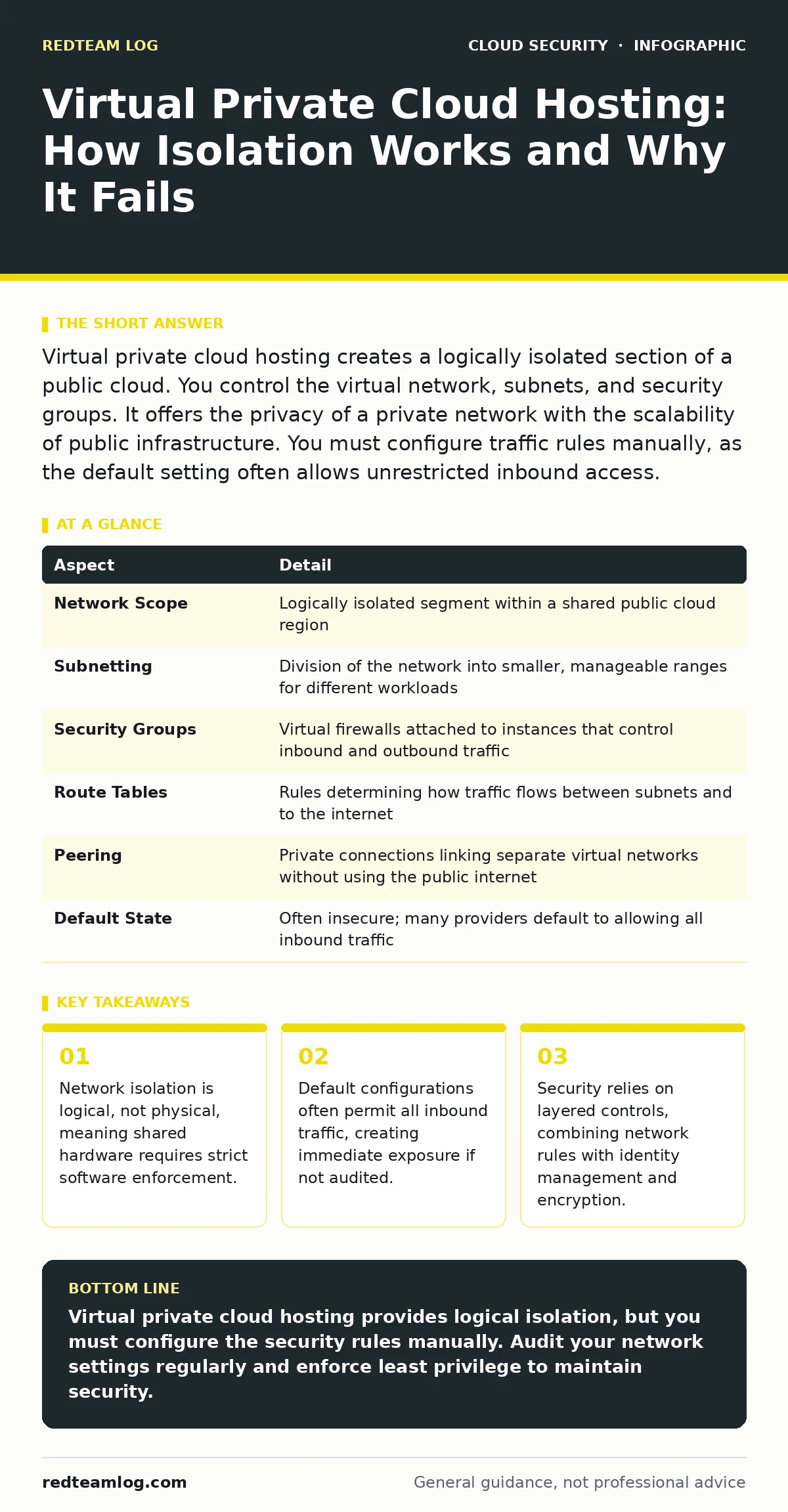
Virtual private cloud hosting creates a logically isolated section of a public cloud. You control the virtual network, subnets, and security groups. It offers the privacy of a private network with the scalability of public infrastructure. You must configure traffic rules manually, as the default setting often allows unrestricted inbound access.
Everyday Analogy for Network Isolation
Imagine a large office building where every company shares the same lobby, elevators, and power supply. This represents the physical infrastructure of a public cloud. A virtual private cloud is like leasing a floor within that building. You have your own entrance, your own internal rooms, and your own security guards. The walls are real to you, but they exist within a structure you do not own. If your security guard falls asleep, anyone in the lobby can walk in. The isolation depends entirely on your configuration, not the landlord's promise.
At a Glance: Core Components
| Aspect | Detail |
|---|---|
| Network Scope | Logically isolated segment within a shared public cloud region |
| Subnetting | Division of the network into smaller, manageable ranges for different workloads |
| Security Groups | Virtual firewalls attached to instances that control inbound and outbound traffic |
| Route Tables | Rules determining how traffic flows between subnets and to the internet |
| Peering | Private connections linking separate virtual networks without using the public internet |
| Default State | Often insecure; many providers default to allowing all inbound traffic |
What Is Virtual Private Cloud Hosting
Virtual private cloud hosting is the service model that allows you to provision a dedicated network environment within a shared cloud provider. You define the IP address range, create subnets, and manage route tables. This setup mimics the control you would have in an on-premises data centre. The cloud provider manages the underlying hardware, hypervisors, and physical network switches. You manage the virtual network configuration and the security policies that govern traffic flow. This separation of duties means you are responsible for the logical security, while the provider ensures physical security and hardware reliability.
The term "virtual private cloud" refers specifically to this isolated network segment. It is not a server, nor is it a storage bucket. It is the plumbing that connects your resources. When people search for virtual private cloud hosting, they are usually looking for this network isolation capability. They want to know if their data is truly separate from other customers. The answer is yes, but only if you configure the isolation correctly. The provider guarantees the physical separation of tenants, but the virtual boundaries are software-defined.
How the Isolation Mechanism Works
The isolation relies on software-defined networking. The cloud provider uses hypervisors to run multiple virtual machines on a single physical server. Each virtual machine connects to a virtual switch. These switches are programmed to enforce the security groups and network access control lists you define. When a packet arrives, the virtual switch checks the source and destination against your rules. If the rule denies the traffic, the packet is dropped before it reaches your operating system. This happens at line speed, meaning it does not slow down your application significantly.
This mechanism is powerful because it allows for dynamic changes. You can update a security group rule, and every instance attached to it changes its behaviour instantly. You do not need to reboot servers or reconfigure individual firewalls. However, this speed introduces risk. A single erroneous rule can expose thousands of instances in seconds. The isolation is only as strong as your most permissive rule. If one instance allows all traffic, the logical boundary of your virtual private cloud hosting environment is compromised for that specific resource.
Who Is Affected by Misconfiguration
Every organisation using public cloud infrastructure is affected by virtual private cloud configuration errors. Small startups often deploy applications quickly without reviewing default settings. They assume the cloud provider handles security. Large enterprises face complexity. They have hundreds of teams deploying resources, leading to inconsistent policies. A developer might open a port for testing and forget to close it. This creates a persistent vulnerability. The impact is not limited to data breaches. It includes compliance failures, service disruption, and financial loss from compromised resources used for cryptocurrency mining or further attacks.
Managed service providers face additional pressure. They host multiple clients on the same infrastructure. A breach in one client's virtual network can lead to liability issues. The trust of the client depends on the provider's ability to maintain strict isolation. This requires automated compliance checks and continuous monitoring. The responsibility is shared, but the blame is rarely shared equally. If a client's configuration is wrong, the client is usually liable. If the provider's underlying infrastructure fails, the provider is liable. The boundary is the virtual network configuration.
See also: Confidential Computing: 6 Misconceptions That Compromise Security · Data Center Resilience Planning: Keep Services Running During Failures
What People Usually Get Wrong
Many administrators believe that placing resources in a virtual private cloud makes them secure. This is a dangerous misconception. The virtual private cloud is a container, not a shield. If you launch a web server and do not configure the security group, the default might allow all inbound traffic. Your database is now accessible from any IP address on the internet. The isolation of the virtual network does not prevent direct access to open ports. You must explicitly deny traffic that is not required.
Another common error is relying solely on perimeter security. Administrators set up strong rules at the edge but leave internal subnets wide open. An attacker who compromises one instance can move laterally to others. This is known as pivoting. To prevent this, you must apply security groups to every instance and use network access control lists for subnet-level filtering. Layered security is mandatory. For deeper protection strategies, review our guide on cloud firewalls to understand how to filter traffic at multiple levels.
What To Do About It
Start by auditing your current virtual private cloud hosting setup. Identify all security groups and network access control lists. Remove any rules that allow unrestricted inbound traffic from the internet. Apply the principle of least privilege. Only allow traffic from specific sources on specific ports. Document these rules and enforce them through code. Use infrastructure as code to ensure consistency. This prevents manual errors and allows for version control.
Implement regular vulnerability scanning. Look for open ports and misconfigured services. Monitor traffic patterns for anomalies. If a server suddenly starts sending large amounts of data to an unknown external IP, investigate immediately. Integrate identity management to control who can change network settings. Restrict administrative access to a small group of trusted users. For secure data storage, refer to our guide on cloud encryption. For managing access permissions, see workload identity.
Common Pitfalls and Hidden Costs
One hidden cost of virtual private cloud hosting is egress traffic. Many providers charge for data leaving the virtual network, especially if it goes to the internet or another region. If your application generates large amounts of outbound traffic, this can become expensive. Plan your architecture to minimise egress. Use internal endpoints for services where possible. Another pitfall is IP address exhaustion. If you allocate large subnets without planning, you may run out of addresses. Use variable-length subnet masking to allocate addresses efficiently.
Identity sprawl is another significant risk. As you add more users and services, managing permissions becomes complex. If permissions are not reviewed regularly, unused accounts accumulate. These accounts become targets for attackers. Regularly review and revoke unnecessary permissions. See our guide on identity sprawl for strategies to manage access control. Additionally, ensure your container deployments are secure by following our guide on insecure container images. For API security, consult insecure cloud APIs.
Key takeaways
- Network isolation is logical, not physical, meaning shared hardware requires strict software enforcement.
- Default configurations often permit all inbound traffic, creating immediate exposure if not audited.
- Security relies on layered controls, combining network rules with identity management and encryption.
Virtual private cloud hosting provides logical isolation, but you must configure the security rules manually. Audit your network settings regularly and enforce least privilege to maintain security.
Frequently asked questions
Does virtual private cloud hosting guarantee my data is on dedicated hardware?
No, the hardware is shared with other customers. Isolation is enforced by software and virtualisation layers, not physical separation.
Can I connect my virtual private cloud to my on-premises network?
Yes, you can use dedicated virtual private network tunnels or dedicated connections to link your local network to the cloud.
What happens if I delete a subnet in my virtual private cloud?
You cannot delete a subnet if it contains running instances. You must terminate or move those instances first.
Is virtual private cloud hosting more secure than public subnets?
It offers more control, but security depends on your configuration. Misconfigured private subnets can be as vulnerable as public ones.
How this guide was produced: written by the RedTeam Log editorial team with AI assistance, checked against the public references listed below, and reviewed when the facts change. See our editorial policy or report an error.