
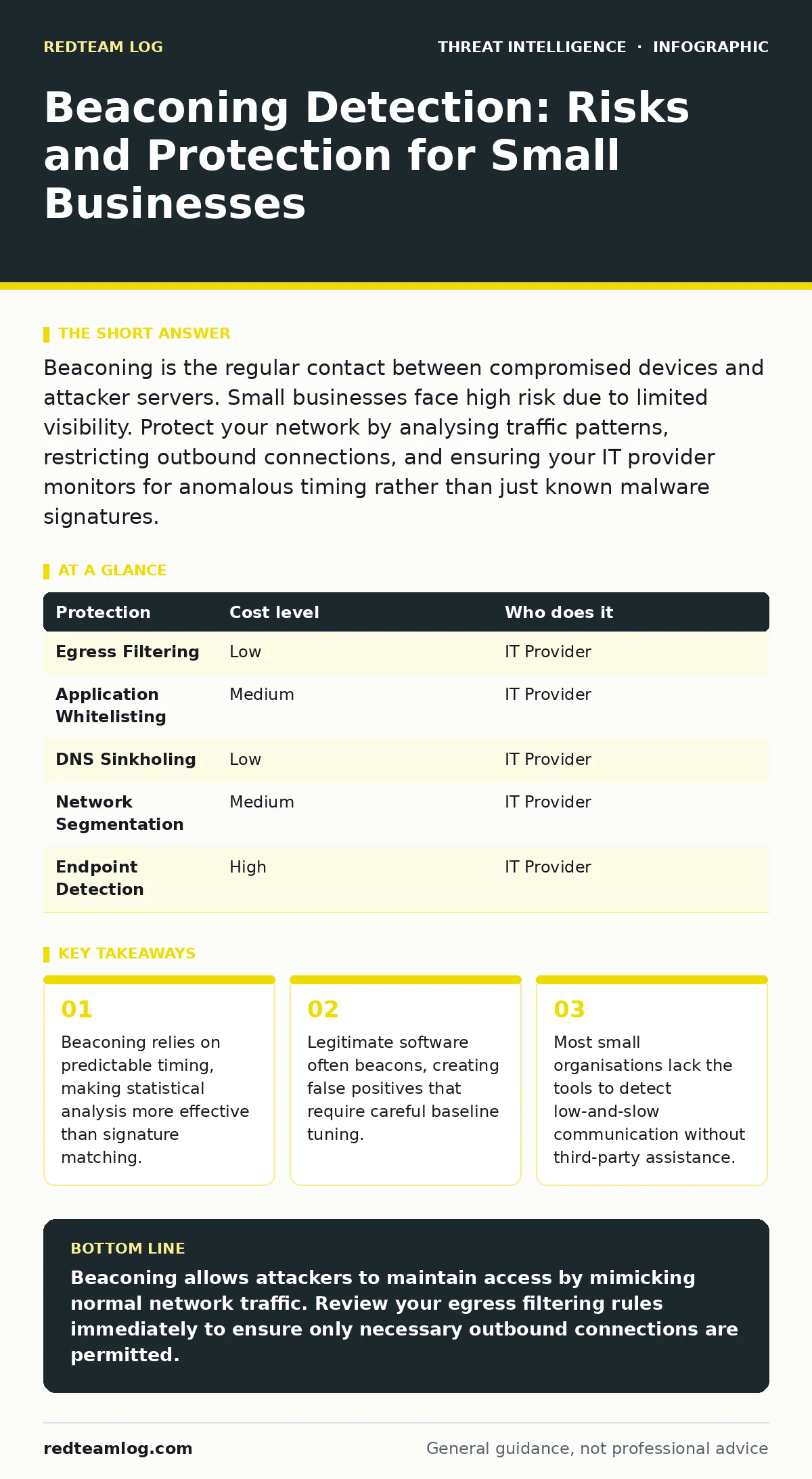
Beaconing is the regular contact between compromised devices and attacker servers. Small businesses face high risk due to limited visibility. Protect your network by analysing traffic patterns, restricting outbound connections, and ensuring your IT provider monitors for anomalous timing rather than just known malware signatures.
The Mechanics of Persistence
Beaconing is a technique where compromised software sends regular, small packets of data to a remote server. This establishes a persistent channel for attackers to receive commands and exfiltrate information. Unlike a one-time data theft, beaconing allows the attacker to maintain a foothold even if the initial exploit fails.
The attacker configures the malware to wait for a specific interval before "calling home." This interval might be fixed, such as every hour, or jittered to appear random. Jitter adds a small random variation to the timing to evade simple detection rules. The goal is to blend in with legitimate background traffic.
Most endpoint protection tools focus on what a file is, not what it does over time. A malicious script can look identical to a legitimate system update tool at the moment of execution. The danger lies in the sustained, repetitive nature of the communication. If you do not monitor traffic patterns, you are blind to this slow bleed of control.
Why Small Organisations Are Exposed
Small businesses often assume their size protects them from sophisticated adversaries. This assumption is dangerous. Attackers target smaller entities because they typically have fewer security controls and slower detection times. A breach in a small firm can serve as a stepping stone to larger partners or clients.
Resource constraints force many small organisations to rely on basic antivirus solutions. These tools detect known threats but struggle with behaviour-based anomalies. Beaconing is a behaviour, not a unique file signature. Without specialised monitoring, the regular pings from an infected machine go unnoticed.
Another factor is the complexity of modern software. Legitimate applications, such as office suites or cloud storage clients, also beacon to their providers for updates and synchronisation. This creates a noisy environment where malicious beacons hide among legitimate ones. Distinguishing between the two requires deep inspection capabilities that few small IT teams possess.
The Hidden Cost of False Negatives
The primary risk of beaconing is not the initial infection, but the duration of access. The longer an attacker remains undetected, the more damage they can cause. They can map your network, escalate privileges, and move laterally to sensitive servers. This dwell time is the window in which ransomware is often deployed.
Detecting beaconing is difficult because it mimics normal network behaviour. Standard firewalls allow outbound traffic to common ports like HTTP and HTTPS. An attacker can tunnel their commands through these standard channels. This makes traditional perimeter defences ineffective against established beacons.
Furthermore, attackers can change their beaconing interval if they suspect detection. They might switch from every ten minutes to every hour. If your monitoring relies on static rules, you will miss these adjustments. The attack becomes quieter, but the access remains. This adaptability makes beaconing one of the most persistent threats in the MITRE ATT&CK framework.
Low-Cost Protections for Limited Budgets
You do not need expensive enterprise suites to mitigate beaconing risks. Basic network hygiene can significantly reduce the attack surface. Start by implementing strict egress filtering. Block all outbound traffic except what is explicitly required for business operations. If a printer does not need internet access, deny it.
Disable unnecessary protocols and ports. Many legacy systems use outdated communication methods that are easy to exploit and hard to monitor. By reducing the number of allowed outbound connections, you limit the paths an attacker can use for beaconing. This forces malicious traffic into blocked channels where it is visible.
Implement application whitelisting on critical servers. This ensures that only approved software can execute. Even if an attacker gains access, they cannot install new beaconing tools if the system prevents unknown executables from running. This control is highly effective against fileless attacks that rely on scripting languages.
| Protection | Cost level | Who does it |
|---|---|---|
| Egress Filtering | Low | IT Provider |
| Application Whitelisting | Medium | IT Provider |
| DNS Sinkholing | Low | IT Provider |
| Network Segmentation | Medium | IT Provider |
| Endpoint Detection | High | IT Provider |
What to Ask Your IT Provider
Your IT provider should be your first line of defence against beaconing. However, many providers offer basic support without advanced threat monitoring. You need to verify their capabilities explicitly. Do not assume that "managed security" includes beacon detection. It often does not.
Ask about their visibility into outbound traffic. Can they see what your devices are talking to outside the network? If they only monitor inbound threats, they are missing half the battle. Beaconing is an outbound activity. Without egress monitoring, they cannot detect the call home.
Inquire about their baseline establishment process. Good providers create a profile of normal network behaviour for your organisation. They then alert on deviations from this baseline, such as a server contacting a new IP address at odd hours. This statistical approach is far superior to signature-based detection for identifying beaconing.
See also: DDoS Attacks Types: How Floods of Traffic Break Services · Port scanning meaning: how attackers map your network before striking
Questions to Ask an IT Provider
When evaluating your current provider or selecting a new one, use these specific questions to gauge their competence in detecting beaconing:
- How do you distinguish between legitimate software updates and malicious beaconing traffic?
- Do you monitor for jitter in connection intervals, or do you rely solely on known bad IP addresses?
- What is your process for investigating outbound connections to unfamiliar domains?
- Can you provide evidence of detecting low-and-slow communication patterns in the past?
- How do you handle alerts for applications that beacon frequently, such as cloud storage clients?
These questions force the provider to explain their methodology. If they cannot answer clearly, they likely rely on automated tools that generate noise rather than actionable intelligence. Effective beacon detection requires human analysis combined with automated pattern recognition.
Integrating with Broader Security Efforts
Beaconing detection does not exist in isolation. It must be part of a layered security strategy. Effective log management ensures that you have the historical data needed to identify patterns over time. Without sufficient log retention, you cannot analyse long-term behaviour.
Consider the role of incident response runbooks. When a beacon is detected, your team needs a clear plan for containment and eradication. This includes isolating the affected device, blocking the attacker’s server, and investigating lateral movement. Without a predefined process, response times increase, allowing the attacker more time to operate.
For deeper analysis, YARA rules can help identify known beaconing components in memory or on disk. While beaconing is primarily a network phenomenon, the tools used often leave traces that YARA can detect. Combining network analysis with host-based indicators provides a more complete picture of the threat.
The Reality of Detection Limits
No system can detect every beacon with perfect accuracy. Legitimate applications, such as telemetry tools and cloud sync clients, exhibit beacon-like behaviour. This creates false positives that can overwhelm your monitoring team. Tuning your detection systems to ignore known good traffic is a continuous process.
The trade-off is between sensitivity and noise. High sensitivity catches more beacons but generates more alerts. Low sensitivity reduces noise but risks missing subtle attacks. You must find a balance that fits your operational capacity. For small businesses, this often means relying on a managed provider to handle the tuning.
Remember that beaconing is a symptom, not the root cause. The root cause is the initial compromise. Focusing solely on detection ignores the need for prevention. Strengthening your initial access controls reduces the likelihood of beaconing in the first place. This includes securing remote access and managing user privileges carefully.
Key takeaways
- Beaconing relies on predictable timing, making statistical analysis more effective than signature matching.
- Legitimate software often beacons, creating false positives that require careful baseline tuning.
- Most small organisations lack the tools to detect low-and-slow communication without third-party assistance.
Beaconing allows attackers to maintain access by mimicking normal network traffic. Review your egress filtering rules immediately to ensure only necessary outbound connections are permitted.
Frequently asked questions
What is the difference between beaconing and C2?
Command and Control (C2) is the overall framework for attacker communication. Beaconing is the specific technique of regular, timed check-ins used within that framework to maintain persistence.
Can firewall rules stop beaconing?
Standard firewalls allow outbound traffic on common ports, which attackers exploit. Effective prevention requires egress filtering that blocks all outbound traffic except explicitly whitelisted destinations.
How long can an attacker beacon undetected?
Without specific monitoring, an attacker can beacon for months or years. The duration depends on the noise level of your network and the sophistication of their jitter techniques.
Is beaconing only used by ransomware groups?
No, any attacker seeking persistent access uses beaconing. It is a standard technique for espionage, data theft, and lateral movement, regardless of the final objective.
How this guide was produced: written by the RedTeam Log editorial team with AI assistance, checked against the public references listed below, and reviewed when the facts change. See our editorial policy or report an error.