
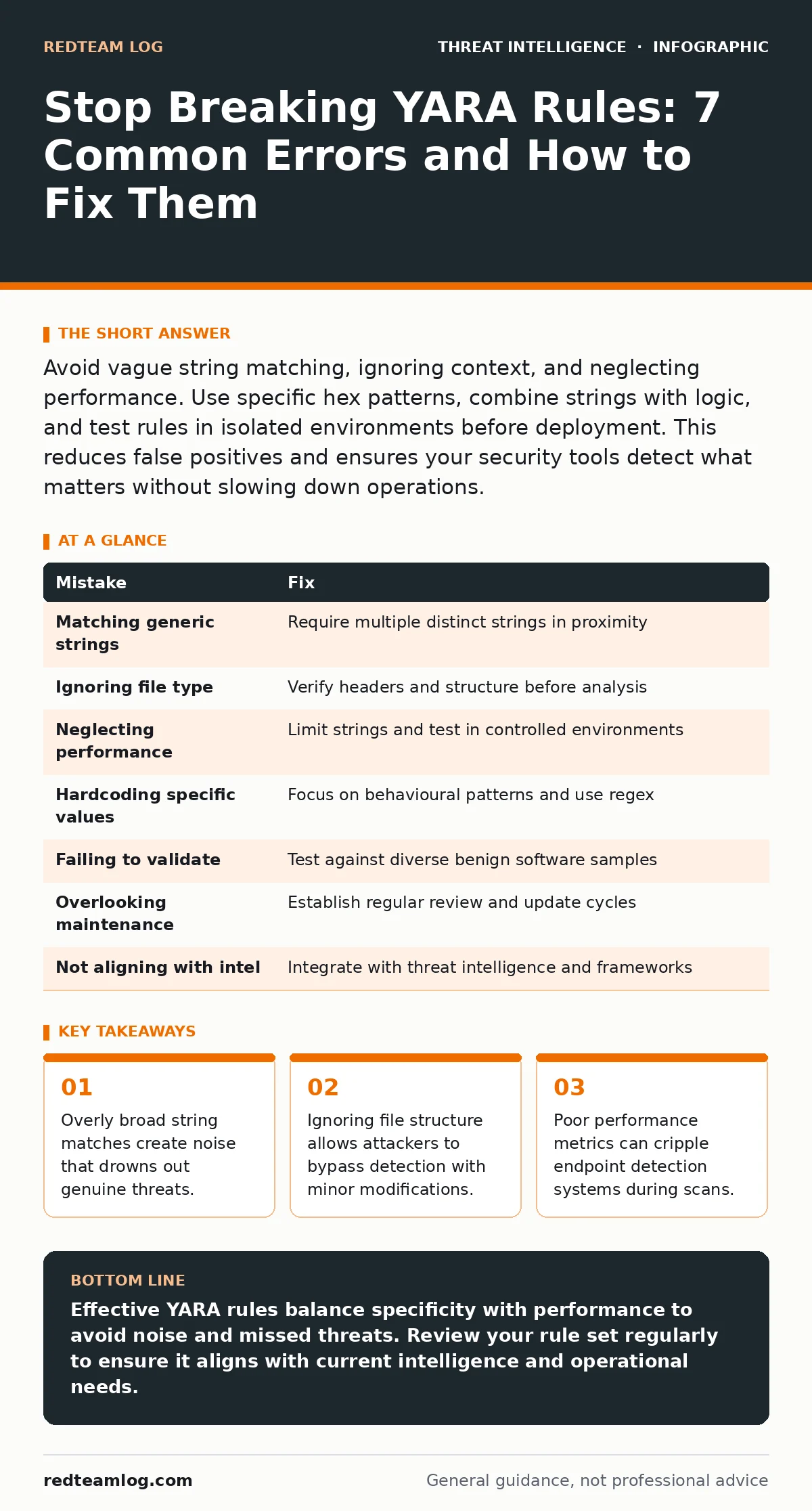
Avoid vague string matching, ignoring context, and neglecting performance. Use specific hex patterns, combine strings with logic, and test rules in isolated environments before deployment. This reduces false positives and ensures your security tools detect what matters without slowing down operations.
Mistake 1: Matching Generic Strings Without Context
Using common words or short phrases as detection triggers is the most frequent error. Words like "malware", "password", or "admin" appear in thousands of legitimate files. When you write a rule that flags any file containing these terms, you generate alerts for office documents, system logs, and configuration files.
Why it hurts:
The alert fatigue sets in quickly. Analysts begin to ignore notifications because the signal-to-noise ratio collapses. By the time a real threat surfaces, it is lost in a sea of false positives. This desensitisation weakens your overall security posture and wastes operational resources on triaging harmless events.
The fix:
Require multiple distinct strings within a specific proximity. Use YARA’s all of them or any of them operators to demand that at least three unique indicators appear in the same file. Combine text strings with hexadecimal patterns that are less likely to appear in benign software. This raises the bar for what constitutes a match, ensuring only files with a strong signature trigger an alert.
Mistake 2: Ignoring File Type and Structure
Detecting content without verifying the file format is a structural weakness. A string might appear in a PDF, an executable, or a text file, but the intent and risk differ vastly. Treating all files identically ignores the binary structure that defines how the data is processed.
Why it hurts:
You miss opportunities to catch obfuscated threats. Attackers often embed malicious code within seemingly innocent file types. If your rule does not account for the file header or internal structure, it may fail to recognise the payload when it is hidden inside a legitimate container. This allows sophisticated malware to slip through undetected.
The fix:
Use YARA’s import "pe" module for Windows executables or import "elf" for Linux binaries. Check specific headers and sections before evaluating strings. For example, verify that a file is a valid PE file before looking for suspicious imports. This ensures you are analysing the correct context and reduces false positives from misidentified files.
Mistake 3: Neglecting Performance Impact
Complex rules with large string arrays or excessive logical conditions consume significant processing power. Endpoint detection and response systems scan files continuously. If your rules are heavy, they slow down the scanning process and impact system performance.
Why it hurts:
Slow scans can lead to missed detections during high-volume events. Systems may skip files or delay analysis to maintain responsiveness. This creates gaps in your monitoring coverage. Additionally, high resource usage can trigger alerts from performance monitoring tools, creating confusion about the source of the slowdown.
The fix:
Limit the number of strings in a single rule. Use efficient data types and avoid unnecessary imports. Test rules in a controlled environment to measure their impact on CPU and memory usage. Optimise by combining similar strings or using wildcards where appropriate. Regularly review and prune outdated rules to maintain performance.
Mistake 4: Hardcoding Specific Values
Relying on fixed values such as IP addresses, domain names, or file hashes is fragile. Attackers change these details easily to evade detection. Hardcoding makes your rules obsolete as soon as the threat actor updates their infrastructure.
Why it hurts:
Your detection capability degrades rapidly. You must constantly update rules to keep pace with changes. This reactive approach is unsustainable and leaves windows of vulnerability. It also increases maintenance overhead as you chase moving targets instead of focusing on behaviour.
The fix:
Focus on behavioural indicators rather than static values. Look for patterns in how the malware operates, such as specific API calls or registry modifications. Use regular expressions to match variable components while keeping the core pattern stable. This approach remains effective even when attackers change superficial details.
Mistake 5: Failing to Validate Against Benign Software
Rules are often tested only against known malicious samples. This narrow testing misses the impact on legitimate software. Many commercial applications use similar techniques to malware, such as self-modification or memory injection.
Why it hurts:
False positives disrupt business operations. Legitimate applications may be blocked or quarantined, causing downtime and user frustration. This erodes trust in your security tools and may lead to users disabling protections. It also creates additional work for support teams to resolve issues.
The fix:
Test rules against a diverse set of benign files, including operating system binaries, common applications, and user documents. Use tools that simulate normal user activity to ensure rules do not interfere with routine tasks. Adjust thresholds and conditions to exclude known benign behaviour. This balancing act is critical for effective detection.
See also: 7 Mistakes That Leave You Open to Advanced Persistent Threats · SIEM Mistakes That Blind Your Defenders and How to Fix Them
Mistake 6: Overlooking Rule Maintenance
YARA rules are not set-and-forget artifacts. They require regular review and updates. As software evolves and new threats emerge, old rules may become irrelevant or inaccurate. Neglecting maintenance leads to a cluttered rule set that is difficult to manage.
Why it hurts:
Outdated rules increase noise and reduce efficiency. They may conflict with new rules or each other, creating logical errors. This makes debugging difficult and slows down response times. A neglected rule set is a liability that hinders your ability to detect current threats.
The fix:
Establish a regular review cycle for your YARA rules. Remove rules that no longer detect active threats. Update rules to reflect new indicators and improve performance. Document the purpose and scope of each rule to aid future maintenance. This discipline ensures your detection engine remains sharp and effective.
Mistake 7: Not Aligning with Threat Intelligence
Writing rules in isolation from broader threat intelligence efforts is a strategic error. YARA rules should reflect the latest insights from threat analysis. Without this alignment, you may be looking for the wrong indicators or missing critical threats.
Why it hurts:
Your detection capabilities lag behind emerging threats. You may focus on low-risk indicators while high-risk threats go unnoticed. This disconnect undermines the value of your security operations. It also prevents you from anticipating attack patterns and preparing proactive defenses.
The fix:
Integrate YARA rule development with your threat intelligence process. Use insights from sources like the MITRE ATT&CK framework to identify relevant techniques and indicators. Collaborate with analysts to translate intelligence into actionable rules. This ensures your detection engine is aligned with the current threat environment and focuses on the most significant risks.
| Mistake | Fix |
|---|---|
| Matching generic strings | Require multiple distinct strings in proximity |
| Ignoring file type | Verify headers and structure before analysis |
| Neglecting performance | Limit strings and test in controlled environments |
| Hardcoding specific values | Focus on behavioural patterns and use regex |
| Failing to validate | Test against diverse benign software samples |
| Overlooking maintenance | Establish regular review and update cycles |
| Not aligning with intel | Integrate with threat intelligence and frameworks |
Key takeaways
- Overly broad string matches create noise that drowns out genuine threats.
- Ignoring file structure allows attackers to bypass detection with minor modifications.
- Poor performance metrics can cripple endpoint detection systems during scans.
Effective YARA rules balance specificity with performance to avoid noise and missed threats. Review your rule set regularly to ensure it aligns with current intelligence and operational needs.
Frequently asked questions
How do I test YARA rules before deployment?
Use a sandbox environment with a mix of malicious and benign samples. Monitor system performance and alert generation to identify issues.
Can YARA rules detect encrypted malware?
YARA can detect encrypted malware if you have samples of the encryption routine or specific headers. It cannot decrypt content but can identify patterns associated with encryption.
How often should I update YARA rules?
Update rules as new threats emerge and existing indicators change. A monthly review is a good starting point, but adjust based on your threat environment.
What is the difference between a YARA rule and a signature?
A YARA rule is a flexible pattern-matching language that allows complex logic. A signature is often a static hash or simple string match. YARA offers greater adaptability.
How this guide was produced: written by the RedTeam Log editorial team with AI assistance, checked against the public references listed below, and reviewed when the facts change. See our editorial policy or report an error.