
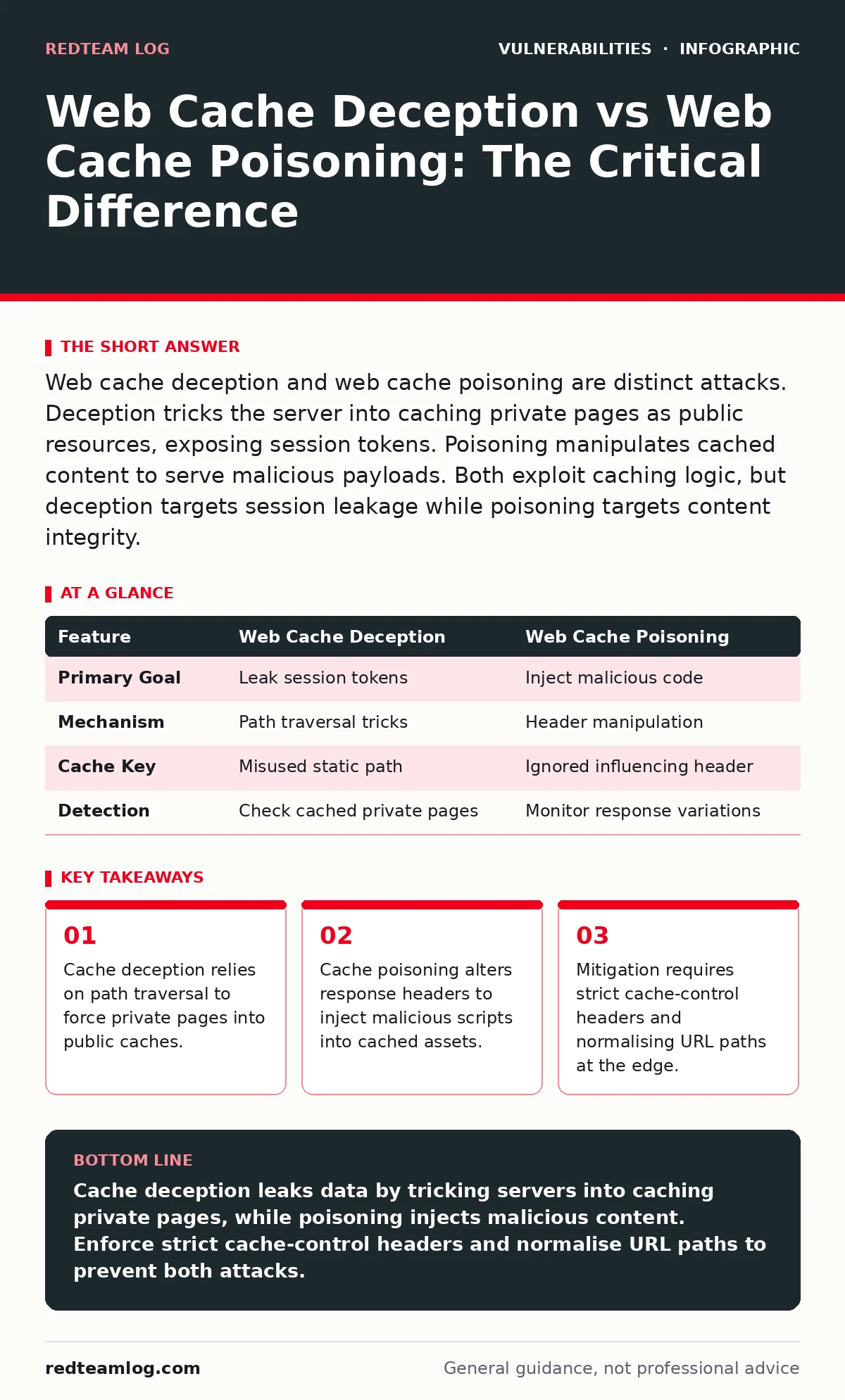
Web cache deception and web cache poisoning are distinct attacks. Deception tricks the server into caching private pages as public resources, exposing session tokens. Poisoning manipulates cached content to serve malicious payloads. Both exploit caching logic, but deception targets session leakage while poisoning targets content integrity.
What is the difference between web cache deception and web cache poisoning?
Web cache deception and web cache poisoning differ in their primary objective and mechanism. Cache deception tricks a server into caching a private page as a public resource, exposing session tokens to anyone who requests that resource. Web cache poisoning injects malicious content into a cached response, serving harmful code to all users who receive the cached version. Deception leaks data; poisoning alters content.
How does web cache deception exploit caching logic?
Web cache deception exploits the way servers map URLs to cached resources. Attackers craft requests that look like static assets but resolve to private pages. The server caches the private page under the static asset’s path. When a victim requests the static asset, they receive the cached private page, including their own session token. This bypasses authentication checks because the cache serves the response before the application processes the request.
Why does web cache poisoning succeed where other attacks fail?
Web cache poisoning succeeds by manipulating how caches identify unique resources. Attackers find a header or query parameter that influences the response but is ignored by the cache key. They inject malicious content via that parameter. The cache stores the poisoned response as the canonical version. All subsequent users receive the malicious content because the cache believes it is serving the correct, unaltered resource. This bypasses server-side input validation entirely.
What conditions allow cache deception to bypass security controls?
Cache deception requires 3 specific conditions to bypass standard security controls. First, the application must serve private pages without strict cache-control headers. Second, the server must normalise URLs incorrectly, allowing path traversal to reach private endpoints. Third, the cache must treat the manipulated path as a public static resource. If any condition is missing, the attack fails. Proper header management prevents the private page from being cached in the first place.
Which exceptions make cache poisoning harder to detect?
Cache poisoning becomes harder to detect when the injected content is context-aware. Attackers may use parameters that only trigger on specific user agents or referrers. The cache key ignores these nuances, storing a generic poisoned response. Legitimate users see normal content, while targeted victims receive the malicious payload. This selective poisoning evades standard monitoring tools that look for widespread anomalies. It requires deep packet inspection to identify the subtle header discrepancies.
How do you mitigate web cache deception effectively?
Mitigating web cache deception requires enforcing strict cache-control headers on all private pages. Set Cache-Control: private, no-store to prevent any caching of authenticated content. Normalise URL paths at the edge layer to block path traversal attempts. Ensure that static assets and private pages use distinct domains or subdomains. This separation prevents the cache from confusing resource types. Regularly audit cache configurations to ensure headers are applied consistently across all endpoints.
What role does Content Security Policy play in defence?
Content Security Policy acts as a secondary defence against cache poisoning. Even if malicious content is cached, CSP can prevent its execution. It restricts which sources are allowed to run scripts or load resources. If the poisoned content tries to load an external script, CSP blocks it. This reduces the impact of a successful poisoning attack. However, CSP does not prevent the caching of the malicious content itself. It only limits what the browser does with it.
How does vulnerability scanning help identify cache risks?
Vulnerability scanning tools can identify misconfigured cache headers and path traversal issues. Automated scans test various URL patterns to see if private pages are cached. They check for inconsistencies between request headers and cache keys. Regular scanning helps catch configuration drift before attackers exploit it. Combine automated scans with manual testing to cover edge cases. This ensures that new deployments do not introduce cache vulnerabilities.
| Feature | Web Cache Deception | Web Cache Poisoning |
|---|---|---|
| Primary Goal | Leak session tokens | Inject malicious code |
| Mechanism | Path traversal tricks | Header manipulation |
| Cache Key | Misused static path | Ignored influencing header |
| Detection | Check cached private pages | Monitor response variations |
What advanced techniques complicate cache security?
Advanced attackers use timing attacks to infer cache status. By measuring response times, they determine if a specific path is cached. This helps them refine their deception or poisoning attempts. They may also exploit CDN-specific features to bypass standard protections. Understanding these techniques requires deep knowledge of edge computing architectures. Defenders must monitor latency anomalies and enforce strict cache invalidation policies. This proactive approach reduces the window of opportunity for sophisticated attacks.
How do you handle file upload vulnerabilities in caching?
File upload vulnerabilities can intersect with caching if uploaded files are served through a cache. Attackers may upload malicious scripts with benign names. If the cache serves these files without validation, they become persistent poisoning vectors. Ensure that uploaded content is served with no-cache headers. Validate file types and contents before caching. This prevents malicious uploads from becoming cached resources. Regularly review upload handling logic to ensure it aligns with cache security best practices.
Key takeaways
- Cache deception relies on path traversal to force private pages into public caches.
- Cache poisoning alters response headers to inject malicious scripts into cached assets.
- Mitigation requires strict cache-control headers and normalising URL paths at the edge.
Cache deception leaks data by tricking servers into caching private pages, while poisoning injects malicious content. Enforce strict cache-control headers and normalise URL paths to prevent both attacks.
Frequently asked questions
Can web cache poisoning affect mobile applications?
Yes, if mobile apps use the same backend APIs that serve cached responses, they can receive poisoned content.
Does using HTTPS prevent cache deception?
No, HTTPS encrypts data in transit but does not prevent servers from caching private pages incorrectly.
How often should I review cache configurations?
Review configurations after every deployment and quarterly to catch configuration drift or new vulnerabilities.
Is web cache deception common in modern frameworks?
It is less common due to better default headers, but misconfigurations still occur frequently in complex setups.
How this guide was produced: written by the RedTeam Log editorial team with AI assistance, checked against the public references listed below, and reviewed when the facts change. See our editorial policy or report an error.