
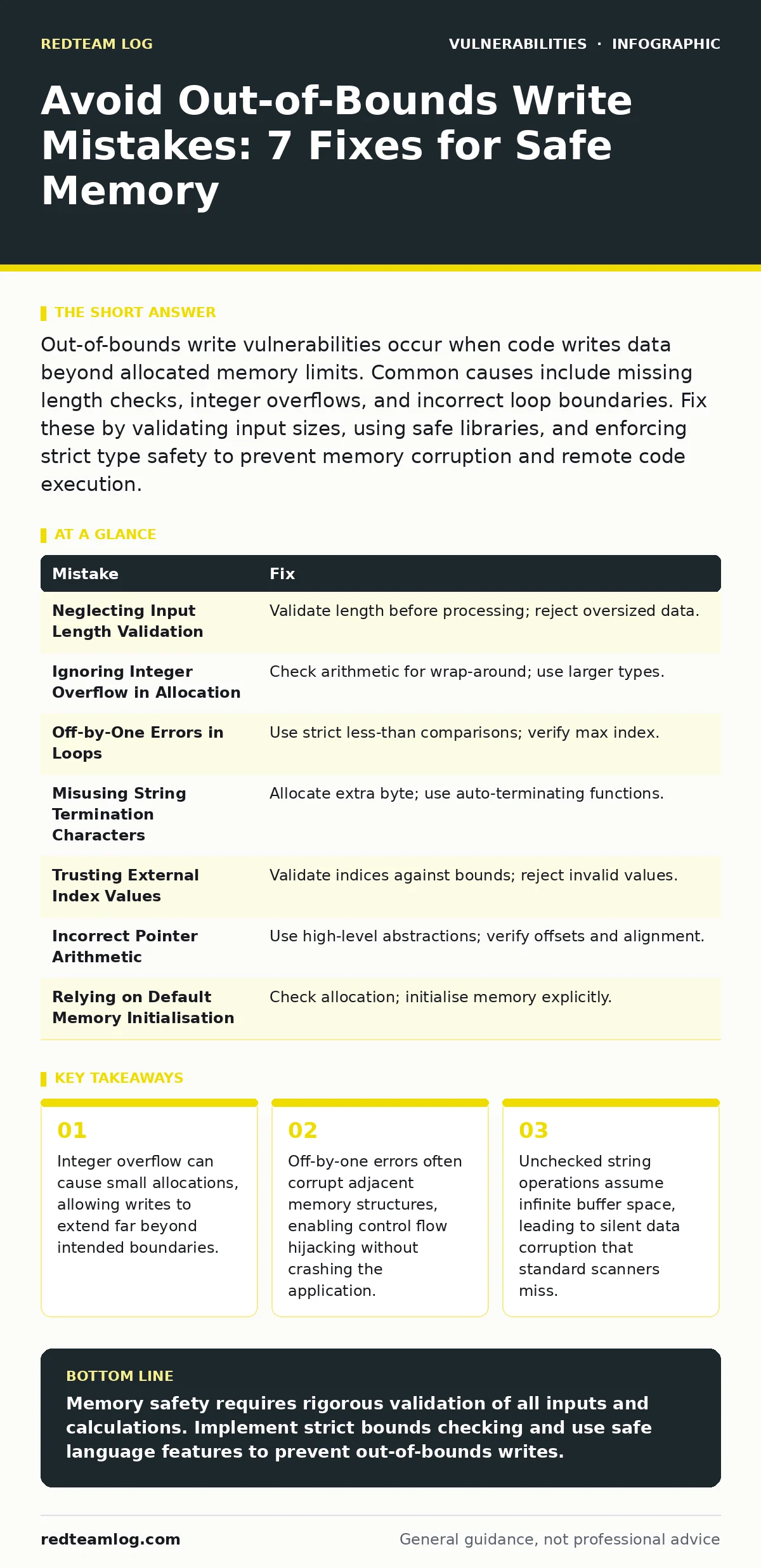
Out-of-bounds write vulnerabilities occur when code writes data beyond allocated memory limits. Common causes include missing length checks, integer overflows, and incorrect loop boundaries. Fix these by validating input sizes, using safe libraries, and enforcing strict type safety to prevent memory corruption and remote code execution.
Mistake 1: Neglecting Input Length Validation
Developers often assume input data fits within predefined buffers. This assumption fails when external sources provide unexpectedly large payloads. The code proceeds to copy data without verifying the source size against the destination capacity. This direct write operation overflows the buffer, corrupting adjacent memory regions.
Why it hurts:
Memory corruption allows attackers to overwrite return addresses or function pointers. This leads to remote code execution or privilege escalation. The application may crash immediately, causing denial of service, or it may continue running with compromised state. Silent corruption is harder to detect than immediate crashes, allowing attackers to maintain persistence while evading basic monitoring tools.
The fix:
Always check the length of incoming data before processing. Compare the source length against the allocated buffer size. Reject or truncate data that exceeds limits. Use functions that require explicit length parameters rather than relying on null-terminators for safety. Integrate this validation into your vulnerability scanning routines to catch regressions early.
Mistake 2: Ignoring Integer Overflow in Allocation
Calculations for buffer sizes often use signed or unsigned integers. If an addition or multiplication exceeds the maximum value, the result wraps around to a small number. The system allocates a tiny buffer based on this wrapped value. The subsequent write operation uses the original large size, writing far beyond the small allocation.
Why it hurts:
This discrepancy creates a massive window for exploitation. The attacker controls the size of the overflow, allowing precise placement of shellcode or payload data. Because the allocation appears valid, standard memory checkers may not flag it. This flaw is particularly dangerous in network services handling variable-length messages, where size fields are attacker-controlled.
The fix:
Validate arithmetic operations before allocation. Ensure the result of size calculations does not wrap around. Use larger integer types for size calculations or explicit checks for overflow conditions. Review code for patterns where user input influences memory allocation sizes. Treat these calculations with the same scrutiny as hard-coded credentials, as they determine memory integrity.
Mistake 3: Off-by-One Errors in Loops
Loop conditions often use less-than-or-equal operators instead of less-than. This single character difference allows the loop to execute one extra iteration. The final write occurs at the index immediately following the buffer. This overwrites the first byte of the next memory block, often a critical control structure.
Why it hurts:
Overwriting a single byte can alter function pointers or length fields in adjacent structures. This subtle corruption may not crash the application immediately. Instead, it changes program logic in unpredictable ways. Attackers exploit this to redirect execution flow. The small footprint makes these errors difficult to spot during manual review, requiring precise static analysis.
The fix:
Use strict less-than comparisons for loop bounds. Prefer higher-level abstractions that manage iteration automatically. When writing manual loops, verify the maximum index against the buffer size. Conduct peer reviews specifically looking for boundary conditions. Combine this with software bill of materials (SBOM) practices to track library versions that may contain similar legacy bugs.
Mistake 4: Misusing String Termination Characters
Some languages require strings to end with a null character. Developers sometimes forget to allocate space for this terminator. They fill the buffer to capacity with data. The writing function then appends the null character, writing one byte past the end of the buffer. This is a classic form of out-of-bounds write.
Why it hurts:
The null byte overwrite can corrupt metadata or security flags in adjacent memory. In structured data formats, this may alter length fields or type identifiers. This corruption can lead to logic errors or information disclosure. It is a frequent source of instability in parsing libraries. Ensure your vulnerability remediation SLAs include fixes for these low-impact but high-frequency issues.
The fix:
Allocate one extra byte for string buffers. Use functions that handle termination automatically. Prefer fixed-size buffers with explicit length tracking over dynamic strings where possible. Validate that all string operations respect the allocated capacity. This prevents the silent overflow that occurs when termination characters are appended without space.
Mistake 5: Trusting External Index Values
Code often uses external data as array indices. If this data is not validated, it may point to locations outside the array. The write operation proceeds to this invalid address. This allows direct manipulation of arbitrary memory locations. It is a direct path to code execution if the attacker can control the index.
Why it hurts:
Unvalidated indices bypass array bounds checking. Attackers can target specific memory addresses to overwrite function pointers or global variables. This technique is common in deserialization vulnerabilities. It allows precise exploitation without relying on heap spraying. The impact is severe because it grants direct memory access.
The fix:
Validate all index values against array bounds. Reject indices that are negative or exceed the array length. Use type-safe containers that enforce bounds checking. Avoid direct memory access patterns. Implement strict input validation at all entry points. This prevents attackers from using external data to manipulate internal memory structures.
Mistake 6: Incorrect Pointer Arithmetic
Pointer arithmetic allows moving memory addresses by byte offsets. Errors in calculating these offsets can lead to writes outside the intended object. This happens when structure sizes are miscalculated or when alignment is ignored. The write occurs at an unexpected location, corrupting unrelated data.
Why it hurts:
Pointer errors are difficult to predict because they depend on memory layout. Corrupted data may not manifest immediately, leading to delayed crashes or subtle logic errors. Attackers exploit this to achieve arbitrary code execution. The complexity of pointer math makes manual review challenging. Static analysis tools are often required to detect these issues.
The fix:
Use high-level abstractions that hide pointer arithmetic. When manual calculation is necessary, verify offsets against object sizes. Use compiler warnings to catch potential pointer errors. Avoid casting pointers to incompatible types. Ensure alignment requirements are met. This reduces the risk of writing to incorrect memory locations.
Mistake 7: Relying on Default Memory Initialisation
Developers sometimes assume memory is zero-initialised. They write data without checking if the buffer is properly allocated. If allocation fails or returns garbage, writes occur to invalid addresses. This leads to undefined behaviour and potential out-of-bounds writes. The application may crash or behave erratically.
Why it hurts:
Uninitialised memory contains random data. Writing to it without validation can overwrite critical system structures. This leads to instability and security vulnerabilities. Attackers may exploit this to inject malicious data. The lack of initialisation makes debugging difficult. Ensure all memory is properly initialised before use.
The fix:
Always check allocation results. Initialise memory to known values before use. Use tools that detect uninitialised memory access. Avoid relying on default initialisation behaviour. Implement strict error handling for memory operations. This prevents writes to invalid or uninitialised memory regions.
| Mistake | Fix |
|---|---|
| Neglecting Input Length Validation | Validate length before processing; reject oversized data. |
| Ignoring Integer Overflow in Allocation | Check arithmetic for wrap-around; use larger types. |
| Off-by-One Errors in Loops | Use strict less-than comparisons; verify max index. |
| Misusing String Termination Characters | Allocate extra byte; use auto-terminating functions. |
| Trusting External Index Values | Validate indices against bounds; reject invalid values. |
| Incorrect Pointer Arithmetic | Use high-level abstractions; verify offsets and alignment. |
| Relying on Default Memory Initialisation | Check allocation; initialise memory explicitly. |
Key takeaways
- Integer overflow can cause small allocations, allowing writes to extend far beyond intended boundaries.
- Off-by-one errors often corrupt adjacent memory structures, enabling control flow hijacking without crashing the application.
- Unchecked string operations assume infinite buffer space, leading to silent data corruption that standard scanners miss.
Memory safety requires rigorous validation of all inputs and calculations. Implement strict bounds checking and use safe language features to prevent out-of-bounds writes.
Frequently asked questions
How do out-of-bounds writes differ from buffer overflows?
Out-of-bounds writes refer to writing data outside allocated memory, while buffer overflow is a specific type where data exceeds buffer capacity. All buffer overflows are out-of-bounds writes, but not all out-of-bounds writes are buffer overflows.
Can static analysis tools detect all out-of-bounds writes?
No. Static analysis tools can identify many common patterns, but they may miss complex logic errors or context-dependent issues. Manual review and dynamic testing are still necessary for comprehensive coverage.
What is the impact of an out-of-bounds write on security?
It can lead to remote code execution, privilege escalation, or denial of service. Attackers can overwrite critical memory structures to control program flow or inject malicious code.
How often should I review code for memory safety?
Review code during every development cycle. Integrate static analysis into your CI/CD pipeline. Conduct manual reviews for high-risk components. Regular updates to your vulnerability scanning practices ensure new issues are caught early.
How this guide was produced: written by the RedTeam Log editorial team with AI assistance, checked against the public references listed below, and reviewed when the facts change. See our editorial policy or report an error.