
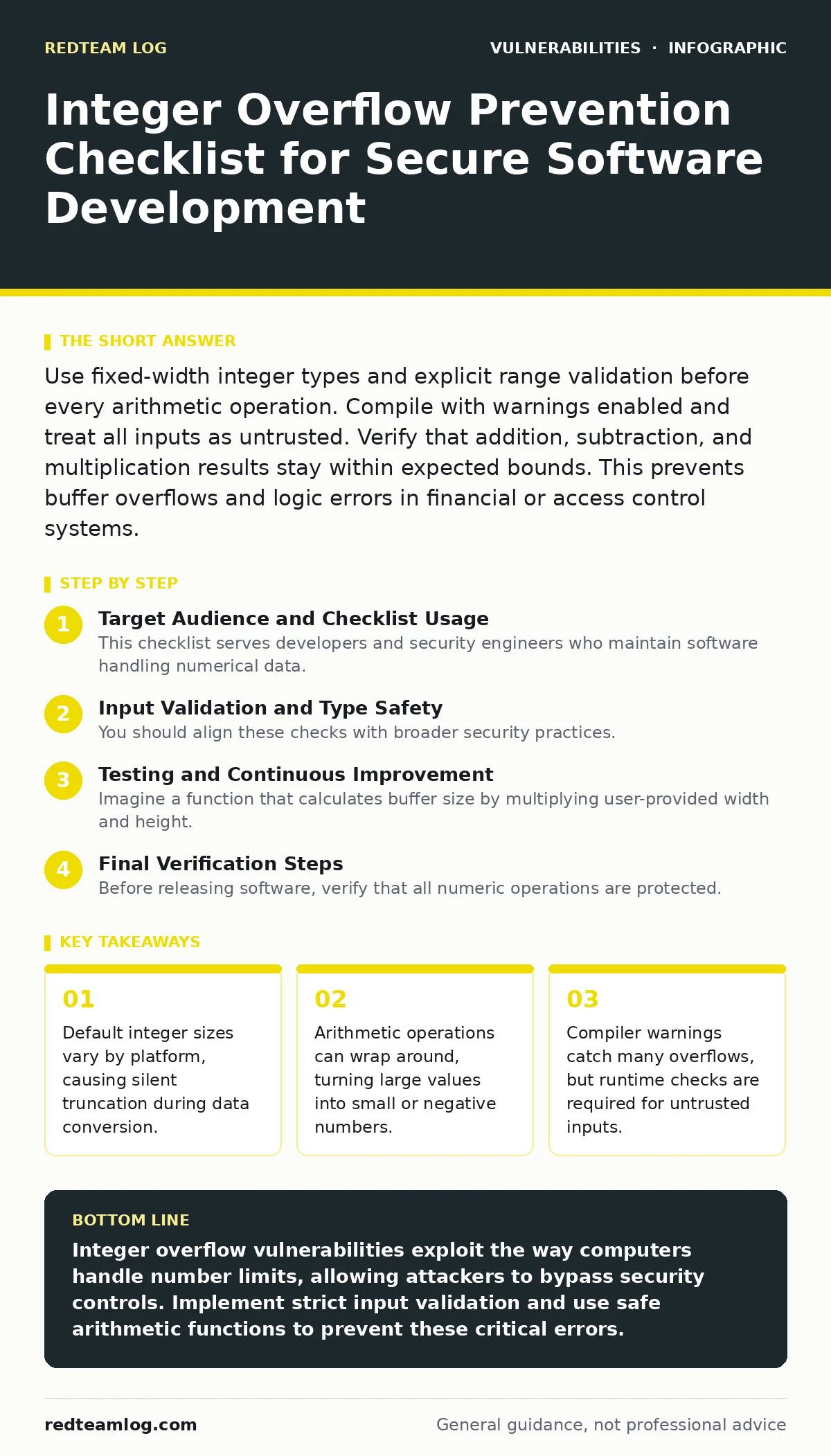
Use fixed-width integer types and explicit range validation before every arithmetic operation. Compile with warnings enabled and treat all inputs as untrusted. Verify that addition, subtraction, and multiplication results stay within expected bounds. This prevents buffer overflows and logic errors in financial or access control systems.
Target Audience and Checklist Usage
This checklist serves developers and security engineers who maintain software handling numerical data. You use this list during code reviews and before deployment. Each item requires a specific action, not just a mental note. Integer overflow vulnerabilities occur when a calculation exceeds the maximum value a variable can hold. The value wraps around to the minimum, often becoming negative. This breaks logic assumptions in memory allocation and access controls.
Input Validation and Type Safety
- Define explicit bounds for all numeric inputs: unbounded inputs allow attackers to trigger wrap-around conditions.
- Use fixed-width integer types instead of native sizes: native int sizes change between 32-bit and 64-bit systems.
- Reject inputs that exceed the maximum safe value: accepting large numbers forces the system to handle unexpected overflow behavior.
- Validate data before casting to smaller types: casting a large value to a small integer truncates data silently.
- Treat all external data as untrusted integers: network packets and API responses may contain malformed numerical fields.
Arithmetic Operation Safeguards
- Check for overflow before addition or subtraction: adding two large positive numbers can result in a negative value.
- Verify multiplication results against expected ranges: multiplying two moderate numbers can exceed the type limit.
- Use safe arithmetic libraries or built-in functions: standard operators do not signal errors when overflow occurs.
- Avoid implicit type promotion in mixed operations: mixing signed and unsigned integers changes comparison results unpredictably.
- Test boundary values in unit tests: inputs just below and above the limit reveal edge-case failures.
Memory Allocation and Buffer Management
- Validate size parameters before allocation calls: a negative size argument may be interpreted as a huge positive number.
- Check for zero-sized allocations: some systems treat zero as a large number, causing heap corruption.
- Use language-specific safe allocation functions: standard malloc does not check for overflow in size calculations.
- Monitor heap usage for anomalies: unexpected small allocations following large inputs indicate a successful overflow attack.
- Restrict dynamic allocation sizes to reasonable limits: arbitrary large allocations can exhaust system resources.
Compilation and Runtime Protections
- Enable compiler overflow detection flags: modern compilers can insert checks for arithmetic operations automatically.
- Treat compiler warnings as errors: ignoring warnings leaves potential overflow paths unaddressed in the build.
- Use address sanitizers during testing: these tools detect out-of-bounds memory accesses caused by incorrect sizes.
- Implement runtime assertions for critical calculations: assertions fail fast when an unexpected value occurs in production.
- Review third-party library dependencies: libraries may contain vulnerable arithmetic code that your application inherits.
See also: NoSQL Injection Risks and Protection for Small Businesses
Code Review and Logic Verification
- Audit loops that increment counters: loop counters can overflow and cause infinite loops or skipped iterations.
- Verify financial and scoring calculations: incorrect totals due to overflow lead to data integrity issues.
- Check for signedness errors in comparisons: comparing signed and unsigned integers can bypass security checks.
- Ensure error handling paths are secure: error messages should not leak information about internal integer states.
- Document expected ranges for all numeric variables: clear documentation helps reviewers identify unusual values quickly.
Integration with Security Frameworks
You should align these checks with broader security practices. For instance, maintaining a software bill of materials (SBOM) helps you track which libraries contain vulnerable arithmetic code. This visibility allows you to prioritize patches for components that handle external input. Similarly, understanding insecure direct object references (IDOR) helps you see how integer overflows might be used to access unauthorized records by manipulating IDs.
Testing and Continuous Improvement
- Perform fuzz testing on numeric inputs: automated tools generate random values to find unexpected overflow paths.
- Review logs for arithmetic errors: monitoring for failed assertions or unusual values provides early warning.
- Update dependencies regularly: newer library versions often fix known integer handling vulnerabilities.
- Train developers on integer types: understanding the difference between signed and unsigned is fundamental.
- Conduct periodic code audits: manual review catches complex logic errors that automated tools miss.
Final Verification Steps
Before releasing software, verify that all numeric operations are protected. Ensure that your testing suite includes cases for maximum and minimum values. Check that your build process flags any potential overflow warnings. This proactive approach reduces the risk of remote code execution and data corruption. Regularly review your security posture against emerging threats.
Key takeaways
- Default integer sizes vary by platform, causing silent truncation during data conversion.
- Arithmetic operations can wrap around, turning large values into small or negative numbers.
- Compiler warnings catch many overflows, but runtime checks are required for untrusted inputs.
Integer overflow vulnerabilities exploit the way computers handle number limits, allowing attackers to bypass security controls. Implement strict input validation and use safe arithmetic functions to prevent these critical errors.
Frequently asked questions
How do I detect integer overflow in existing code?
Use static analysis tools that flag unsafe arithmetic operations. Review code for manual size calculations and missing bounds checks. Enable compiler warnings to catch potential issues during build.
Are unsigned integers safer than signed integers?
Unsigned integers avoid negative values but can still overflow. They wrap around to zero, which can cause infinite loops or logic errors. Both types require explicit bounds checking for security.
Does using a high-level language prevent integer overflows?
High-level languages often handle overflow differently, such as throwing exceptions. However, interactions with external systems or libraries may still expose vulnerabilities. Always validate inputs regardless of the language.
How does integer overflow relate to other vulnerabilities?
Integer overflows often lead to buffer overflows and memory corruption. They can also be combined with other issues, such as prototype pollution, to escalate privileges or execute arbitrary code.
How this guide was produced: written by the RedTeam Log editorial team with AI assistance, checked against the public references listed below, and reviewed when the facts change. See our editorial policy or report an error.