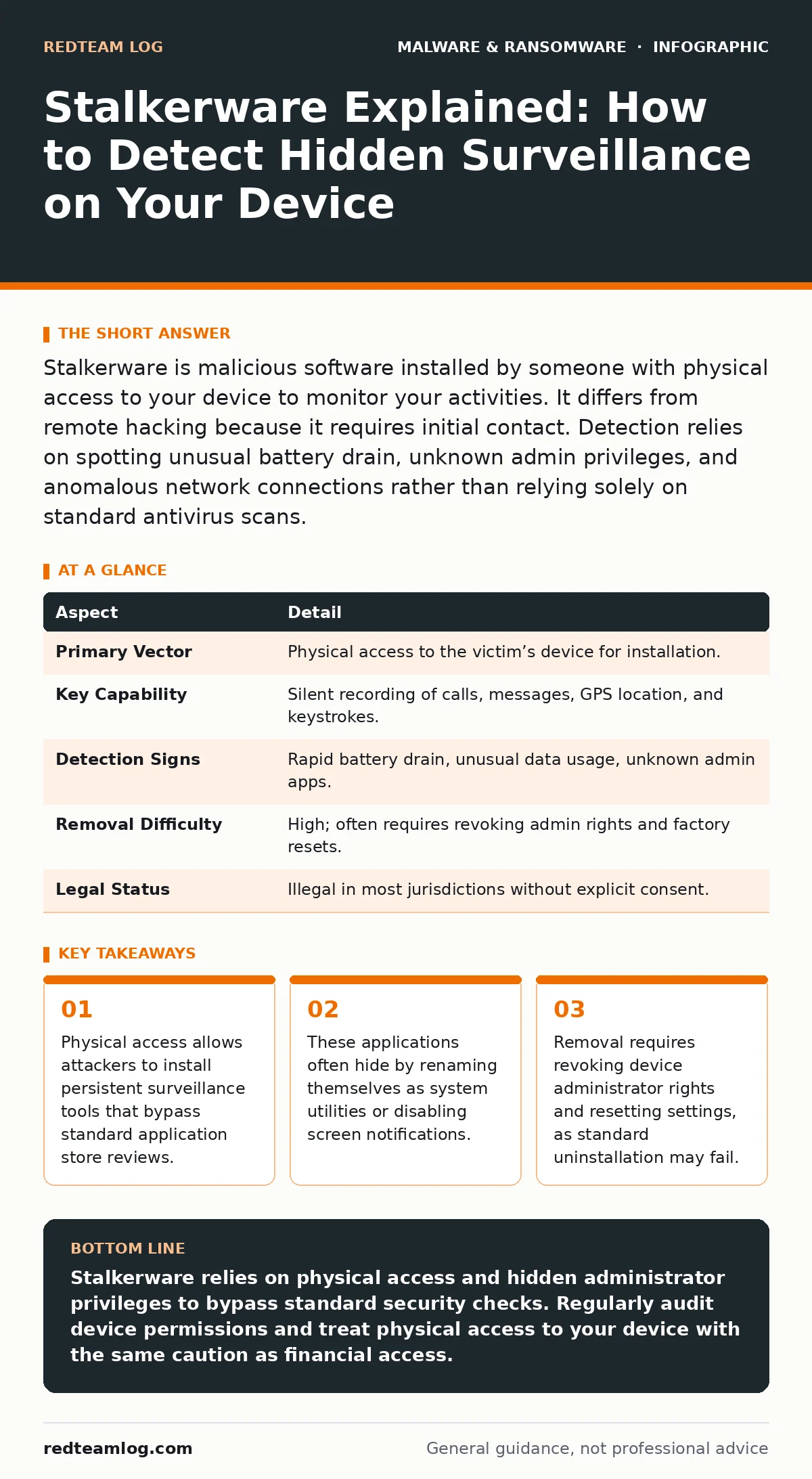
Stalkerware is malicious software installed by someone with physical access to your device to monitor your activities. It differs from remote hacking because it requires initial contact. Detection relies on spotting unusual battery drain, unknown admin privileges, and anomalous network connections rather than relying solely on standard antivirus scans.
The Invisible Roommate
Imagine sharing a flat with someone who has a key to your bedroom. They do not break in; they simply walk in when you are showering or sleeping. They note what you wear, what you say, and who visits. Stalkerware operates on this same principle of trusted access. It is not a ghost in the machine that hacks you from miles away. It is software placed on your device by someone you know, or who has had physical possession of your hardware.
The term refers to applications designed to monitor a user’s behaviour without their knowledge. Unlike typical mobile malware that spreads via phishing links, this software relies on intimacy or opportunity. The attacker needs to hold your phone or tablet for a few minutes. Once installed, it runs silently in the background, capturing data and sending it to a remote dashboard.
The danger lies in the assumption of safety. You likely trust the person who borrowed your phone to charge it. That trust is the attack vector. The software exploits the gap between physical security and digital permissions.
At a Glance
| Aspect | Detail |
|---|---|
| Primary Vector | Physical access to the victim’s device for installation. |
| Key Capability | Silent recording of calls, messages, GPS location, and keystrokes. |
| Detection Signs | Rapid battery drain, unusual data usage, unknown admin apps. |
| Removal Difficulty | High; often requires revoking admin rights and factory resets. |
| Legal Status | Illegal in most jurisdictions without explicit consent. |
How the Installation Works
The process begins with physical proximity. An attacker asks to borrow your phone to make a call, check a map, or charge the battery. In that brief window, they install the surveillance application. Many of these tools are available through open markets or unregulated app stores. They are not vetted by the strict security teams of major platforms.
Once installed, the attacker grants the app device administrator privileges. This is a critical step. Administrator rights allow the software to prevent itself from being uninstalled. It can also disable other security measures. The app then hides its icon. It may rename itself to look like a system component, such as "System Update" or "Keyboard Helper".
You continue using your phone normally. The stalkerware captures your location via GPS, records ambient audio through the microphone, and logs your keystrokes. It transmits this data over Wi-Fi or mobile data. The traffic often looks like normal internet usage, blending in with regular background updates.
Common Forms and Disguises
Stalkerware comes in several varieties, each targeting different aspects of your digital life. Some are comprehensive suites that track everything. Others are single-purpose tools that focus on location or social media.
Location trackers are the most common. They use GPS and cell tower triangulation to pinpoint your position. They often disguise themselves as "find my device" utilities. Message interceptors hook into your SMS and instant messaging apps. They capture text, images, and even deleted messages. Keystroke loggers record every character you type, capturing passwords and search queries.
Some variants function similarly to malicious browser extensions. They inject themselves into your web browser to capture login credentials. Others operate at a lower level, capturing screenshots at regular intervals. This creates a visual timeline of your activities. The variety means no single signature detects all threats.
Who Is Affected
The primary victims are individuals in abusive relationships. The attacker is often a current or former partner. This dynamic changes the threat model. The attacker knows your habits, your passwords, and your social circle. They can predict when you are distracted.
However, the scope is widening. Parents may install tracking software on teenagers’ devices under the guise of safety. Employers may monitor company-owned phones used by staff. While some monitoring is legal with consent, covert surveillance violates privacy laws in many regions. The distinction between protection and persecution often lies in transparency.
Corporate espionage is another vector. A disgruntled employee might install tracking tools on a colleague’s device to steal intellectual property. In these cases, the stalkerware acts as a spy tool rather than a control mechanism. The impact on the victim remains the same: a loss of privacy and autonomy.
What People Usually Get Wrong
A common misconception is that antivirus software will catch stalkerware. Standard antivirus quarantine procedures look for known malicious signatures. Stalkerware often uses clean code or disguises itself as legitimate tools. It does not behave like a virus. It does not replicate or corrupt files. It simply observes.
Another error is assuming that removing the app icon stops the surveillance. Many tools run as background services. Even if you hide the icon, the process continues. You must check for active administrator privileges. If an unknown app has these rights, it can resist deletion.
Reducing the Risk
Prevention starts with physical security. Treat your device like a wallet. Do not leave it unattended. If someone borrows your phone, supervise the usage. Lock your screen with a strong biometric or passcode. Change these credentials regularly, especially if you suspect compromise.
Regularly review the list of applications with administrator rights. On Android, this is found in the Security settings. On iOS, check for profiles in the General settings. Look for any app you do not recognise. If you see one, revoke its rights immediately.
Monitor your battery and data usage. Stalkerware consumes resources. If your battery drains faster than usual, or if data usage spikes when the phone is idle, investigate. Check for unknown apps in the full application list, not just the home screen.
The Limits of Detection
No tool guarantees complete protection. Some advanced variants mimic system processes so closely that they are indistinguishable from legitimate components. They may even disable remote wiping commands. In these cases, the only sure fix is a hardware replacement or a deep forensic analysis.
Understanding the mechanism helps you stay alert. The threat is not in the code alone, but in the access. Protecting your physical device is the first line of defence. Digital hygiene, such as keeping software updated and monitoring permissions, forms the second. Together, they reduce the window of opportunity for an attacker.
Key takeaways
- Physical access allows attackers to install persistent surveillance tools that bypass standard application store reviews.
- These applications often hide by renaming themselves as system utilities or disabling screen notifications.
- Removal requires revoking device administrator rights and resetting settings, as standard uninstallation may fail.
Stalkerware relies on physical access and hidden administrator privileges to bypass standard security checks. Regularly audit device permissions and treat physical access to your device with the same caution as financial access.
Frequently asked questions
Can stalkerware be installed remotely?
Generally no. Most stalkerware requires physical access to the device for installation and permission granting. Remote installation usually involves separate exploits or vulnerabilities.
Does a factory reset remove all stalkerware?
Yes, a factory reset wipes the operating system and all installed applications. However, you must set up the device as new, not restore from a backup, to avoid re-installing the malicious app.
How can I tell if my phone is being tracked?
Look for unknown apps with administrator rights, unusual battery drain, and high data usage. Check for apps with generic names that you did not install yourself.
Is stalkerware the same as ransomware?
No. **Ransomware** encrypts your files to demand payment. Stalkerware collects data silently. They have different goals and mechanisms, though both are forms of cybercrime.
How this guide was produced: written by the RedTeam Log editorial team with AI assistance, checked against the public references listed below, and reviewed when the facts change. See our editorial policy or report an error.