
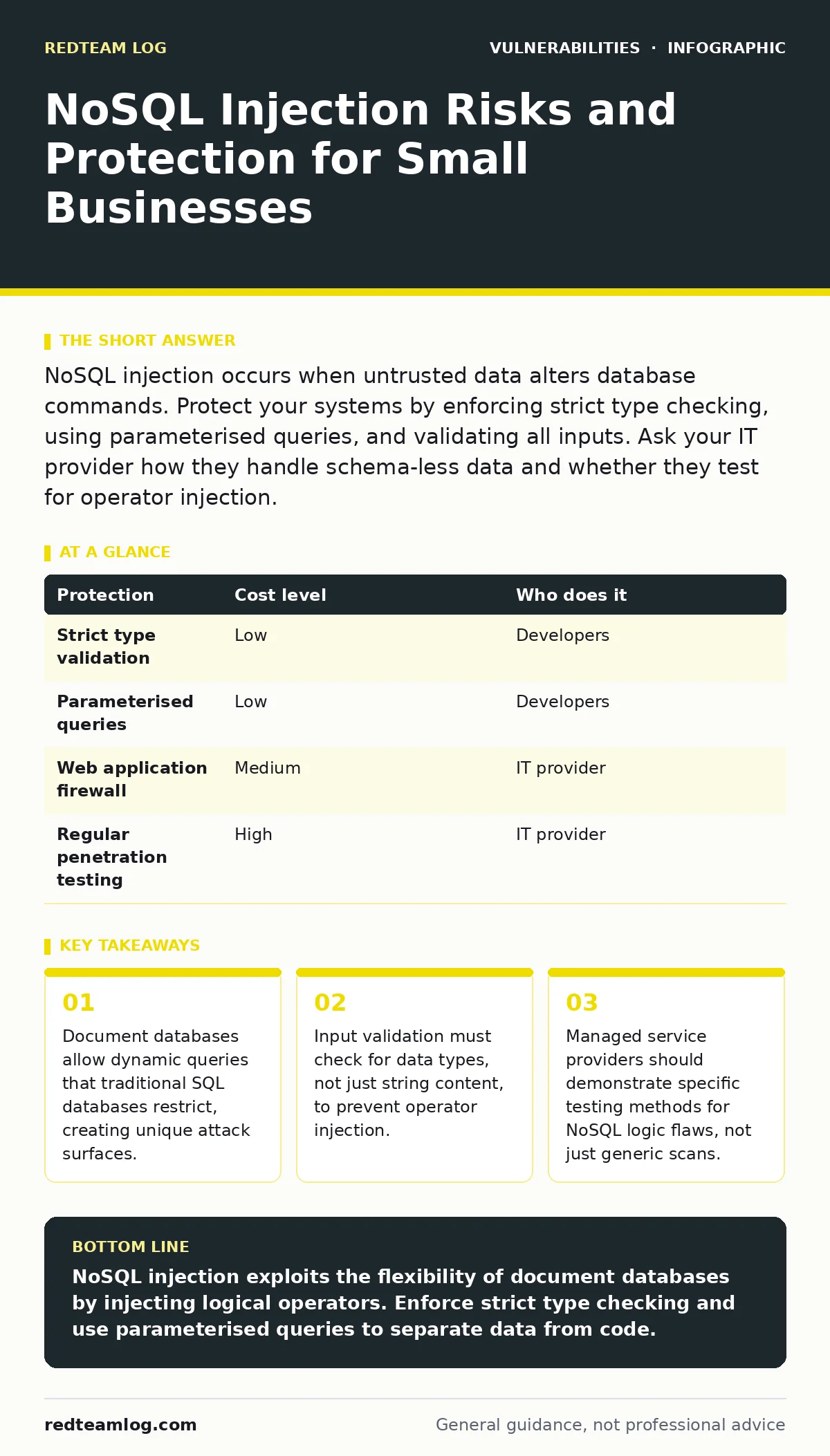
NoSQL injection occurs when untrusted data alters database commands. Protect your systems by enforcing strict type checking, using parameterised queries, and validating all inputs. Ask your IT provider how they handle schema-less data and whether they test for operator injection.
The Hidden Flexibility of Document Stores
Traditional relational databases enforce a rigid structure. You define columns, data types, and relationships before you insert data. This rigidity acts as a natural barrier against certain types of injection. If you try to insert text into a numeric field, the database rejects it.
NoSQL databases, particularly document stores, operate differently. They store data in flexible formats like JSON. You can insert any structure you like at any time. This flexibility speeds up development and simplifies scaling. It also removes the safety net of strict schema enforcement.
When a database does not enforce types, the application code must do the work. Developers often assume the database will handle sanitisation. It does not. The application becomes the sole line of defence. If the code trusts user input, the database executes whatever logic that input constructs.
Why Small Organisations Face Higher Exposure
Small teams often prioritise speed over security. They adopt modern stacks that promise rapid deployment. These stacks frequently include document databases for their ease of use. The assumption is that modern tools are inherently safer than legacy systems. This assumption is incorrect.
Security tools designed for SQL injection do not always detect NoSQL injection. Standard scanners look for specific patterns like semicolons or union statements. NoSQL injection uses different syntax. It relies on operators like $gt (greater than) or $ne (not equal). A scanner that does not understand this syntax will report a clean bill of health.
You may also lack dedicated security staff. Your developers wear many hats. They build features, fix bugs, and manage infrastructure. Security becomes an afterthought. Without a process to review how data enters the database, flaws remain hidden until an attacker finds them.
Understanding the Mechanics of the Attack
NoSQL injection does not always involve dropping tables or stealing entire databases. The danger lies in logic manipulation. An attacker can change how the database evaluates conditions.
Suppose your login code checks if a username and password match a record. It might construct a query object that says "find user where username is X and password is Y". If the user inputs a special character sequence that represents "not equal to", the query changes. It might become "find user where password is not null". The database returns a record. The application grants access.
This is distinct from SQL injection. In SQL, you inject code that runs against the database engine. In NoSQL, you inject operators that change the query structure. The result is the same: unauthorised access. The method is different, which is why generic advice fails.
| Protection | Cost level | Who does it |
|---|---|---|
| Strict type validation | Low | Developers |
| Parameterised queries | Low | Developers |
| Web application firewall | Medium | IT provider |
| Regular penetration testing | High | IT provider |
Low-Cost Protections You Can Implement Today
You do not need expensive tools to mitigate this risk. The most effective defence is strict input validation. Every piece of data entering your system must be checked. Does it match the expected format? Is it the correct type?
If you expect a user ID to be a number, reject any string that contains letters or symbols. Do not try to clean the input. Reject it outright. This is known as allowlisting. You define what is valid and block everything else.
Use parameterised queries or prepared statements where possible. These methods separate code from data. The database treats the input as a value, not as part of the command. This prevents the input from altering the query logic.
What to Ask Your IT Provider
If you outsource your IT, you need clarity on how they handle these specific risks. Do not ask if they are secure. Ask how they test for logic flaws.
Ask them to explain their approach to schema-less data. How do they ensure that flexible data structures do not become security holes? Do they use automated tools that understand NoSQL syntax?
Request details on their testing methodology. Do they perform manual code reviews? Do they use dynamic analysis tools that simulate NoSQL injection attempts? If they only run standard vulnerability scanners, they are missing this specific threat.
- Do you validate input types on the server side for all document database interactions?
- How do you test for operator injection in NoSQL queries?
- Do you use allowlisting for all user inputs, or do you rely on blocklisting?
- Can you provide evidence of recent penetration testing that included NoSQL logic flaws?
See also: Integer Overflow Prevention Checklist for Secure Software Development
The Role of Code Quality and Frameworks
Modern frameworks often include protections against common threats. However, these protections are not always enabled by default. You must configure them correctly.
Some frameworks provide built-in validation libraries. Use them. Do not write your own validation logic unless you have a specific reason. Custom logic is prone to errors.
Review your dependencies. Libraries you use to interact with the database may have known vulnerabilities. Keep them updated. This relates to the concept of a software bill of materials (SBOM). Knowing exactly which components you use helps you react quickly when flaws are discovered.
Beyond Injection: Related Security Gaps
NoSQL injection is one part of a larger picture. If your input validation is weak, you are likely vulnerable to other issues.
For instance, poor handling of user input can lead to file upload vulnerabilities. Attackers may try to upload malicious scripts that execute on your server.
If your application does not enforce proper access controls, you might expose data through insecure direct object references (IDOR). Users can change IDs in URLs to access other users' data.
Ensure your team understands these connections. Security is not a list of isolated tasks. It is a system of interlocking defences. Weakness in one area often reveals weakness in another.
Key takeaways
- Document databases allow dynamic queries that traditional SQL databases restrict, creating unique attack surfaces.
- Input validation must check for data types, not just string content, to prevent operator injection.
- Managed service providers should demonstrate specific testing methods for NoSQL logic flaws, not just generic scans.
NoSQL injection exploits the flexibility of document databases by injecting logical operators. Enforce strict type checking and use parameterised queries to separate data from code.
Frequently asked questions
Is NoSQL injection the same as SQL injection?
No. SQL injection injects code into the database command. NoSQL injection injects operators that change the query structure. The syntax and detection methods differ.
Can a web application firewall stop NoSQL injection?
It can help, but only if configured specifically for NoSQL patterns. Many standard WAFs miss NoSQL operators. You still need application-level validation.
Do I need to change my database to fix this?
No. The issue is in how your application code constructs queries. Fixing the code resolves the risk without changing the database.
How often should I test for this?
Test every time you change code that interacts with the database. Continuous integration should include automated tests for input validation.
How this guide was produced: written by the RedTeam Log editorial team with AI assistance, checked against the public references listed below, and reviewed when the facts change. See our editorial policy or report an error.