
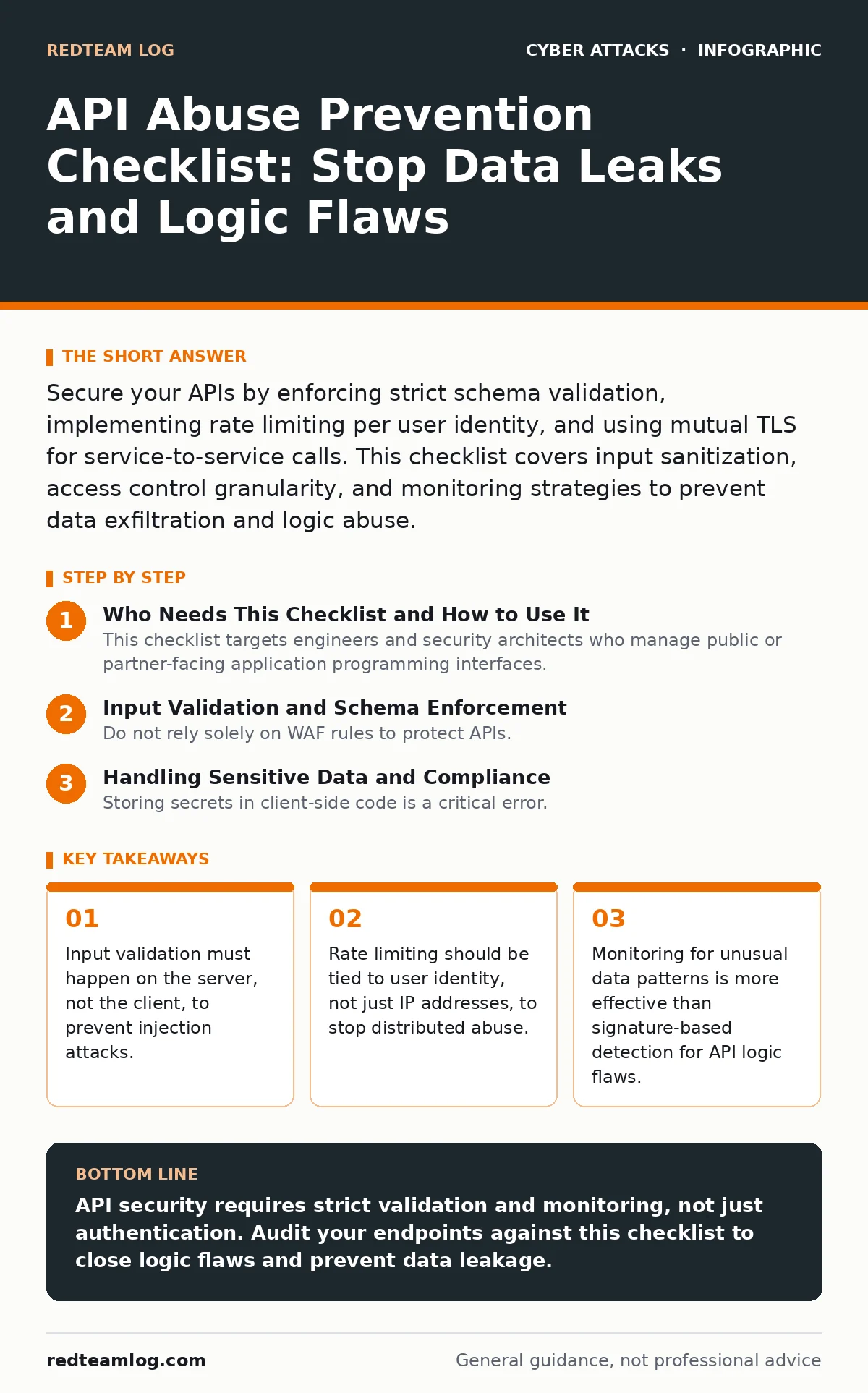
Secure your APIs by enforcing strict schema validation, implementing rate limiting per user identity, and using mutual TLS for service-to-service calls. This checklist covers input sanitization, access control granularity, and monitoring strategies to prevent data exfiltration and logic abuse.
Who Needs This Checklist and How to Use It
This checklist targets engineers and security architects who manage public or partner-facing application programming interfaces. An API allows different software systems to communicate, but it often lacks the visual safeguards of a web browser. You use this list to audit your current API security posture. Check off each item after verifying your implementation. Do not skip items because they seem basic; API abuse often exploits overlooked fundamentals.
Input Validation and Schema Enforcement
- Enforce strict JSON schema validation: Reject any request that does not match the expected structure, preventing injection of unexpected fields.
- Sanitize all string inputs: Strip or encode special characters to stop command injection and cross-site scripting attempts.
- Validate data types explicitly: Ensure numeric fields contain only numbers, blocking attackers from injecting code via type confusion.
- Limit request payload size: Set a hard cap on body size to prevent denial of service through excessive data processing.
- Reject unknown headers: Ignore or reject non-standard headers to prevent header injection attacks that manipulate server behavior.
Authentication and Authorization Controls
- Use OAuth 2.0 with short-lived tokens: Short expiration times reduce the window of opportunity if a token is stolen or leaked.
- Implement scope-based access: Grant only the minimum permissions required for each operation, limiting damage from compromised accounts.
- Verify JWT signatures server-side: Never trust client-provided claims; always verify the signature to ensure the token has not been tampered with.
- Enforce mutual TLS for internal services: Require both client and server to present certificates, ensuring that only authorized systems can communicate.
- Rotate API keys regularly: Automate key rotation to limit the impact of a leaked credential, reducing the time an attacker can use stolen access.
Rate Limiting and Abuse Prevention
- Apply rate limits per user ID: Tie limits to authenticated identities rather than IP addresses, stopping distributed attacks from rotating IPs.
- Implement exponential backoff: Force attackers to wait longer after each failed attempt, slowing down brute-force and credential stuffing attacks.
- Monitor for burst traffic: Detect sudden spikes in request volume that deviate from normal user behaviour, indicating automated scraping or abuse.
- Block known malicious user agents: Identify and reject requests from common scraping tools or known bad bots, reducing noise in your logs.
- Cap concurrent connections per user: Limit the number of simultaneous requests to prevent resource exhaustion and ensure fair usage.
Monitoring and Anomaly Detection
- Log all API requests and responses: Capture full request details, including headers and payloads, to enable forensic analysis after an incident.
- Alert on unusual data access patterns: Trigger alerts when a user accesses data outside their normal scope or volume, indicating account takeover.
- Monitor for broken object level authorization: Detect attempts to access resources belonging to other users, a common API vulnerability.
- Track error rates by endpoint: Sudden increases in 4xx or 5xx errors can signal an attacker probing for vulnerabilities or misconfigurations.
- Correlate logs with identity providers: Link API activity to identity logs to spot anomalies in authentication patterns or geographic locations.
Secure Development Lifecycle Integration
- Include API security in code reviews: Train reviewers to look for logic flaws and improper access controls, not just syntax errors.
- Automate security testing in CI/CD: Run static and dynamic analysis tools on every build to catch vulnerabilities before deployment.
- Use threat modeling for new endpoints: Identify potential abuse cases during design, ensuring security controls are built in from the start.
- Document security requirements for each API: Clearly define expected inputs, outputs, and security controls, reducing ambiguity for developers.
- Regularly update dependencies: Patch libraries and frameworks to fix known vulnerabilities, reducing the attack surface of your API infrastructure.
Handling Sensitive Data and Compliance
- Encrypt data in transit and at rest: Use TLS for all communications and encryption for stored data, ensuring confidentiality even if infrastructure is compromised.
- Mask sensitive fields in logs: Remove or hash personally identifiable information from logs, preventing accidental exposure of sensitive data.
- Implement data minimization: Return only the data fields required by the client, reducing the impact of a data breach.
- Enforce data retention policies: Automatically delete old API logs and cached data, reducing the amount of information available to attackers.
- Audit access to sensitive endpoints: Regularly review who has access to high-risk APIs, ensuring only authorized personnel can interact with them.
Related considerations include protecting against phishing attempts that target API credentials, and using DNS filtering to block malicious domains accessed via API integrations. For broader network security, consult guides on intrusion prevention systems and security operations centers to correlate API anomalies with other threat indicators.
Key takeaways
- Input validation must happen on the server, not the client, to prevent injection attacks.
- Rate limiting should be tied to user identity, not just IP addresses, to stop distributed abuse.
- Monitoring for unusual data patterns is more effective than signature-based detection for API logic flaws.
API security requires strict validation and monitoring, not just authentication. Audit your endpoints against this checklist to close logic flaws and prevent data leakage.
Frequently asked questions
How do I prevent broken object level authorization?
Enforce strict server-side checks that verify the user owns the resource they are requesting, never trusting client-provided IDs.
What is the best way to handle API rate limiting?
Implement rate limiting based on user identity and endpoint sensitivity, using a sliding window algorithm to smooth out burst traffic.
Should I use API keys or OAuth tokens?
Use OAuth tokens for user-facing applications to enable fine-grained access control, and API keys for server-to-server communication with strict scope limits.
How often should I rotate API keys?
Rotate API keys automatically on a regular schedule, such as every 90 days, and immediately upon any suspected compromise or employee departure.
How this guide was produced: written by the RedTeam Log editorial team with AI assistance, checked against the public references listed below, and reviewed when the facts change. See our editorial policy or report an error.