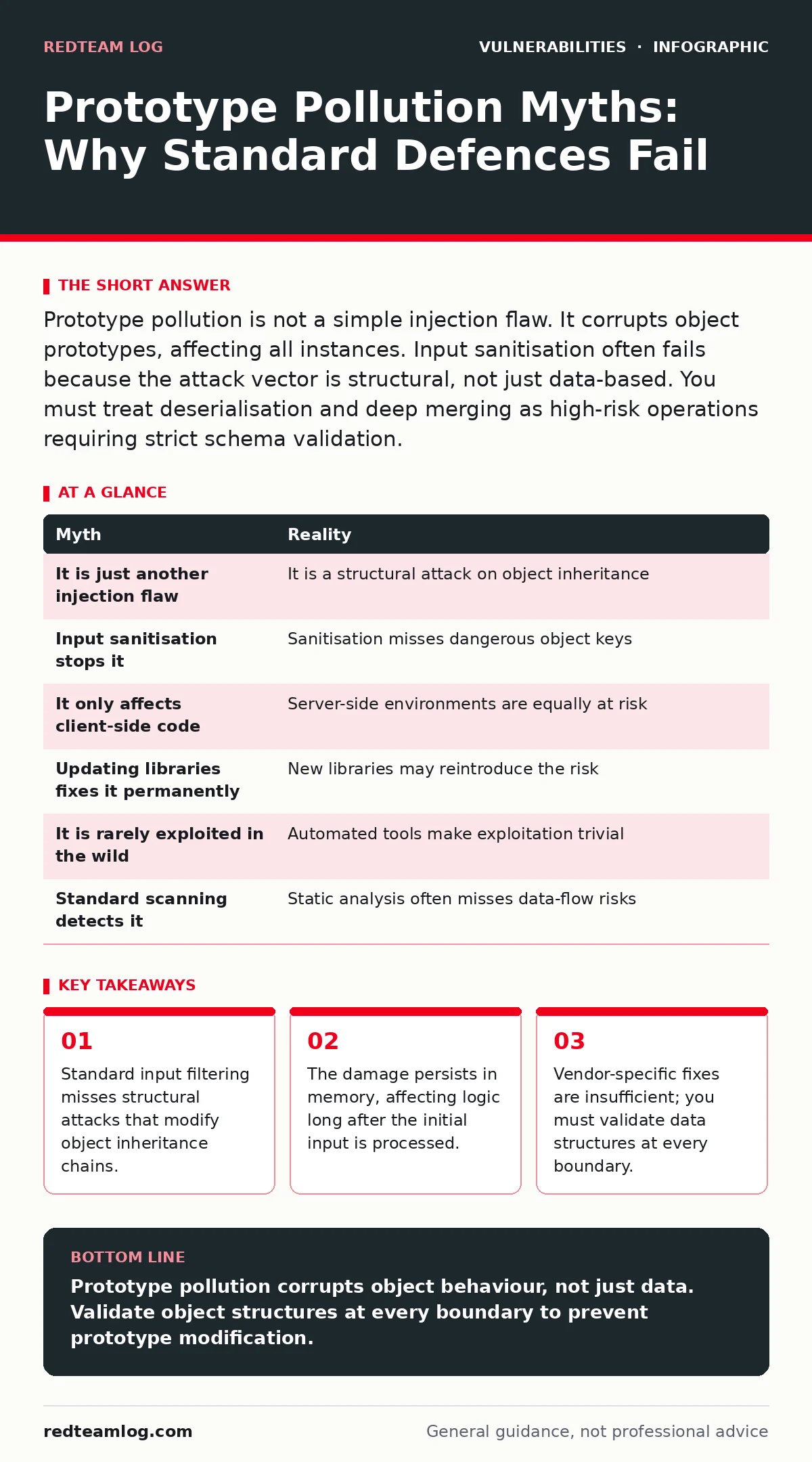
Prototype pollution is not a simple injection flaw. It corrupts object prototypes, affecting all instances. Input sanitisation often fails because the attack vector is structural, not just data-based. You must treat deserialisation and deep merging as high-risk operations requiring strict schema validation.
Myth: It Is Just Another Injection Flaw
Reality: Prototype pollution operates differently to traditional injection vulnerabilities. It does not execute arbitrary code directly. Instead, it modifies the prototype of a native JavaScript object. This change affects every object that inherits from that prototype.
Imagine a configuration object that defaults to false for a security flag. An attacker pollutes the prototype to set this flag to true. Every new configuration object created thereafter inherits this malicious default. The application logic remains intact, but the data it relies on is corrupted. This is a structural attack, not a syntax error.
Unlike SQL injection, which targets a database query, this targets the application’s memory model. The code executes exactly as written, but the context is poisoned. You cannot patch this by escaping special characters. You must prevent the modification of the prototype itself.
Myth: Input Sanitisation Stops It
Reality: Standard input sanitisation focuses on stripping dangerous characters or patterns. It assumes the threat is in the content of the string. Prototype pollution hides in the keys of an object.
Suppose you filter for <script> tags or SQL keywords. These filters ignore the key __proto__. When a library merges this object into another, it traverses the prototype chain. It sets the property on the base prototype. The sanitised string content is harmless, but the structure is lethal.
Many security libraries treat object keys as opaque identifiers. They do not inspect the semantic meaning of a key name. If you rely solely on output encoding, you miss the root cause. The pollution occurs before output is generated. It occurs during data processing. You need structural validation, not just content filtering.
Myth: It Only Affects Client-Side Code
Reality: This vulnerability exists wherever JavaScript runs. It is not limited to the browser. Node.js environments are equally vulnerable, often more so.
Server-side applications handle sensitive logic, database connections, and user sessions. If a server-side library merges user input into a configuration object, the server’s state is compromised. This can lead to privilege escalation or denial of service. The impact is immediate and systemic.
Client-side attacks are often dismissed as less severe. However, modern architectures use JavaScript on both ends. A polluted prototype on the server can send corrupted data to the client. The client then acts on false assumptions. You must secure the server-side processing pipeline with the same rigour as the client.
Myth: Updating Libraries Fixes It Permanently
Reality: Updating libraries addresses known vulnerable versions. It does not eliminate the underlying risk. New libraries may introduce similar merge functions.
Dependency management is a continuous process. A library you trust today may have a flaw tomorrow. Moreover, transitive dependencies can reintroduce the risk. You might update a direct dependency, but it pulls in an older, vulnerable package.
You need a strategy beyond version updates. Implement strict schema validation at every entry point. Define what keys are allowed. Reject any object that contains reserved keys like __proto__ or constructor. This defence works regardless of the library version. It shifts the burden from the tool to the architecture.
Myth: It Is Rarely Exploited in the Wild
Reality: The ease of exploitation makes it a frequent target. It requires no complex payload. It requires only a single object with a specific key.
Attackers automate the discovery of vulnerable merge functions. They scan for common libraries known to have this flaw. Once found, the exploit is trivial. The impact is high because it affects core application logic.
The lack of high-profile, named incidents does not mean it is safe. Many attacks are silent. They alter configuration or logic without crashing the application. They degrade security over time. You may not see a breach notification, but your security posture is eroding. Assume it is being attempted against your endpoints.
Myth: You Can Detect It With Standard Scanning
Reality: Static analysis tools often miss prototype pollution. They look for patterns of code, not patterns of data flow.
A merge function looks like standard code. It does not contain malicious syntax. The danger lies in the data passed to it. If the data comes from an untrusted source, the risk is high. Scanners cannot always trace the origin of an object key through complex application logic.
Dynamic analysis is more effective but still imperfect. It requires testing every input path. This is difficult in large applications. You must combine automated scanning with manual code review. Focus on functions that merge, clone, or extend objects. Check if they allow user input to define keys.
Summary of Myths and Realities
| Myth | Reality |
|---|---|
| It is just another injection flaw | It is a structural attack on object inheritance |
| Input sanitisation stops it | Sanitisation misses dangerous object keys |
| It only affects client-side code | Server-side environments are equally at risk |
| Updating libraries fixes it permanently | New libraries may reintroduce the risk |
| It is rarely exploited in the wild | Automated tools make exploitation trivial |
| Standard scanning detects it | Static analysis often misses data-flow risks |
Key takeaways
- Standard input filtering misses structural attacks that modify object inheritance chains.
- The damage persists in memory, affecting logic long after the initial input is processed.
- Vendor-specific fixes are insufficient; you must validate data structures at every boundary.
Prototype pollution corrupts object behaviour, not just data. Validate object structures at every boundary to prevent prototype modification.
Frequently asked questions
How do I check if my code is vulnerable?
Review all functions that merge or extend objects. Ensure they do not allow user input to set keys like `__proto__` or `constructor`. Use schema validation to restrict allowed keys.
Is this relevant if I do not use JavaScript?
If your application uses JavaScript libraries or runs in a JavaScript environment, yes. Many modern frameworks and APIs rely on JavaScript, even if the core backend is in another language.
Can Content Security Policy prevent this?
No. Content Security Policy controls resource loading. It does not inspect object structures or prevent prototype modification during data processing.
What is the best defence against prototype pollution?
Strict schema validation. Reject any object that contains reserved keys. Use libraries that are explicitly designed to be prototype-safe or that allow you to disable prototype traversal.
How this guide was produced: written by the RedTeam Log editorial team with AI assistance, checked against the public references listed below, and reviewed when the facts change. See our editorial policy or report an error.