Ransomware recovery fails when teams assume backups are clean, ignore network segmentation, or skip forensics. Correct plans verify data integrity, isolate compromised segments, and test restoration procedures regularly before an incident occurs.
Misreading: Backups Guarantee Instant Recovery
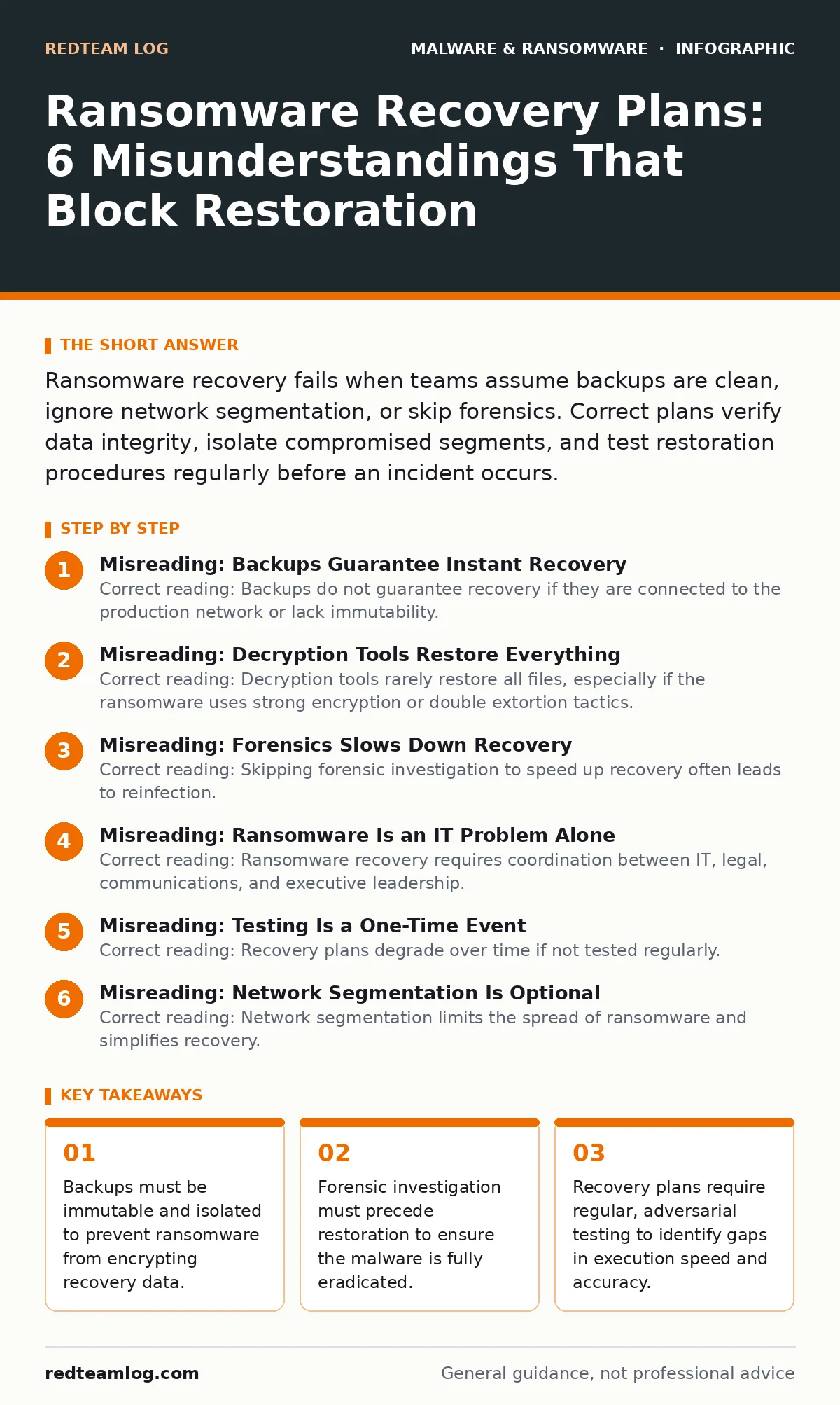
Correct reading: Backups do not guarantee recovery if they are connected to the production network or lack immutability. Ransomware operators routinely scan for and encrypt backup volumes before targeting primary systems. If your backup storage is accessible via standard network protocols, the malware reaches it. You must store backups in an air-gapped state or use immutable storage that prevents modification for a set retention period. This separation ensures that even if the primary network is compromised, the recovery data remains untouched.
Consider the difference between a snapshot and a true backup. Snapshots often inherit the state of the source volume, including any hidden malware. If you restore from a snapshot taken after infection, you restore the infection. True backups are point-in-time copies stored separately. You must verify that your backup solution creates independent copies that cannot be altered by credentials stolen from the production environment. This distinction determines whether your recovery data is viable or compromised.
Misreading: Decryption Tools Restore Everything
Correct reading: Decryption tools rarely restore all files, especially if the ransomware uses strong encryption or double extortion tactics. Many modern strains encrypt files locally and exfiltrate sensitive data before encryption. Decrypting the files does not stop the threat actors from publishing stolen information. Furthermore, decryption keys are often unique to each victim, meaning generic tools fail. You cannot rely on decryption as a primary recovery strategy. Your plan must assume that encrypted files are lost and that you must restore from clean backups.
This creates a fragmented system that is difficult to validate. You must accept data loss as a possibility and plan for manual reconstruction of critical records. This approach shifts the focus from hoping for a technical fix to ensuring operational resilience through verified backups. It also reduces the pressure to pay ransoms, which does not guarantee decryption or silence.
Misreading: Forensics Slows Down Recovery
Correct reading: Skipping forensic investigation to speed up recovery often leads to reinfection. Ransomware is rarely the only malware on a system. Threat actors often install backdoors, remote access tools, and credential stealers before deploying ransomware. If you restore systems without identifying and removing these secondary threats, the attackers regain access immediately. You must conduct a thorough forensic analysis to determine the initial entry point, the scope of compromise, and all persistence mechanisms. This process takes time but prevents a second, more damaging breach.
Suppose you restore servers in 24 hours without forensics. The attacker’s backdoor remains active. Within days, they return and encrypt the newly restored data. This cycle wastes resources and increases operational downtime. Forensics is not an optional delay; it is a prerequisite for safe restoration. You must involve security experts who can map the attacker’s lateral movement. This mapping reveals which systems are trusted and which must be rebuilt from scratch. It ensures that the restored environment is genuinely clean.
Misreading: Ransomware Is an IT Problem Alone
Correct reading: Ransomware recovery requires coordination between IT, legal, communications, and executive leadership. IT handles the technical restoration, but legal teams assess regulatory obligations and liability. Communications teams manage stakeholder expectations and public messaging. Executive leadership makes strategic decisions about paying ransoms and accepting downtime. If IT acts in isolation, the organization faces legal penalties, reputational damage, and operational chaos. You must define roles and responsibilities for each department in the recovery plan. This cross-functional approach ensures that all aspects of the incident are managed effectively.
Consider the regulatory implications of a breach. Some jurisdictions require notification within specific timeframes. If IT focuses only on restoring servers, they may miss these deadlines, leading to fines. Legal teams must guide this process. Communications teams must prepare statements that protect the brand without admitting liability prematurely. Executive leadership must balance the cost of downtime against the cost of recovery. This holistic view prevents siloed decisions that exacerbate the incident. It aligns technical actions with business objectives.
Misreading: Testing Is a One-Time Event
Correct reading: Recovery plans degrade over time if not tested regularly. Personnel change, systems update, and threats evolve. A plan that worked two years ago may fail today. You must conduct tabletop exercises and technical tests at least annually. Tabletop exercises simulate decision-making processes, while technical tests verify backup restoration speeds and accuracy. These tests reveal gaps in documentation, training, and infrastructure. You must update the plan based on test results. This continuous improvement cycle ensures that the plan remains relevant and effective.
Imagine a test where the backup restoration takes twice as long as expected. This delay impacts business continuity. You must identify the bottleneck, whether it is bandwidth, storage performance, or process inefficiency. Then, you optimise the process. Regular testing also trains staff to act under pressure. Familiarity with the plan reduces panic and errors during a real incident. It builds muscle memory for critical steps. This preparation is the difference between a chaotic response and a controlled recovery.
Misreading: Network Segmentation Is Optional
Correct reading: Network segmentation limits the spread of ransomware and simplifies recovery. Without segmentation, ransomware moves laterally across the entire network. You must divide the network into zones based on function and sensitivity. Critical systems, such as databases and authentication servers, should be in isolated segments with strict access controls. This containment allows you to restore unaffected segments quickly while focusing on compromised areas. You cannot recover efficiently if the entire network is infected. Segmentation reduces the blast radius and accelerates restoration.
Suppose a workstation is infected. In a flat network, the ransomware scans all devices. In a segmented network, it is blocked by firewalls and access controls. This limitation preserves the integrity of critical systems. You must design segments to enforce least privilege access. This design ensures that compromised credentials cannot be used to move laterally. It also simplifies forensic investigation by narrowing the scope of compromise. Segmentation is a technical control that supports operational resilience. It makes recovery feasible by limiting damage.
Key takeaways
- Backups must be immutable and isolated to prevent ransomware from encrypting recovery data.
- Forensic investigation must precede restoration to ensure the malware is fully eradicated.
- Recovery plans require regular, adversarial testing to identify gaps in execution speed and accuracy.
Frequently asked questions
How often should we test our ransomware recovery plan?
Test the plan at least annually, with tabletop exercises every six months. Technical tests should verify backup restoration speeds and accuracy regularly.
Can we use cloud backups for ransomware recovery?
Yes, if the cloud storage is immutable and isolated from the production network. Ensure that access credentials are not stored on the same systems as the data.
What is the first step in a ransomware recovery plan?
Isolate the infected systems to prevent further spread. Then, assess the scope of the compromise before initiating restoration.
Do we need to involve law enforcement in recovery?
Not always, but it can help in tracking threat actors and understanding trends. Consult legal counsel to determine if reporting is mandatory in your jurisdiction.
How this guide was produced: written by the RedTeam Log editorial team with AI assistance, checked against the public references listed below, and reviewed when the facts change. See our editorial policy or report an error.