
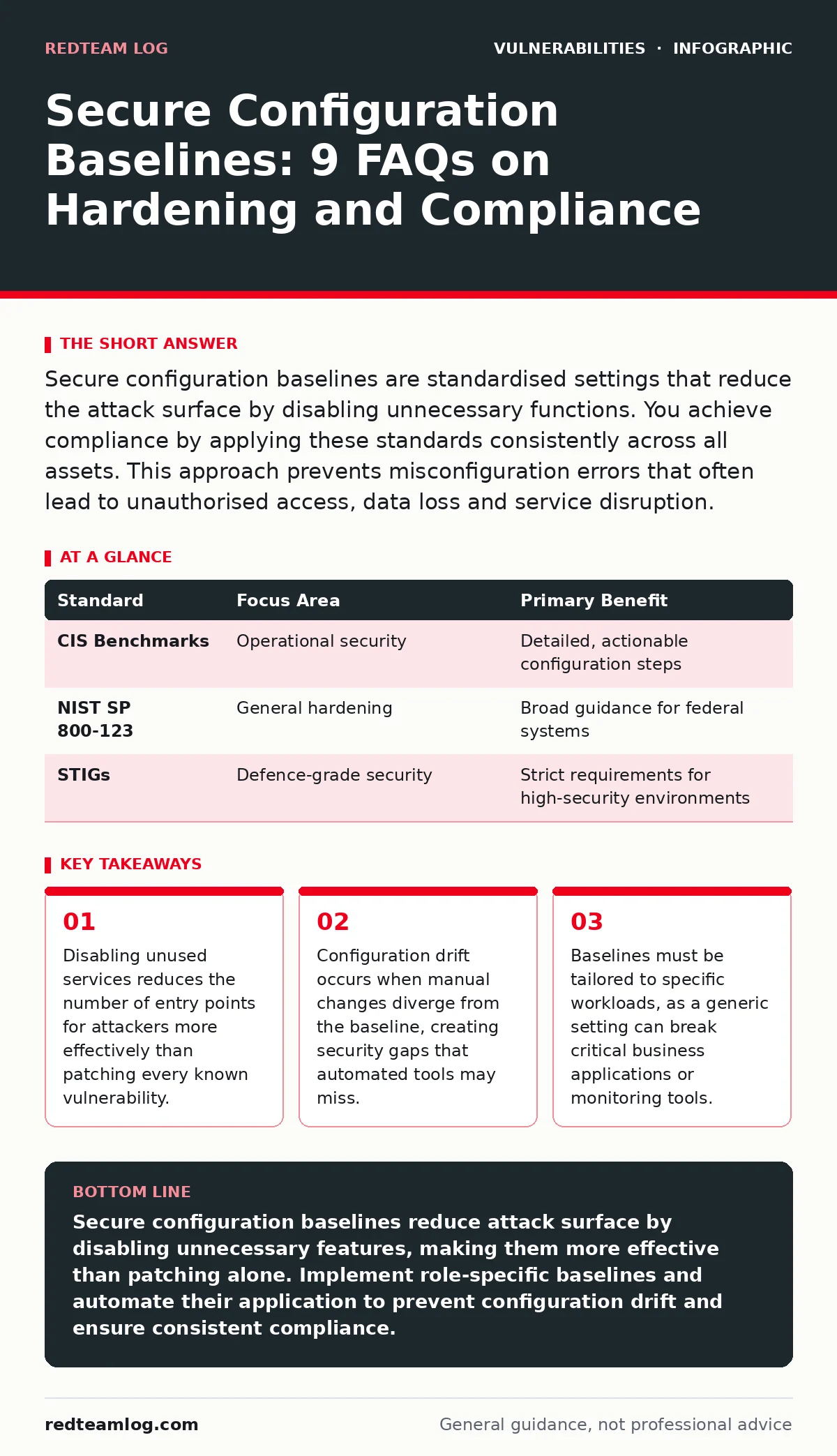
Secure configuration baselines are standardised settings that reduce the attack surface by disabling unnecessary functions. You achieve compliance by applying these standards consistently across all assets. This approach prevents misconfiguration errors that often lead to unauthorised access, data loss and service disruption.
What is a secure configuration baseline?
A secure configuration baseline is a documented set of security settings applied to an asset to ensure it operates in the most secure state possible. These standards define which services remain active, which ports are open and how authentication mechanisms behave. You use them to eliminate default weaknesses that manufacturers leave in place for ease of use.
Why are baselines more effective than patching alone?
Patching fixes known bugs in existing code, but it does not remove unnecessary features that could be abused. A server with 20 open services presents 20 potential entry points, even if every service is fully patched. By disabling 15 of those services, you reduce the attack surface by 75 per cent. This reduction limits the opportunities for an attacker to find a weakness, regardless of whether new vulnerabilities emerge.
How do you handle configuration drift over time?
Configuration drift happens when manual adjustments or software updates change settings away from the original baseline. You detect this by comparing the current state of each asset against the stored baseline using automated compliance tools. Regular scanning identifies deviations before they become exploitable. Without continuous monitoring, a single administrative change can re-open a previously closed port or weaken a password policy.
Do baselines need to differ for cloud environments?
Cloud environments require distinct baselines because the shared responsibility model shifts security duties between the provider and the customer. The provider secures the underlying infrastructure, while you secure the operating system, applications and data access controls. A baseline for a virtual machine must address identity and access management, network security groups and storage encryption. Ignoring these cloud-specific controls leaves gaps that traditional server hardening does not cover.
What is the cost of applying strict baselines?
Strict baselines can break legacy applications that rely on outdated protocols or weak encryption standards. You must test every baseline change in a staging environment before deploying it to production. The hidden cost is the time spent resolving compatibility issues, not the tools used to apply the settings. Failure to test leads to service outages, which damage trust more than a minor security misconfiguration.
How do you validate a baseline against industry standards?
You validate baselines by mapping them to recognised frameworks such as the Center for Internet Security benchmarks or the National Institute of Standards and Security guidelines. These frameworks provide detailed, version-specific recommendations for every major operating system and application. Mapping ensures your internal rules align with broader security expectations. It also simplifies audits by providing a clear trail of compliance evidence.
| Standard | Focus Area | Primary Benefit |
|---|---|---|
| CIS Benchmarks | Operational security | Detailed, actionable configuration steps |
| NIST SP 800-123 | General hardening | Broad guidance for federal systems |
| STIGs | Defence-grade security | Strict requirements for high-security environments |
Can a single baseline work for all servers?
No, a single baseline fails because different workloads have different functional requirements. A database server needs different network rules than a web server hosting customer content. You create role-specific baselines that disable only the services irrelevant to that specific function. This approach maintains security without breaking the core purpose of the machine. Applying a web server baseline to a database server will likely block legitimate client connections.
How do baselines relate to vulnerability remediation?
Baselines reduce the number of vulnerabilities you need to manage by eliminating unnecessary components. When a new vulnerability is announced, you only need to patch the services that are actually running. This focused approach speeds up remediation efforts. It also reduces the risk of missing a critical patch because the asset list is smaller and more predictable.
What happens when a baseline conflicts with application needs?
When a baseline conflicts with an application, you must document the exception and justify the risk. You cannot simply ignore the standard, as this creates an audit failure. Instead, you implement compensating controls, such as network segmentation or additional monitoring, to mitigate the risk. This process ensures that security requirements do not hinder business operations while maintaining accountability for any deviations.
How do you maintain baselines across multiple vendors?
You maintain baselines by integrating them into your procurement and deployment processes. Every new vendor solution must be assessed against your security standards before installation. You request configuration files that align with your baseline requirements. This proactive approach prevents the introduction of non-compliant assets. It also ensures that third-party tools do not weaken your overall security posture.
Are baselines static or dynamic documents?
Baselines are dynamic documents that evolve with new threats and technology changes. You review and update them regularly to incorporate lessons learned from incidents and changes in the operating environment. Static baselines become outdated quickly, leaving assets vulnerable to new techniques. Regular reviews ensure that your security posture remains effective against current tactics.
What is the first step in implementing a baseline?
The first step is inventorying all assets and their current configurations. You cannot secure what you do not know exists. Use automated discovery tools to build a complete list of servers, devices and applications. This inventory provides the foundation for applying consistent standards. Without it, you risk missing critical assets that remain exposed to attack.
How do baselines support incident response?
Baselines provide a known good state that simplifies incident investigation. When an attack occurs, you compare the compromised asset’s configuration against the baseline to identify changes. This comparison reveals whether the attacker modified settings to maintain access. It also helps determine the scope of the incident by identifying other assets that may have similar deviations.
Key takeaways
- Disabling unused services reduces the number of entry points for attackers more effectively than patching every known vulnerability.
- Configuration drift occurs when manual changes diverge from the baseline, creating security gaps that automated tools may miss.
- Baselines must be tailored to specific workloads, as a generic setting can break critical business applications or monitoring tools.
Secure configuration baselines reduce attack surface by disabling unnecessary features, making them more effective than patching alone. Implement role-specific baselines and automate their application to prevent configuration drift and ensure consistent compliance.
Frequently asked questions
How often should I review my configuration baselines?
Review baselines at least annually or whenever major software updates occur. More frequent reviews are necessary for high-risk environments or after significant security incidents.
Can I use open-source tools for baseline management?
Yes, many open-source tools support configuration compliance checking. Ensure they are maintained actively and capable of integrating with your existing infrastructure.
What if an application requires a non-secure setting?
Document the exception, implement compensating controls and limit the exposure of that asset. Regularly reassess whether the non-secure setting is still necessary.
How do baselines help with regulatory compliance?
Baselines map directly to many regulatory requirements, providing evidence of secure configuration. This simplifies audits and demonstrates a proactive approach to security management.
How this guide was produced: written by the RedTeam Log editorial team with AI assistance, checked against the public references listed below, and reviewed when the facts change. See our editorial policy or report an error.